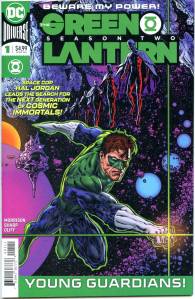
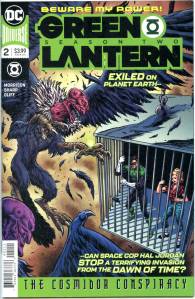
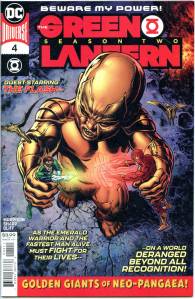
Green Lantern would know a number of revivals and cancellations. Its title would change to Green Lantern Corps at one point as the popularity rose and waned. During a time there were two regular titles, each with a Green Lantern, and a third member in the Justice League.
Doctor Stephen Strange was the world’s greatest neurosurgeon and the Earth’s Sorcerer Supreme, defending the world against invasions from other dimensions and supernatural threats. He has lost and regained the role several times and journeyed to the strangest of places, even met Eternity itself, but he has always been there to defend this dimension against threats of every size and shape imaginable.
And now he’s dead.
Who will protect the Earth? Who will keep the supernatural evils at bay?
And who killed Doctor Strange?
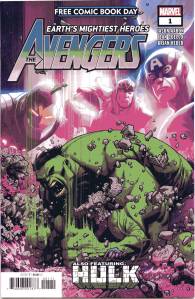
Death of Doctor Strange Bloodstone #1 NM $6Death of Doctor Strange – Avengers #1 Variant NM $5Death of Doctor Strange – Avengers #1 NM $5The Death of Doctor Strange – X-Men Black Knight #1 NM $5Death of Doctor Strange – Blade #1 NM $5
In June 2002, a new Micronauts series by Image Comics was published for eleven issues before its cancellation in September 2003. The same year saw a four-issue limited series featuring Baron Karza’s origin and his relationship with the Time Traveler entity.
In 1956, DC Comics successfully revived superheroes, ushering in what became known as the Silver Age of comic books. Rather than bringing back the same Golden Age heroes, DC rethought them as new characters for the modern age. The Flash was the first revival, in the aptly named tryout comic book Showcase #4 (Oct. 1956).
This new Flash was Barry Allen, a police scientist who gained super-speed when bathed by chemicals after a shelf of them was struck by lightning. He adopted the name The Flash after reading a comic book featuring the Golden Age Flash.After several more appearances in Showcase, Allen’s character was given his own title, The Flash, the first issue of which was #105 (resuming where Flash Comics had left off).
Published by Dark Horse Comics, the first issue was released in September 2002. It ran for 40 issues, and was continued in the Star Wars: Rebellion series.
In the weeks before the events in Star Wars: A New Hope, as the Death Star is readied for its fateful first mission, a power-hungry cabal of Grand Mofs and Imperial Officers embark on a dangerous plan to kill Emperor Palpatine and Darth Vader and seize control of the Empire!
The Atom introduced in Showcase #34 (1961) is physicist and university professor Dr. Raymond Palmer, Ph.D. (He was named for real-life science fiction writer Raymond A. Palmer, who was himself quite short.) After stumbling onto a mass of white dwarf star matter that had fallen to Earth, he fashioned a lens which allowed him to shrink down to subatomic size. Originally, his size and molecular density abilities derived from the white dwarf star material of his costume, controlled by mechanisms in his belt, and later by controls in the palms of his gloves. Much later, he gained the innate equivalent powers within his own body. After the events of Identity Crisis, Ray shrank himself to microscopic size and disappeared. Finding him became a major theme of the Countdown year long series and crossover event.
Atom #27 F+ $30The Atom #28 VG $10The Atom #33 VF $39Atom #34 VF- $35Atom and Hawkman #45 VG $10
Due to strong sales on the character’s first appearance in Amazing Fantasy #15, Spider-Man was given his own ongoing series in March 1963. The initial years of the series, under Lee and Ditko, chronicled Spider-Man’s nascent career with his civilian life as hard-luck yet perpetually good-humored teenager Peter Parker. Peter balanced his career as Spider-Man with his job as a freelance photographer for The Daily Bugle under the bombastic editor-publisher J. Jonah Jameson to support himself and his frail Aunt May. At the same time, Peter dealt with public hostility towards Spider-Man and the antagonism of his classmates Flash Thompson and Liz Allan at Midtown High School, while embarking on a tentative, ill-fated romance with Jameson’s secretary, Betty Brant.
By focusing on Parker’s everyday problems, Lee and Ditko created a groundbreakingly flawed, self-doubting superhero, and the first major teenaged superhero to be a protagonist and not a sidekick. Ditko’s quirky art provided a stark contrast to the more cleanly dynamic stylings of Marvel’s most prominent artist, Jack Kirby, and combined with the humor and pathos of Lee’s writing to lay the foundation for what became an enduring mythos.
Amazing Spider-Man #17 FN+ $525Amazing Spider-Man #23 VF- $379Amazing Spider-Man 30 CGC 7.5 Off-White to White Pages $295Amazing Spider-Man #54 CGC 9.0 White Pages $339
Moore created a new, teenaged Youngblood group that was financed independently by millionaire Waxey Doyle, formerly the WWII superhero Waxman. The team was led by Shaft and was augmented by new members Big Brother, Doc Rocket, Twilight, Suprema, and Johnny Panic. Moore said he wanted Youngblood to be a “less sprawling, more dynamic team” and that “if you have more characters than [six], the action gets cluttered and it becomes increasingly difficult to establish each character as a real and solid person in their own right”. All of the new team members and most of the villains featured in this series, including Jack-A-Dandy, were Moore’s creations.
Everyone who was invited to the house knows Walter—well, they know him a little, anyway. Some met him in childhood; some met him months ago. And Walter’s always been a little…off. But after the hardest year of their lives, nobody was going to turn down Walter’s invitation to an astonishingly beautiful house in the woods, overlooking an enormous sylvan lake. It’s beautiful, it’s opulent, it’s private—so a week of putting up with Walter’s weird little schemes and nicknames in exchange for the vacation of a lifetime? Why not? All of them were at that moment in their lives when they could feel themselves pulling away from their other friends; wouldn’t a chance to reconnect be…nice?
The Nice House on the Lake #1 NM $9The Nice House on the Lake #1 2nd print NM $4The Nice House on the Lake #1 3rd Print NM $4The Nice House on the Lake #2 2nd print NM- $3The Nice House on the Lake #4 NM- $3The Nice House on the Lake #5 NM- $3The Nice House on the Lake #6 NM- $3The Nice House on the Lake #7 NM- $3The Nice House on the Lake #8 NM- $3The Nice House on the Lake #9 NM $4The Nice House on the Lake #12 NM $4
In 1989, a third Moon Knight volume, titled Marc Spector: Moon Knight was published. It was the longest-running series, lasting sixty issues. This volume introduces Moon Knight’s teenage sidekick Jeff Wilde, also known as “Midnight,” the son of Midnight Man, a villain from the first volume of the series. At this time, Moon Knight first encounters the Black Cat. Turned into a cyborg by the Secret Empire, Midnight is seemingly killed in the “Round Robin” story arc of Amazing Spider-Man, spanning issues #353-#358.
The series was canceled with issue #60 (March 1994), with four of the last six issues drawn by Stephen Platt, who was hired by Image Comics based on the strength of his work on the series.