The Walking Dead (2003)

The Walking Dead is an ongoing black-and-white comic book series created by writer Robert Kirkman and artist Tony MooreIt focuses on Rick Grimes, a deputy who is shot in the line of duty and awakens from a coma in the zombie apocalypse that placed Georgia under quarantine. He finds his wife and son, and meets other survivors, gradually taking on the role of leader among a group and later a community as Rick and his group try to survive the zombie apocalypse.

Curse of the Spawn (1996)

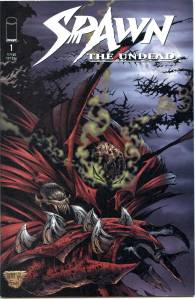
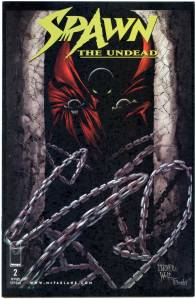
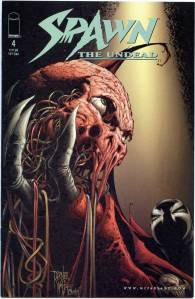
The first four issues of the series focuses on Daniel Llanso. His story is set some 400 years in the future in an apocalyptic world some time after Armageddon where the Devil Phlegethonyarre has his servant, Abaddon the Angel of the Bottomless Pit and their Undead Army of Nightmares (Necro-Soldiers, Zombies powered by Hell’s Darklight) dominate and hunt all humans.

The rest of the Curse of the Spawn issues focuses around related characters from the main Spawn series, like Jessica PriestSam and TwitchThe Angel Abdiel and Angela, Hatchet a Zombie Spawn, and other tales of other hell throughout the comics timelines.

Some of these stories include; An angel named Abdiel sent to spy on Malebolgia is tricked and banished from heaven, A Greek boy named Raenius, who was killed by Zeus (the god) and resurrected as a Hellspawn, who kills Zeus with the gorgon Medusa by his side.

Masters of the Universe (2002)

From 2002 to 2005 Image Comics and MVCreations published several series of comics and one-shots that mirrored tales of the 2002 Mike Young Productions show; the comic series elaborated and added to the mythos by introducing characters that never made it in after the 39 episodes of the television series. The first issues were seen in the summer of 2002 in the form of special promotional/preview issues, with three mini-series continuing on after; ‘The Shards of Darkness’ in fall 2002, followed by ‘Dark Reflections’ and ‘Rise of the Snake Men’ in 2003. After delving into the back-stories of Skeletor’s henchmen Beast-Man, Mer-Man, Trap-Jaw and Tri-Klops in a four issue ‘Icons of Evil’ series, a short-lived ongoing series, solely produced by MVC, continued on for eight issues in 2004. Along with these, a handful of special or ‘pack-in’ one-shots and trade paperback collected volumes were also produced.

Nailbiter (2014)

The series centers around the fictional town of Buckaroo, Oregon, which has produced sixteen of the United States’ worst serial killers. Its most recent creation is Edward Charles Warren, otherwise known as “Nailbiter” due to his predilection for chewing off his victim’s nails and part of their flesh. By the series’s start Warren has been caught by FBI agent Charles Carroll, however Carroll has since gone missing, leaving it up to his friend and NSA agent Nicholas Finch to search for him. Nicholas decides to start his search in Buckaroo, where he begins to question why the small town has produced so many murderers.

King Spawn (2022)

King Spawn further expands the Spawn Universe with a growing presence of Hell, Heaven, and Heroes here on Earth.

A classic villain from Spawn’s past has begun asserting his powers on Earth by corrupting as many souls as possible. And only Spawn knows that he even exists. Continuing the dramatic battles from Spawn’s Universe #1.

Youngblood V1 (1992)

Youngblood is a superhero team that starred in their self-titled comic book, created by writer/artist Rob Liefeld. The team made its debut as a backup feature in the 1987 one-shot Megaton Explosion #1 before later appearing in 1992 in its own ongoing series as the flagship publication for Image Comics. Youngblood was originally published by Image Comics, and later by Awesome Entertainment. Upon Rob Liefeld’s return to Image Comics, it was revived in 2008 and again in 2012.

Youngblood was a high-profile superteam sanctioned and overseen by the United States government. Youngblood’s members include Shaft, a former FBI agent who uses a high-tech bow; Badrock, a teenager transformed into a living block of stone; Vogue, a Russian fashion model with purple-and-chalk-white skin; and Chapel, a government assassin.

Saga (2012)

Writer Brian K. Vaughan conceived Saga in his childhood, calling it “a fictional universe that I created when I was bored in math class. I just kept building it.” He was inspired by such influences as Star Wars,Flash Gordon and children’s books, and has also invoked the awe and wonder of first seeing the Silver Surfer, which seemed an “incredible and different” concept to him. It was not until his wife became pregnant with his second daughter, however, that he conceived of the protagonists, the winged Alana and the horned Marko, two lovers from warring extraterrestrial races who struggle to survive with their newborn daughter, Hazel, who occasionally narrates the series. It was also at this point that the central theme that Vaughan wanted for the book emerged. Vaughan explains, “I wanted to write about parenthood, but I wanted to Trojan-horse it inside some sort of interesting genre story, to explore the overlap between artistic creation and the creation of a child.”] Vaughan, who intended to return to writing a comics series following the 2010 conclusion of his previous series, Ex Machina, and who notes that the publication of Saga #1 coincided with the birth of his daughter, saw parallels between the caution advised by colleagues against launching a new book in the poor economy and those who cautioned against bringing a new child into the world.

Seven to Eternity (2016)

The God of Whispers has spread an omnipresent paranoia to every corner of the kingdom of Zhal; his spies hide in every hall spreading mistrust and fear. Adam Osidis, a dying knight from a disgraced house, must choose between joining a hopeless band of magic users in their desperat e bid to free their world of the evil God, or accepting his promise to give Adam everything his heart desires. Writer RICK REMENDER reteams with collaborators JEROME OPEÑA (Uncanny X-Force, Fear Agent) and MATT HOLLINGSWORTH (TOKYO GHOST, WYTCHES) to take you on a hard road through the strange fantasy world of Zhal. All men have surrendered their freedom for fear. Now, one last free man must choose.

Gen 13 V2 (1995)

Gen 13 (Volume 2) was an ongoing series, published by WildStorm Productions. It ran from 1995 until 2002. Despite outrageous story arcs and many artist collaborations, the popularity of the book dwindled to the point where Wildstorm decided to blow up the entire team with a 6-megaton bomb (Gen¹³ vol. 2, #76, June 2002). This served as the catalyst to revamp the series with a new first issue written by Chris Claremont with pencils by Ale Garza.

Spawn (1992)

Spawn enjoyed considerable popularity upon its initial release in the 1990s. Comic book collecting was enjoying a marked upswing at the time, fueled by the speculator boom looking for the next hot book that would jump in value after its release. McFarlane had enjoyed superstar status among comic fans with his work on Spider-Man, which had featured McFarlane’s name prominently as both writer and artist. McFarlane’s subsequent break with Marvel and the formation of Image Comics was seen by many as a sea-change event, changing the very way in which comics were produced. Wizard, on May 2008, rated “The Launch of Image Comics” as No.1 in the list of events that rocked the Comic Industry from 1991 to 2008.

The first issue of Spawn was very popular with sales of 1.7 million copies. During Spawn’s second year of publication, Wizard noted that “The top dog at Image is undoubtedly Todd McFarlane’s Spawn, which, without the added marketing push of fancy covers, polybagged issues, or card inserts has become the best-selling comic on a consistent basis that is currently being published. Sales slumped around the time of Spawn #25, but by Spawn #45 it was again a consistently strong seller.