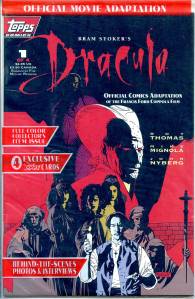
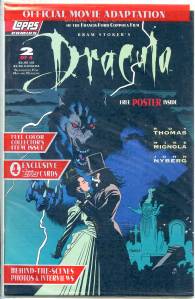
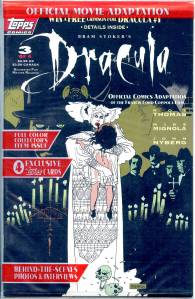
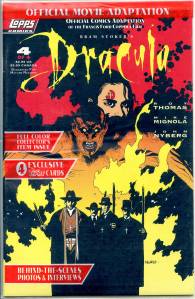
Bram Stoker’s Dracula, a four-issue Topps comic book adaptation of Columbia Pictures’ (Sony Pictures Entertainment) 1992 film directed by Francis Ford Coppola which starred a young Keanu Reeves as Jonathan Harker, Winona Ryder as Mina Murray, Anthony Hopkins as Professor Abraham Van Helsing and Gary Oldman as Dracula. Topps Comics released a 120-page adaptation in 1993, written by Roy Thomas and drawn by Mike Mignola, one of the last projects before launching Hellboy.
This film adaptation includes one possible explanation of the title’s significance in story context: the narrative line, “Blade runner. You’re always movin’ on the edge.”
This was a reprint of issue 22 of the Marvel Comics Super Special series of titles, which by this time only printed Marvel’s movie adaptations, but without the feature content contained in the special.
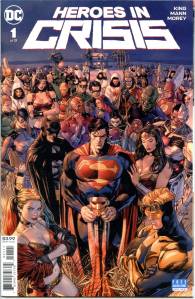
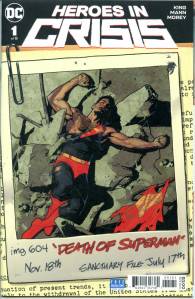
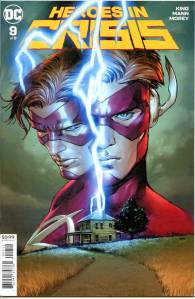
Heroes in Crisis primarily deals with the emotional cost of being a superhero and explores “what violence does to a society”, a common theme in King’s work. King, a former CIA counterterrorism officer, believed this was an important subject that needed to be discussed. King described this creative decision: “Comic books, throughout the whole history of the medium, have been reflective of history. In World War II, there were comics about fighting in World War II. In the seventies, the comics were about psychedelic escape. Today, our moment right now is a moment of violence and living with violence and our comics have to address that”.
Victor Von Doom – scientist, sorcerer, disfigured face, twisted soul – has been spending much of his time warning against a trillion-dollar global effort to create the first “artificial” black hole. Wrestling with visions of an entirely different life…a better future…DOCTOR DOOM finds himself at a crossroads. (what is he questioning?) A catastrophic act of terrorism kills thousands, and the prime suspect is… DOOM? Victor will have to push his unexplained thoughts aside and focus on remaining alive as the title of “Most Wanted Man” is thrust upon him….
Left with no homeland, no armies, no allies, indeed, nothing at all, will the reign of Doctor Doom come to an abrupt halt?
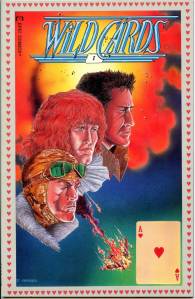
Wild Cards is a four-part comic book series covering events in the Wild Cards anthology. It recounts events previously published in print in novel format, and ties them all together in a story pitting Jay Ackroyd against the machinations of a mystery bomber.
First published in 1990 by Marvel Comics under the Epic Comics imprint Wild Cards ran from September to December of 1990.
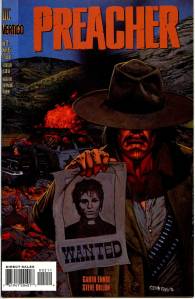
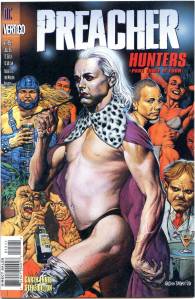
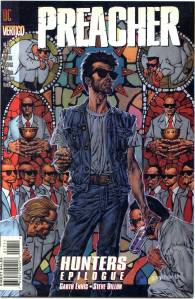
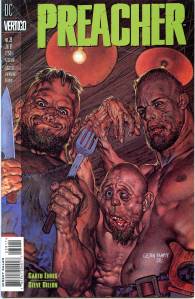
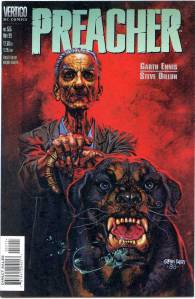
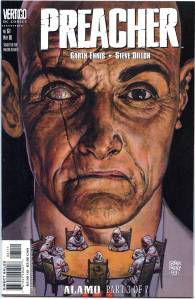
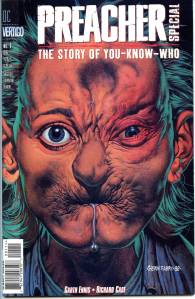
Preacher tells the story of Jesse Custer, a preacher in the small Texas town of Annville. Custer was accidentally possessed by the supernatural creature named Genesis in an incident which killed his entire congregation and flattened his church.
Custer, driven by a strong sense of right and wrong, goes on a journey across the United States attempting to (literally) find God, who abandoned Heaven the moment Genesis was born. He also begins to discover the truth about his new powers. They allow him, when he wills it, to command the obedience of those who hear and comprehend his words. He is joined by his old girlfriend Tulip O’Hare, as well as a hard-drinking Irish vampire named Cassidy.
The world of Batman: White Knight expands with this standalone tale! On the night of Bruce Wayne’s traumatic birth, Victor Fries must intervene to save the lives of Martha Wayne and the future Batman. As the evening unfolds, Victor distracts Thomas with the incredible tale of his own father figures-one a Nazi, the other a Jew-and their complex connection to Wayne Laboratories. As the Third Reich roars into power, the deep friendship and working relationship between the Baron von Fries and his research partner, Jacob Smithstein, is in crisis. Ordered by Himmler to speed development of their cryotechnology in service of world domination, Smithstein is forced to go into hiding and compromise his moral code in order to save his wife and infant daughter, Nora, from persecution and certain death. When the S.S. ramps up surveillance over the project, young Victor begins to question his father’s true allegiance. Both families are driven toward an impossible choice and a sinister standoff, and Victor makes a pact with Smithstein that will ripple through generations.
When an escaped convict commits murder and finds his way to a decaying movie palace, he cannot know that his own life is about to end, while the dreams of a half decade’s moviegoers are just beginning. for this convict’s cancerous tumor refuses to die, and the angels of the cinema can greant mirages–and nightmares–of their own.
In a world that has given up God for Garbo, life may be nothing more than an endless series of flickering images–and death the only refuge from the…Son of Celluloid.
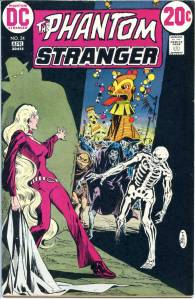
After an appearance in Showcase #80 (February 1969), he received another series beginning May–June 1969 that lasted until February–March 1976. The Showcase appearance and the first three issues of Phantom Stranger consisted of reprints from both the 1950s title and the “Dr. 13: Ghost-Breaker” feature from the last nine issues of Star Spangled Comics at the same time, with new, brief framing sequences. These had Dr. Thirteen, certain that the Phantom Stranger was an impostor, determined to expose him.
Beginning with issue #4 (November-December 1969), the series began featuring all-new material, with stories produced by Robert Kanigher, Len Wein, Jim Aparo, Neal Adams, Tony DeZuniga and others. In these stories, while the Stranger’s past remained a mystery, the writers added a semi-regular cast of characters for him. A demonic sorceress named Tala would become his archenemy; an alchemist/sorcerer named Tannarak was first an enemy and would later assist him against the Dark Circle; and a blind psychic named Cassandra Craft would assist him. Doctor Thirteen, dropped along with the reprints, was given a back-up series here as of #12 (March-April 1971) which morphed into “The Spawn of Frankenstein” in #23 (January-February 1973).
The second volume originally ended with the forty-first issue in November 1975, cover dated March 1976. In January 2010, a forty-second issue was added to the second series during the Blackest Night event, effectively a one-shot.
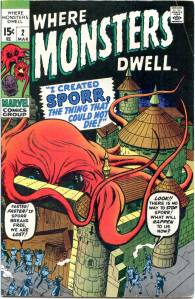
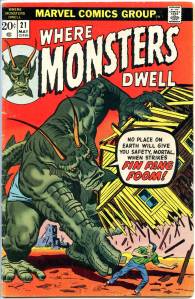
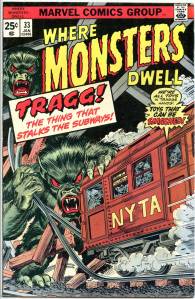
One of Marvel’s revival Horror and Monster comics. It lasted for 38 issues, making it one of the longest running Monster Mags from Marvel in the 1970’s. The series contains stories from many comic legends including Jack Kirby, Steve Ditko, Gil Kane and Bernie Wrightson. Issues #6 contains a reprint of Tales to Astonish #13, which is the 1st appearance of Groot from Guardians of the Galaxy.