Predator vs Judge Dredd vs Aliens was a co-publication with IDW and 2000 AD. The ultimate science-fiction crossover pits the legendary lawman Judge Dredd against the universe’s supreme hunters, the Predators, as they both try to survive an onslaught by the galaxy’s ultimate killing machines, the Aliens! Written by Eisner Award–winning, NYT best-selling Chew creator John Layman! Covers by Eisner Award winner Glenn Fabry!
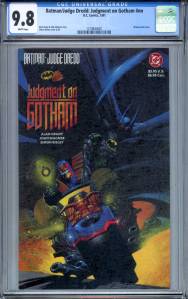
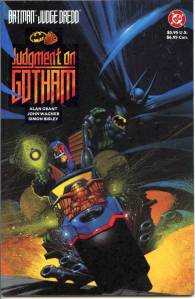
Judge Death makes a dimensional jump to Gotham City, murdering two lovers and a police officer. Batman defeats Death, who flees in spirit form. Among the remains of his host body, Batman finds a dimensional jump belt that he accidentally activates, transporting him to Mega-City One, where is confronted by Mean Machine Angel. As Mean Machine attacks Batman, they are both confronted by Judge Dredd. Mean Machine flees to Gotham using the belt, then wanders into the city looking for Judge Death.
Batman – Judgment on Gotham CGC SS 9.8 Signed by Simon Bisley $229
Batman – Judge Dredd – Judgement on Gotham CGC 9.8 White Pages $79
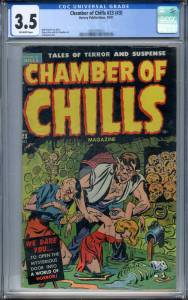
The first Chamber of Chills was a 10-cent horror anthology published bimonthly by Harvey Publications that ran 26 issues (cover-dated June 1951 – Dec. 1954).
Chamber of Chills was formerly Blondie Comics, taking over that comic’s numbering with issue #21. After issue #24 (Dec. 1951), the numbering was reset to #1. Chamber of Chills became Chamber of Clues with the February 1955 issue, and ceased publication two issues later, the last cover-dated April 1955.
Chamber of Chills #23 CGC 3.5 Off-White Pages $349
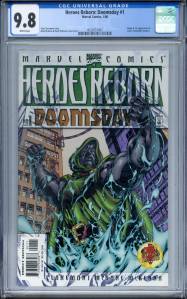
In the years after the Heroes Reborn event, Marvel published a series of one-shots that revisit the pocket universe created by Franklin Richards. These can be read in any order and even touch on some characters who were not featured in the original storyline.
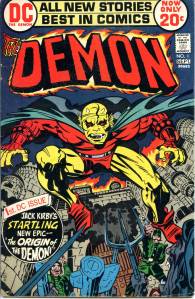
The Demon was created by Jack Kirby. The titular character, named Etrigan, is a demon from Hell who, despite his violent tendencies, usually finds himself allied to the forces of good, mainly because of the alliance between the heroic characters of the DC Universe and Jason Blood, a human to whom Etrigan is bound.
Jack Kirby created the Demon in 1972 when his Fourth World titles were cancelled.According to Mark Evanier, Kirby had no interest in horror comics, but created Etrigan in response to a demand from DC for a horror character. Kirby was annoyed that the first issue sold so well that DC required him to remain on it and abandon the Fourth World titles before he was done with them. Etrigan was inspired by a comic strip of Prince Valiant in which the titular character dressed as a demon. Kirby gave his creation the same appearance as Valiant’s mask.
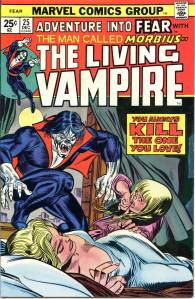
Morbius, the Living Vampire, introduced in The Amazing Spider-Man #101 (Oct. 1971), became the starring feature with Adventure into Fear #20 (Feb. 1974), and continued through the rest of the run. After a single issue by writer Mike Friedrich and penciler Paul Gulacy, Steve Gerber wrote several issues in which Morbius went on a picaresque interdimensional journey and fought the Caretakers of Arcturus and was advised by the eyeball-headed character I. Doug Moench and Bill Mantlo followed, successively, as the feature’s writers. Its round-robin of artists included Gil Kane, P. Craig Russell, Frank Robbins, George Evans, and Don Heck. Back up reprints shortly resumed in issue #20. Morbius would receive his own short-lived comic-book series in the 1990s.
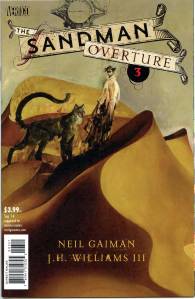
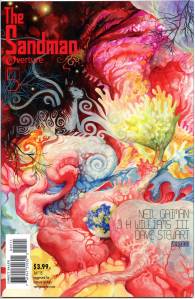
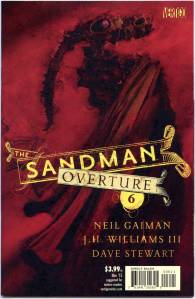
To commemorate the twenty-fifth anniversary of The Sandman, Gaiman wrote a new tale involving the battle that had exhausted Morpheus prior to the beginning of the original story. Written by Gaiman and with art by J. H. Williams III, Overture tells the previously hinted story of Dream’s adventure prior to Preludes and Nocturnes, which had exhausted him so much that it made Burgess’ actions capable of capturing him. The limited series had six issues. Issue #1 was released on October 30, 2013, and although it was planned to have a bi-monthly release schedule, issue 2 was delayed until March 2014, which Gaiman explained was “mostly due to the giant signing tour I was on from June, and me not getting script written on the tour, with knock-on effects”. Special editions were released approximately a month after the original editions, which contain interviews with the creative team, alongside rare artwork.
Avengers A.I. was an ongoingcomic book series published by Marvel Comics that was released in July 2013, as part of the company’s Marvel NOW! initiative. The series takes place after the events of Age of Ultron, where the world has been colonized by A.I.s “who may or may not have positive feelings about the way humanity has been treating them for the past 100 years.” The series ended in April 2014.
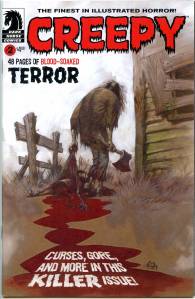
In July 2009, Dark Horse Comics and New Comic Company LLC released the new Creepy magazine. Edited by Shawna Gore and Dan Braun with Craig Haffner, it displayed the work of artists Bernie Wrightson, Angelo Torres, Saskia Gutekunst and Jason Shawn Alexander illustrating scripts by Michael Woods, Dan Braun, Joe Harris and Bill Dubay.
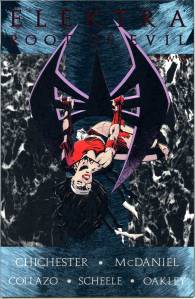
Created by Frank Miller, Elektra first appeared in Daredevil #168 (January 1981). Miller originally intended this issue, which was essentially a filler story, to be Elektra’s only appearance, but she instead became a frequently appearing villain in Daredevil until her death in issue #181 (April 1982). She was resurrected shortly after, but the story contained a narrative note which indicated that Daredevil would never encounter her again.
After over a decade’s absence, she reappeared in Daredevil #324-327 (January–April 1994), and went on to a brief stint as a supporting character in Wolverine (in #100-106). Daredevil writer D. G. Chichester recounted that he and editor Ralph Macchio had
bandied about the idea [of bringing back Elektra] in a casual fashion now and again, but neither of us wanted to do it as a gimmick. On the rare occasion I thought I had a legitimate angle to use her, Ralph was cool to the idea. But as we geared up for what would become Fall From Grace, Ralph out of the blue said, “What about bringing back Elektra?” — and it was really the missing piece that clicked together all the loose pieces of the story in my head, and became the nexus for everything tying together as well as it did. In my mind, it’s always been her to whom the title refers.
This upset Frank Miller, who claimed that Marvel had previously promised him that the character would not be used in any publication.She has since appeared in two eponymous ongoing series and several mini-series.