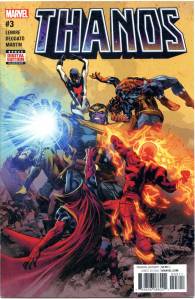
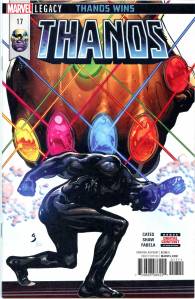
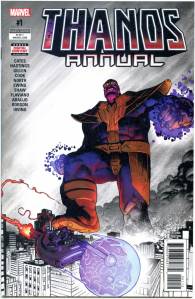
EVIL HAS BEEN UNLEASHED ON THE UNIVERSE. Thanos, possibly the most evil individual in the Marvel Universe, is back…and he’s out for vengeance on all who would oppose him. Unfortunately for the Mad Titan, he’s also heading for an unexpected reckoning…with his family. Take an ongoing walk on the dark side of the galaxy, following the deadly trail of destruction left in the wake of…THANOS!
Whiz Comics #2 (cover-dated Feb. 1940) was published in late 1939. The comic’s lead feature introduced audiences to Billy Batson, an orphaned boy who, by speaking the name of the ancient wizard Shazam, is struck by a magic lightning bolt and transformed into the adult superhero Captain Marvel. Shazam’s name was an acronym derived from the six immortal elders who grant Captain Marvel his superpowers: Solomon, Hercules, Atlas, Zeus, Achilles and Mercury.
In addition to introducing the main character, his alter ego, and his mentor, Captain Marvel’s first adventure in Whiz Comics #2 also introduced his archenemy, the evil Doctor Sivana, and found Billy Batson talking his way into a job as an on-air radio reporter with station WHIZ. Captain Marvel was an instant success, with Whiz Comics #2 selling over 500,000 copies. By 1941, he had his own solo series, Captain Marvel Adventures, while he continued to appear in Whiz Comics, as well as periodic appearances in other Fawcett books, including Master Comics.
Captain Marvel Adventures #115 CGC 7.5 Off-White to White $495
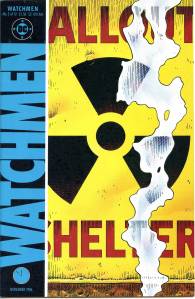
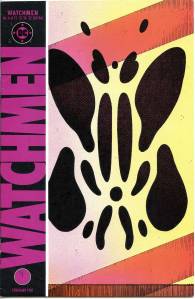
The series was created by a British collaboration consisting of writer Alan Moore, artist Dave Gibbons, and coloristJohn Higgins. Watchmen originated from a story proposal Moore submitted to DC featuring superhero characters that the company had acquired from Charlton Comics. As Moore’s proposed story would have left many of the characters unusable for future stories, managing editor Dick Giordano convinced Moore to create original characters instead.
Moore used the story as a means to reflect contemporary anxieties and to deconstruct and parody the superhero concept. Watchmen depicts an alternate history where superheroes emerged in the 1940s and 1960s and their presence changed history so that the United States won the Vietnam War and the Watergate scandal was never exposed. In 1985, the country is edging toward World War III with the Soviet Union, freelance costumed vigilantes have been outlawed and most former superheroes are in retirement or working for the government. The story focuses on the personal development and moral struggles of the protagonists as an investigation into the murder of a government-sponsored superhero pulls them out of retirement.
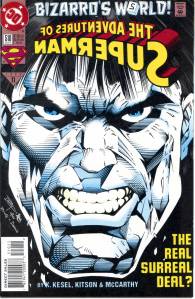
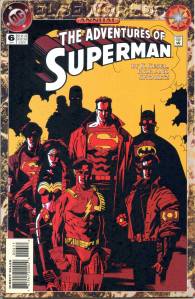
Writer/artist Dan Jurgens worked on the title from 1989–1991. Hank Henshaw, a character who would later become the Cyborg Superman, first appeared in issue #466 (May 1990). By the late 1980s, the plots of the Superman books were often linked. To coordinate the storyline and sequence of event, from January 1991 to January 2002, “triangle numbers” (or “shield numbers”) appeared on the cover of each Superman comic book. During these years, the Superman storylines ran with the story continuing through the titles Superman, Action Comics and later in two further series, Superman: The Man of Steel and Superman: The Man of Tomorrow.
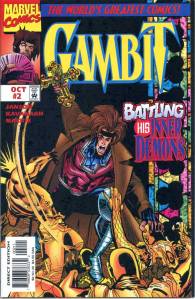
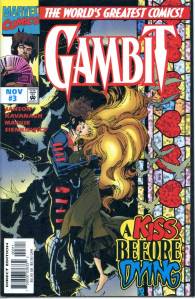
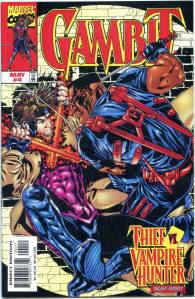
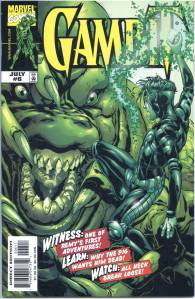
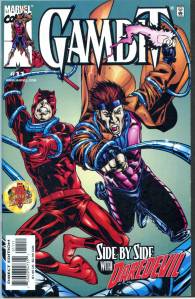
Gambit plays his cards right and vaults into his own kinetically charged solo adventures! He’s a lover and a thief, but what else does ragin’ Cajun Remy LeBeau get up to when he isn’t hangin’ wit’ de X-Men? Would you believe raiding lost temples of Doom? Clashing with the deadly X-Cutioner? Or teaming up with Sabretooth? Still, there’s always time for the ladies- like old friend Storm and his favorite cherie, Rogue. But who is Gambit’s gaseous green guardian?
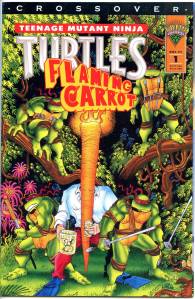
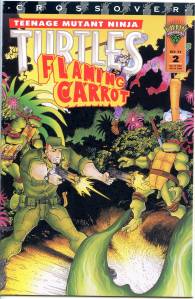
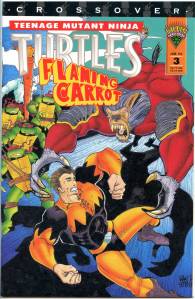
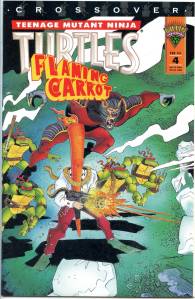
The TMNT are onboard a blimp, traveling to Central America after a devastating storm has crippled much of North and South America. The Turtles are accompanying Colonel Blade, who is using the dirigible to bring relief supplies to those affected by the storm. Upon landing and unloading, Blade receives new instructions from the local ambassador: he’s to travel to the Abecero Penninsula and restore contact with a missing research team. Joining the Colonel and the Turtles on the mission will be archaeologist Professor Daub.
Meanwhile, back in the USA in the secret headquarters of the Mystery Men, the team of unsual heroes (Flamng Carrot, Bondoman, The Shovelor, Mystic Hand, Star Shark, The Zeke’s, the Spleen, Screwball and Mr. Furious) is called into action to find the same research team that the TMNT and Blade are seeking.
Created and designed by Jack Kirby, The New Gods first appeared in February 1971 in New Gods #1.
Kirby’s production assistant of the time, Mark Evanier, remarked that: “Folks forget but the New Gods saga was intended to be a limited series … There was no intention that these characters would go on forever. After Jack’s books started getting good sales figures, DC demanded that we keep them going and use guest stars like Deadman, which we were very much against doing. So Kirby had this novel he was forever stuck in the middle of – he could never get to the last chapter. … You can spot the issues where Jack kind of gave up trying to advance the story of Darkseid and Orion and was marking time. If those books had been intended from the start to run indefinitely, they would have been done very differently.”
New Gods #1 marks the first appearance of Orion, Highfather, and Metron, among others.
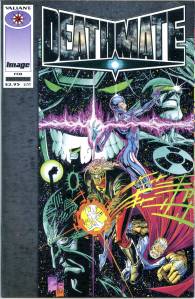
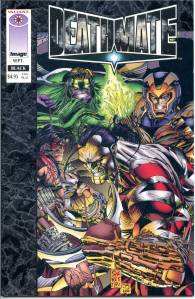
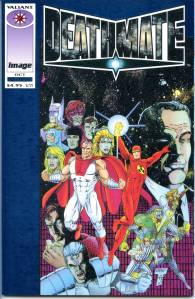
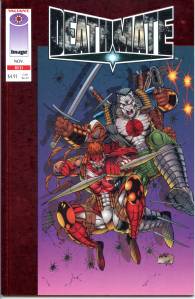
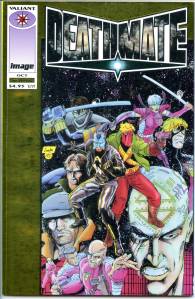
In a world that had been long since become a terrible place, Solar reluctantly granted the wish of his lifelong companion, Gayle Nordheim to dissipate the lifegiving energy that had kept her alive and young for so long. So unable to contain his grief over her death, Solar was literally split in two. The remaining Solar vanished into a life of seclusion while the new persona went off to find other planes of reality to explore.[3]
There, in a dimension between what is real and unreal, he encountered a creature of incredible power, a woman from a distant universe, Void. The two fell in love, a love that wound end all time literally. Upon consummating, their combined energies fused, unwarping the fabric of time, spiraling backwards and eating away at their distinct timelines. In an instant, things were not as they should be: heroes fought alongside those who had been their enemies in a different world; great men who would bring justice to the world died horrible, untimely deaths. Only men with the gift of foresight, Geoff McHenry and Prophet, knew that all was not as it should be. Where they had seen a future so clearly before, there was now nothing.
Geoff and Prophet are resolved to gather the heroes of this amalgamated universe together to fight the battle to save all time.
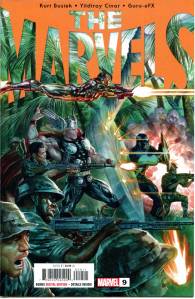
A thriller that will take readers across the Marvel Universe – and beyond! Kurt Busiek (MARVELS) is back, with the biggest, wildest, most sprawling series you’ve ever seen – telling stories that span decades and range from cosmic adventure to intense human drama, from street-level to the far reaches of space, starring literally anyone from Marvel’s first heroes to the superstars of tomorrow! Featuring Captain America, Spider-Man, the Punisher, the Human Torch, Storm, the Black Cat, the Golden Age Vision, Melinda May, Aero, Iron Man, Thor and more – and introducing characters destined to be fan-favorites! Get to know Kevin Schumer – an ordinary guy with some big secrets – and the mysterious Threadneedle! But who (or what) is KSHOOM?