2001: A Space Odyssey (1976)

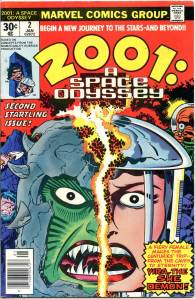
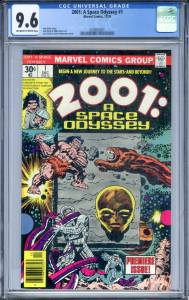
Shortly after the publication of the treasury edition, Kirby continued to explore the concepts of 2001 in a monthly comic book series of the same name, the first issue of which was dated December 1976. In this issue, Kirby followed the pattern established in the film. Once again the reader encounters a prehistoric man (“Beast-Killer”) who gains new insight upon encountering a monolith as did Moon-Watcher in the film. The scene then shifts, where a descendant of Beast-Killer is part of a space mission to explore yet another monolith. When he finds it, this monolith begins to transform the astronaut into a star child, called in the comic a “New Seed”.

Issues #1-6 of the series replay the same idea with different characters in different situations, both prehistoric and futuristic. In #7 (June 1977), the comic opens with the birth of a New Seed who then travels the galaxy witnessing the suffering that men cause each other. While the New Seed is unable or unwilling to prevent this devastation, he takes the essence of two doomed lovers and uses it to seed another planet with the potential for human life.

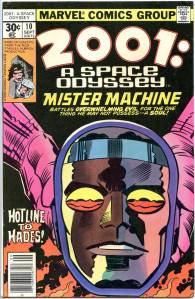
In issue #8 (July 1977), Kirby introduces Mister Machine, who is later renamed Machine Man. Mister Machine is an advanced robot designated X-51. All the other robots in the X series go on a rampage as they achieve sentience and are destroyed. X-51, supported by both the love of his creator Dr. Abel Stack and an encounter with a monolith, transcends the malfunction that destroyed his siblings. After the death of Dr. Stack, X-51 takes the name Aaron Stack and begins to blend into humanity. Issues #9 and 10, the final issues of the series, continue the story of X-51 as he flees destruction at the hands of the Army.
Stranger Things: Tomb of Ybwen (2021)

It’s January 1985 the Hawkins crew survived their battle with the mind flayer, but Will and Joyce are still reeling from the recent death of Bob Newby. Will’s friends have been too busy with their girlfriends to notice how much he is struggling. After he and Mr. Clarke discover a mysterious map Bob left in a box of old nerdy memorabilia, Will rallies the crew to investigate.

World’s Finest (1960’s)

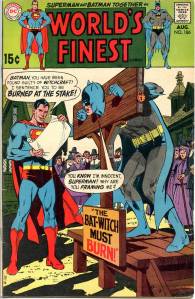
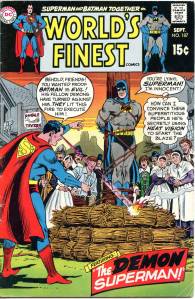
World’s Finest was initially a 96 page quarterly anthology, featuring various DC characters – always including Superman and Batman – in separate stories. Comics historian Les Daniels noted that “Pairing Superman and Batman made sense financially, since the two were DC’s most popular heroes.” When superheroes fell out of vogue in the early 1950s, DC shortened the size of the publication to that of the rest of its output, leaving only enough space for one story; this led to Superman and Batman appearing in the same story together starting with World’s Finest Comics #71 (July 1954). The series continued to feature Superman and Batman team-ups until issue #197. Noted Batman artist Neal Adams first drew the character in an interior story in “The Superman-Batman Revenge Squads” in issue #175 (May 1968).

The Hobbit (1989)

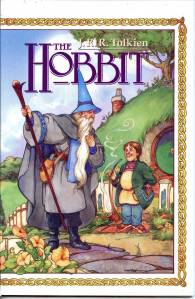
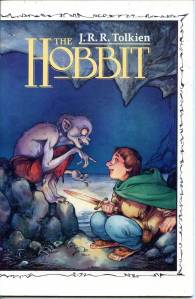
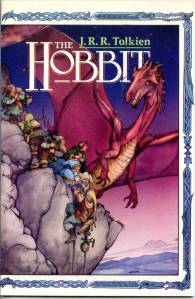
In 1989, Eclipse comics published a three-part comic book adaptation with a script by Chuck Dixon and Sean Deming and illustrations by David Wenzel.

  • Unwin Paperbacks released a one-volume edition in 1990, with cover artwork by the original illustrator David Wenzel.
  • Del Rey Books released a reprint collected in one volume in 2001. Its cover, illustrated by Donato Giancola, was awarded the Association of Science Fiction Artists Award for Best Cover Illustration in 2002.

Before Watchmen: Dr. Manhattan (2012)

The story explores the different universes that Doctor Manhattan alias Jon Osterman simultaneously perceives. It also adds a notable new element to Osterman’s backstory by revealing him to be a half-Jewish German immigrant who escaped with his father from the Third Reich to America; in the original Watchmen series, he was not implied to be anything other than American. It debuted to positive reviews.

Incredible Hulk V3 (2012)

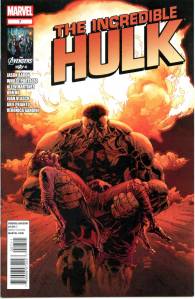
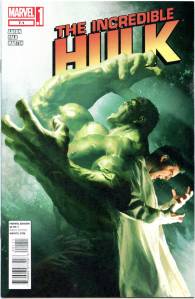
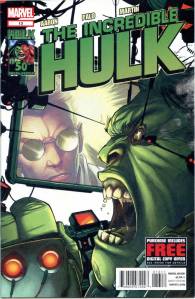
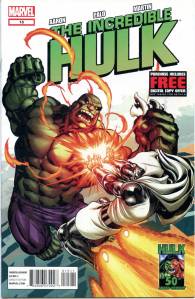
After the events of Fear Itself, the Hulk has gone into hiding, seemingly safe from a world that hates and fears him. But when government agents come knocking at his door, the Hulk has no choice but to return to war against the one man whose existence threatens the safety of every living creature on the Earth. The one man who’s existence could doom the Hulk himself. And that man is Bruce Banner. Now separated into two men, the Hulk and Banner exist worlds apart but one climactic battle will bring them face to face again—and leave the Marvel Universe shaking in its wake.

Tales of the Witchblade (1996)

The Witchblade has a legacy that goes ages into the past and will continue far into the future. Come forth and listen to the distinctions of those who have been bearers of the Witchblade.

The Joker: 80th Anniversary (2020)

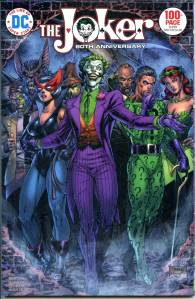
The Clown Prince of Crime celebrates 80 years of chaos! The stories feature a range of terror and anarchy, showing how the Joker has impacted Gotham City from the police to Arkham Asylum, from the local underworld to the Dark Knight and his allies!

Moon Knight V5 (2006)

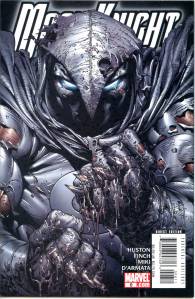
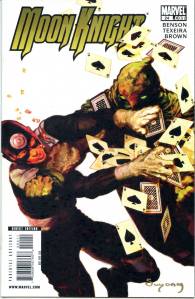
Moon Knight vol. 5, was launched in April 2006, written by Charlie Huston with art by David Finch. The series revises Marc Spector’s history by saying he fought in the Gulf War. Starting with issue #14 of this series, Mike Benson took over writing duties while Huston acted as a story/plot adviser according to Benson. The 2006 series ended with #30 (July 2009), and only one Annual issue for the series was printed in 2008. Peter Milligan wrote a 2008 seasonal one-shot titled Moon Knight: Silent Knight with artist Laurence Campbell.

Hellboy In Hell (2012)

After saving the world in The Storm and The Fury, but sacrificing himself and Great Britain, Hellboy is dead, cast into Hell, where he finds many familiar faces, and a throne that awaits him. Mike Mignola returns to draw Hellboy’s ongoing story for the first time since Conqueror Worm. It’s a story only Mignola could tell, as more of Hellboy’s secrets are at last revealed, in the most bizarre depiction of Hell you’ve ever seen.