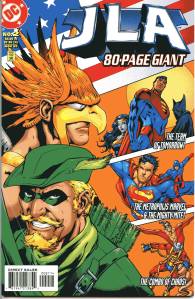
The low sales of the various Justice League spinoff books by the mid-1990s prompted DC to revamp the League as a single team (all the various branch teams were disbanded) on a single title. A Justice League of America formed in the September 1996 limited seriesJustice League: A Midsummer’s Nightmare by Mark Waid and Fabian Nicieza. In 1997, DC Comics launched a new Justice League series titled JLA, written by Grant Morrison with art by Howard Porter and inker John Dell. Morrison stayed as writer for the series through issue #41, though several issues had fill-in writers. JLA #18-#21 and #33 were written by Mark Waid. Mark Millar, Devin Grayson and Mark Waid, and J.M. DeMatteis wrote issues #27, #32 and #35 respectively.
This series, in an attempt at a “back-to-basics” approach, used as its core the team’s original and most famous seven members (or their successors): Superman, Batman, Wonder Woman, Aquaman, Flash (Wally West), Green Lantern (Kyle Rayner), and the Martian Manhunter. Additionally, the team received a new headquarters, the “Watchtower“, based on the Moon. JLA quickly became DC’s best-selling title, a position it enjoyed off and on for several years.
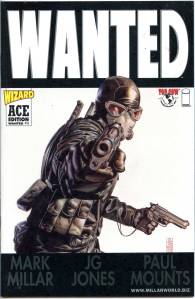
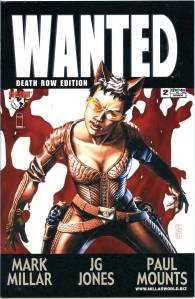
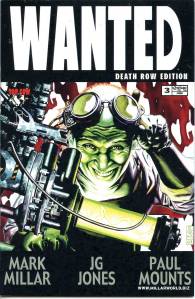
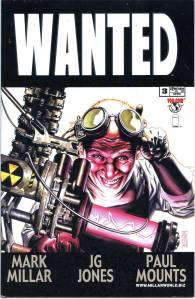
As with Superman: Red Son, Millar claims that the concept for the series occurred to him when he was a child. In this case, it came to him after his brother told him that there were no superheroes any more because they had all disappeared after a great war with their respective supervillains. It was modified from a pitch by Millar for a Secret Society of Super-Villains series.
1986, the year of the aforementioned war in which the supervillains took over and made their world “darker and grittier”, has real world significance to the world of comic books. It marks the publication of Batman: The Dark Knight Returns, Watchmen, and the completion of the 1985-86 Crisis on Infinite Earths series.
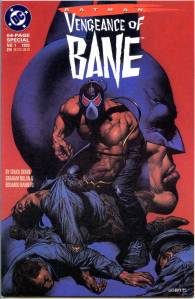
Chuck Dixon, Doug Moench and Graham Nolan created the character of Bane for the Knightfall storyline. Both Dixon and Moench wrote the character’s first appearance in Vengeance of Bane, with art by Graham Nolan. They developed the concept of Bane after an initial idea by Batman editor Dennis O’Neil.
O’Neil had previously created Bane’s birthplace of Santa Prisca in The Question and the drug Venom in the storyline of the same name (published in the pages of Legends of the Dark Knight #16–20, and later reprinted as a trade paperback). In the pages of Azrael, O’Neil introduced Bane’s perception of Venom as both an addiction and the weakness responsible for his earlier defeats.
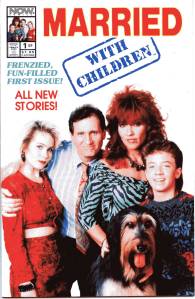
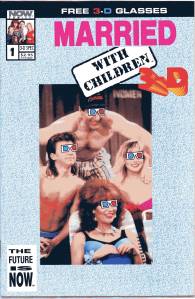
Married… with Children was adapted into a comic book series by NOW Comics starting in 1990. Featuring all the characters you know and love — Al Bundy, Peggy Bundy, Bud Bundy, Kelly Bundy, Snake Face, Greg Miller, Dean Keller and Suzy!
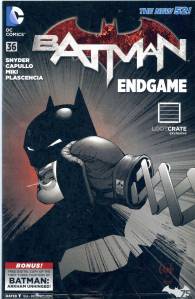
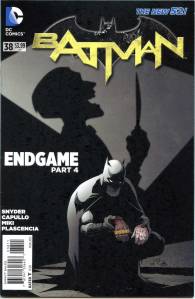
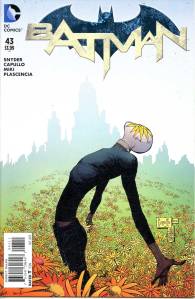
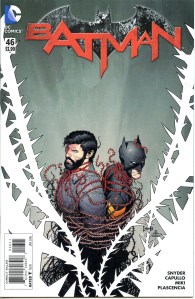
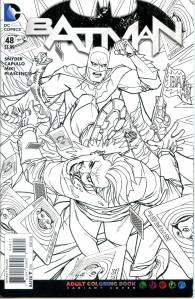
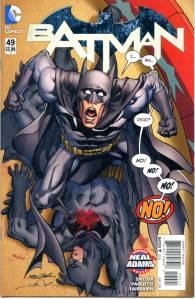
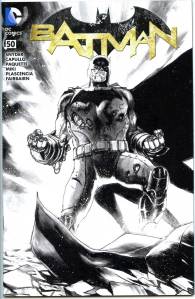
Since the beginning of The New 52, Scott Snyder has been the writer of the flagship Batman title. His first major story arc was “Night of the Owls“, where Batman confronts the Court of Owls, a secret society that has controlled Gotham for centuries. The second story arc was “Death of the Family“, where the Joker returns to Gotham and simultaneously attacks each member of the Batman family. The third story arc was “Batman: Zero Year“, which redefined Batman’s origin in The New 52. It followed Batman #0, published in June 2012, which explored the character’s early years. The final storyline before the Convergence (2015) event was Endgame, depicting the supposed final battle between Batman and the Joker when he unleashes the deadly Endgame virus onto Gotham City. The storyline ends with Batman and the Joker’s supposed deaths. Starting with #41, Commissioner James Gordon takes over Bruce’s mantle as a new, state-sanctioned, mecha Batman, debuting in the Free Comic Book Day special comic Divergence. However, Bruce Wayne is soon revealed to be alive, albeit now suffering almost total amnesia of his life as Batman and only remembering his life as Bruce Wayne through what he has learned from Alfred. Bruce Wayne finds happiness and proposes to his girlfriend, Julie, but Mr. Bloom heavily injures Jim Gordon and takes control of Gotham City and threatens to destroy the city by energizing a particle reactor to create a “strange star” to swallow the city. Bruce Wayne discovers the truth that he was Batman and after talking to a stranger who smiles a lot (it is heavily implied that this is the amnesic Joker) he forces Alfred to implant his memories as Batman, but at the cost of his memories as the reborn Bruce Wayne. He returns and helps Jim Gordon defeat Mr. Bloom and shut down the reactor. Gordon gets his job back as the commissioner, and the government Batman project is shuttered.
Batman: Beyond the White Knight takes place 12 years after the events which are described in the previous volume Batman: Curse of the White Knight, which ended with Bruce Wayne exposed as Batman to the general public and donating his entire fortune to the people of Gotham City, and then turning himself in to the police. Since that, the city has evolved into a futuristic megalopolis known as “Neo-Gotham”. Following the murder of his father Warren, young Terry McGinnis — under the orders of his employer Derek Powers — steals a technologically advanced Batsuit to become the new Batman and avenge his father’s death. At the same time, a middle-aged Bruce escapes from prison in an attempt to rid Neo-Gotham of Batman for good, all while a civil war slowly rages through the city and Powers transforms into the supervillain Blight.
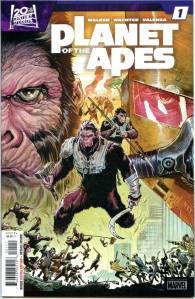
The ALZ-113 virus has rampaged across planet Earth, and humanity is crumbling. While well-meaning researchers hunt for a cure, a fanatical group of humans has their own solution: Kill all apes. Peacekeeper Juliana Tobon is one of the few willing to stand against them, but the crisis is spreading, and soon apes will witness the true depths of human cruelty.
Prophet has starred in three ongoing series bearing his name; these monthlies debuted in 1993, 1995, and 2012, respectively. A fourth series, named Prophet: Earth War, began in January 2016.
The second series, written by Chuck Dixon and illustrated by Stephen Platt premiered in 1995 and lasted eight issues.
DC Comics was a hotbed of experimentation during the 1970s, and in 1975 the character became the first villain to feature as the title character in a comic book series, The Joker. The series followed the character’s interactions with other supervillains, and the first issue was written by O’Neil. Stories balanced between emphasizing the Joker’s criminality and making him a likable protagonist whom readers could support. Although he murdered thugs and civilians, he never fought Batman; this made The Joker a series in which the character’s villainy prevailed over rival villains, instead of a struggle between good and evil. Because the Comics Code Authority mandated punishment for villains, each issue ended with the Joker being apprehended, limiting the scope of each story.
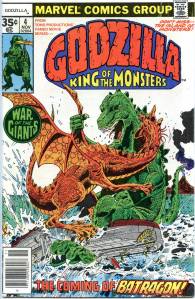
From 1977-79, Godzilla starred in a 24-issue run of comics written by Doug Moench, drawn by Herb Trimpe and published by Marvel Comics entitled Godzilla, King of the Monsters. The series thrusts Godzilla completely into the Marvel Universe. In a nod to King Kong vs. Godzilla, Godzilla first appears by bursting out of an iceberg near Alaska; although how the prehistoric creature came to be trapped again in ice is never revealed (although it is stated in the issue that this “will doubtless be determined in the future.”). Over the course of the series, he crosses the continental United States and eventually ends up in New York City.