Mystery in Space – Silver Age

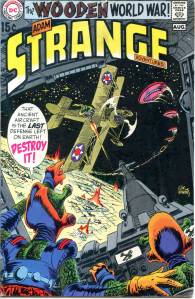
 “Menace of the Robot Raiders!” (Mystery In Space #53, October 1959) featured one of the most enduring and fondly remembered space heroes of the next ten years, Adam Strange, in a 10-page tale which led to the best known period for the Mystery In Space title. Adam Strange had begun in a three-issue run in Showcase #17 (November–December 1958), and although DC considered that those issues had not sold sufficiently to warrant granting him his own title, his return a year later in Mystery In Space#53 was to last an impressive 42 appearances over the next seven years. The Adam Strange space opera tales were crafted by Gardner Fox in the best Flash Gordon tradition, with the hero caught between two planets and a love a galaxy away, giant menacing robots, dust devils, perils on two worlds, and distinctive art by Carmine Infantino and Murphy Anderson who drew almost all issues until #92 (June 1964). A number of these stories are considered among the finest of the 1960s, including the full-issue tale “The Planet That Came to a Standstill!” (Mystery In Space #75, May 1962), which won comic fandoms Alley Award for the “Best Book-Length Story” of 1962, and was fairly unusual for the time inasmuch as it featured a cross-over with other major DC characters, the Justice League of America.

X-Men (Silver Age)

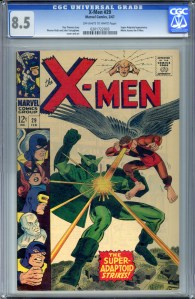
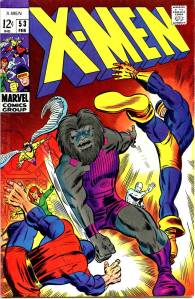
Early X-Men issues introduced the original team composed of Cyclops, Marvel Girl, BeastAngel and Iceman among a few others, their archenemy Magneto and his Brotherhood of Evil Mutants featuring Mastermind, Quicksilver, Scarlet Witch, and Toad. The comic focused on a common human theme of good versus evil and later included storylines and themes about prejudice and racism, all of which have persisted throughout the series in one form or another. The evil side in the fight was shown in human form and under some sympathetic beginnings via Magneto, a character who was later revealed to have survived Nazi concentration camps only to pursue a hatred for normal humanity. His key followers, Quicksilver and the Scarlet Witch, were Romani. Only one new member of the X-Men was added, Mimic/Calvin Rankin, but soon left due to his temporary loss of power.
The title lagged in sales behind Marvel’s other comic franchises. In 1969, writer Roy Thomas and illustrator Neal Adams rejuvenated the comic book and gave regular roles to two recently introduced characters: Havok/Alex Summers (who had been introduced by Roy Thomas before Adams began work on the comic) and Lorna Dane, later called Polaris (created by Arnold Drake and Jim Steranko). However, these later X-Men issues failed to attract sales and Marvel stopped producing new stories with issue #66, later reprinting a number of the older comics as issues #67–93.

Showcase (Silver Age)

Showcase has been the title of several comic anthology series published by DC Comics. The general theme of these series has been to feature new and minor characters as a way to gauge reader interest in them, without the difficulty and risk of featuring “untested” characters in their own ongoing titles. The original series ran from March-April 1956 to September 1970 suspending publication with issue #93, and then was revived for eleven issues from August 1977 to September 1978.

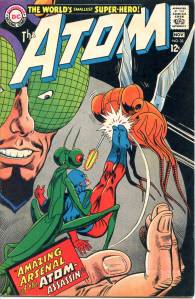
The Showcase series featured characters in either one-shot appearances or brief two or three issue runs as a way to determine reader interest, without the financial risk of featuring “untested” characters in their own ongoing titles. The series began in March-April 1956 and saw the first appearance of several major characters including the Silver Age Flash, the Challengers of the Unknown, Space Ranger, Adam Strange, Rip Hunter, the Silver Age Green Lantern, the Sea Devils, the Silver Age Atom, the Metal Men, the Inferior Five, the Creeper, Anthro, the Hawk and Dove,Angel and the Ape, Bat Lash and The Spectre.

Detective Comics (Silver Age)

In 1964, Julius Schwartz was made responsible for reviving the fading Batman titles. Writer John Broome and artist Carmine Infantino jettisoned the sillier aspects that had crept into the franchise such as Ace the Bathound and Bat-Mite and gave the character a “New Look” that premiered in Detective Comics #327 (May 1964). Schwartz, Gardner Fox, and Infantino introduced, from the William Dozier produced TV series, Barbara Gordon as a new version of Batgirl in a story titled “The Million Dollar Debut of Batgirl!” in issue #359 (Jan. 1967). Mike Friedrich wrote the 30th anniversary Batman story in Detective Comics #387 (May 1969) which was drawn by Bob Brown.

Chamber of Darkness (1970)

Chamber of Darkness is a horror/fantasy anthology comic book published by Marvel Comics that under this and a subsequent name ran from 1969-1974. It featured work by such notable creators as writer-editor Stan Lee, writers Gerry Conway and Archie Goodwin, and artists John Buscema, Johnny Craig, Jack Kirby, Tom Sutton, Barry Windsor-Smith (as Barry Smith), and Bernie Wrightson. Stories were generally hosted by either of the characters Digger, a gravedigger, or Headstone P. Gravely, in undertaker garb, or by one of the artists or writers.

After the eighth issue, the title changed to Monsters on the Prowl, and the comic became almost exclusively a reprint book.

Brave and the Bold (Silver Age)

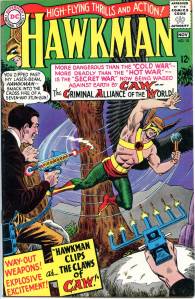
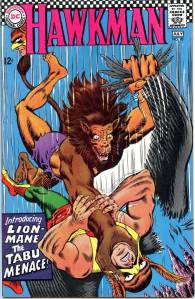
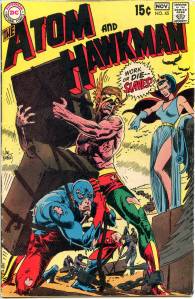
The first volume of the series ran for 200 issues from August/September 1955 to July 1983. Originally, The Brave and the Bold was an anthology series featuring adventure tales from past ages with characters such as the Silent Knight, the Viking Prince, the Golden Gladiator, and Robin Hood. With issue #25, the series was reinvented as a try-out title for new characters and concepts, starting with the Suicide Squad created by writer Robert Kanigher and artist Ross AndruGardner Fox and Joe Kubert created a new version of Hawkman in issue #34 (February–March 1961) with the character receiving his own title three years later.

Thor (Silver Age)

Thor debuted in the science fiction/fantasy anthology title Journey into Mystery #83 (cover-date Aug. 1962), and was created by editor-plotter Stan Lee, scripter Larry Lieber, and penciller-plotter Jack Kirby. A different version of the mythological Thor had appeared previously in Venus #12-13 (Feb.-April 1951).

In a 1984 interview Kirby said “I did a version of Thor for D.C. in the Fifties before I did him for Marvel. I created Thor at Marvel because I was forever enamored of legends, which is why I knew about Balder, Heimdall, and Odin. I tried to update Thor and put him into a superhero costume, but he was still Thor.” And in a 1992 interview, Kirby said “[I] knew the Thor legends very well, but I wanted to modernize them. I felt that might be a new thing for comics, taking the old legends and modernizing them.”

Journey into Mystery was retitled Thor (per the indicia, or The Mighty Thor per most covers) with issue #126 (March 1966). “Tales of Asgard” was replaced by a five-page featurette starring the Inhumans from #146–152 (Nov. 1967 – May 1968), after which featurettes were dropped and the Thor stories expanded to Marvel’s then-standard 20-page length.

Superman (Silver Age)

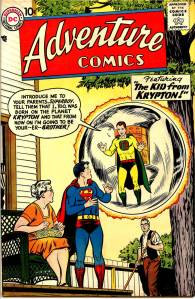
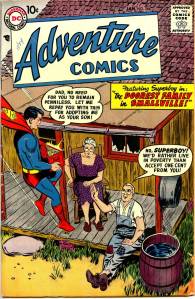
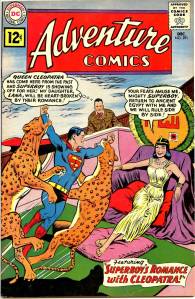
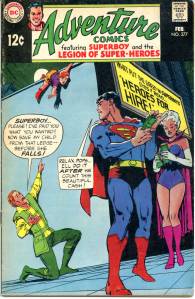
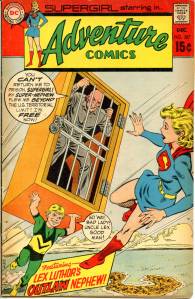
In the view of comics historian Les Daniels, artist Curt Swan became the definitive artist of Superman in the early 1960s with a “new look” to the character that replaced Wayne Boring’s version. Writer Jim Shooter and Swan crafted the story “Superman’s Race With the Flash!” in Superman #199 (Aug. 1967) which featured the first race between the Flash and Superman, two characters known for their super-speed powers. Another Silver Age first is the “Death of Superman,” from 1961’s Superman #149, by Jerry Siegel, Curt Swan and Sheldon Moldoff. The Silver Age was a fantastic period for Superman fans, giving us  characters such as Braniac, Bizzaro, Titano, Supergirl and The Legion of Superheroes.

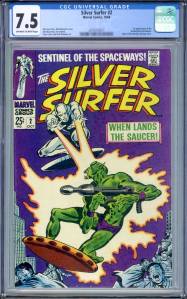
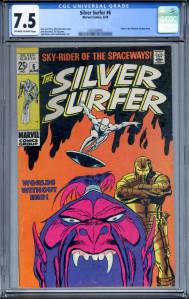
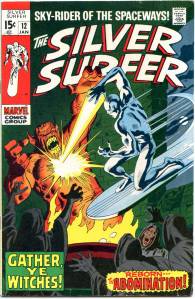
Silver Surfer V1 (1968)

The Silver Surfer debuted as an unplanned addition to Fantastic Four #48 (March 1966). The comic’s writer-editor, Stan Lee, and its penciller and co-plotter, Jack Kirby, had by the mid-1960s developed a collaborative technique known as the “Marvel Method“: the two would discuss story ideas, Kirby would work from a brief synopsis to draw the individual scenes and plot details, and Lee would finally add the dialog and captions. When Kirby turned in his pencil art for the story, he included a new character he and Lee had not discussed. As Lee recalled in 1995, “There, in the middle of the story we had so carefully worked out, was a nut on some sort of flying surfboard”. He later expanded on this, recalling, “I thought, ‘Jack, this time you’ve gone too far'”. Kirby explained that the story’s agreed-upon antagonist, a god-like cosmic predator of planets named Galactus, should have some sort of herald, and that he created the surfboard “because I’m tired of drawing spaceships!” Taken by the noble features of the new character, who turned on his master to help defend Earth, Lee overcame his initial skepticism and began adding characterization. The Silver Surfer soon became a key part of the unfolding story.