The Challengers of the Unknown is a fictional group of adventurers appearing in comic books published by DC Comics. The quartet of adventurers explored paranormal occurrences while facing several fantastic menaces. The characters were created by Joe Simon and JJack Kirby during the end of their company, Mainline Comics. Following the end of the Challengers comic, DC has revived the characters in different incarnations over the years. Some have claimed that Kirby reworked the basic concept of the series with Stan Lee in 1961 to create The Fantastic Four, the first creation that marked the rise of Marvel Comics.
Challengers of the Unknown #67 FN- $9Challengers of the Unknown #68 FN+ $14Challengers of the Unknown #69 FN-VF $12Challengers of the Unknown #71 VF- $14Challengers of the Unknown #73 VF- $14
The initial Justice League lineup included seven of DC Comics’ superheroes who were regularly published at that time: Superman, Batman, Aquaman, Flash, Green Lantern, Martian Manhunter, and Wonder Woman. Rarely featured in most of the stories, Superman and Batman did not even appear on the cover most of the time. Three of DC’s other surviving or revived characters, Green Arrow,the Atom, and Hawkman were added to the roster over the next four years.
The title’s early success was indirectly responsible for the creation of the Fantastic Four. In his autobiography Stan Lee relates how in 1961, during a round of golf, DC publisher Jack Liebowitz mentioned to Marvel-Timely owner Martin Goodman how well DC’s new book (Justice League) was selling. Later that day Goodman, a publishing trend-follower aware of the JLA’s strong sales, told Lee, his comics editor, to come up with a team of superheroes for Marvel.
Justice League of America #45 VG $10Justice League of America #50 FN+ $18Justice League of America #52 FN $12Justice League of America #69 VG- $8
Designed to compete with DC Comics‘ successful launches of House of Mystery and House of Secrets,[2]Tower of Shadows, like its companion comic Chamber of Darkness, sold poorly despite the roster of artists featured. After its first few issues, the title, published bimonthly, began including reprints of “pre-superhero Marvel” monster stories and other SF/fantasy tales from Marvel’s 1950s and early 1960s predecessor, Atlas Comics. After the ninth issue, the title changed to Creatures on the Loose, and the comic became a mix of reprints and occasional sword and sorcery/SF series.
Four years after his debut, Superboy became only the sixth DC superhero to receive his own comic book when Superboy #1 (March–April 1949) was published. The series became the first new DC superhero title to succeed since World War II. Superboy saw the debuts of the first Superbaby story, (about Clark’s adventures as a super-powered toddler), and of Clark’s two closest friends: Lana Lang, who also serves as a romantic interest for Superboy; and Pete Ross, who later discovers and helps protect Clark’s secret identity. Other notable stories to appear in Superboy include the story of the first Bizarro and the first appearances of Legion of Super-Heroes members Mon-El and Ultra Boy.
Daredevil debuted in Marvel Comics‘ Daredevil #1 (cover date April 1964), created by writer-editor Stan Lee and artist Bill Everett, with character design input from Jack Kirby, who devised Daredevil’s billy club. When Everett turned in his first-issue pencils extremely late, Marvel production manager Sol Brodsky and Spider-Man co-creator Steve Ditko inked a large variety of different backgrounds, a “lot of backgrounds and secondary figures on the fly and cobbled the cover and the splash page together from Kirby’s original concept drawing”.
Writer and comics historian Mark Evanier has concluded (but cannot confirm) that Kirby designed the basic image of Daredevil’s costume, though Everett modified it. The character’s original costume design was a combination of black, yellow, and red, reminiscent of acrobat tights. Wally Wood, known for his 1950s EC Comics stories, penciled and inked issues #5–10, introducing Daredevil’s modern red costume in issue #7.
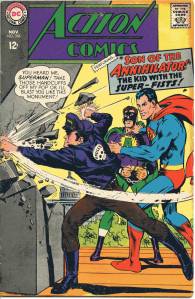
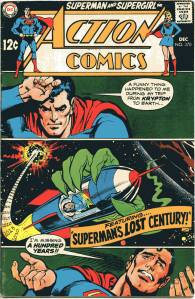
In the view of comics historian Les Daniels, artist Curt Swan became the definitive artist of Superman in the early 1960s with a “new look” to the character that replaced Wayne Boring’s version. Bizarro World first appeared in the story “The World of Bizarros!” in issue #262 (April 1960). Writer Jim Shooter created the villain the Parasite in Action Comics #340 (Aug. 1966).
Action Comics #280 CGC 7.0 Off-White to White Pages $149
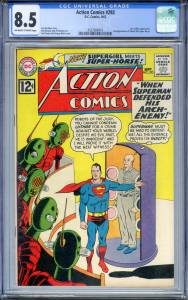
Action Comics #292 CGC 8.5 Off White – White Pages $195
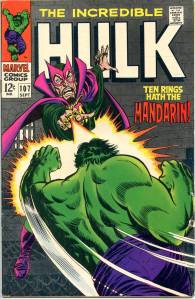
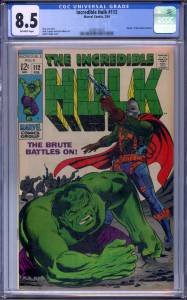
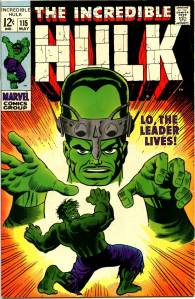
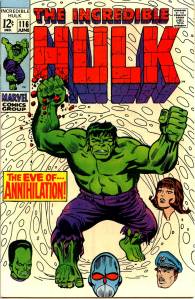
The Hulk first appeared in The Incredible Hulk #1 (cover dated May 1962), written by writer-editor Stan Lee, penciled and co-plotted by Jack Kirby, and inked by Paul Reinman. Lee cites influence from Frankensteinand Dr. Jekyll and Mr. Hyde in the Hulk’s creation. The Hulk’s original series was canceled with issue #6 (March 1963).
In the debut, Lee chose gray for the Hulk because he wanted a color that did not suggest any particular ethnic group.Colorist Stan Goldberg, however, had problems with the gray coloring, resulting in different shades of grey, and even green, in the issue. After seeing the first published issue, Lee chose to change the skin color to green. Green was used in retellings of the origin, with even reprints of the original story being recolored for the next two decades, until The Incredible Hulk vol. 2, #302 (December 1984) reintroduced the gray Hulk in flashbacks set close to the origin story. Since then, reprints of the first issue have displayed the original gray coloring, with the fictional canon specifying that the Hulk’s skin had initially been grey. An exception is the early trade paperback, Origins of Marvel Comics, from 1974, which explains the difficulties in keeping the gray color consistent in a Stan Lee written prologue, and reprints the origin story keeping the gray coloration.
Lee gave the Hulk’s alter ego the alliterative name Bruce Banner because he found he had less difficulty remembering alliterative names. Despite this, in later stories he misremembered the character’s name and referred to him as “Bob Banner”, an error which readers quickly picked up on. The discrepancy was resolved by giving the character the official full name of Robert Bruce Banner.
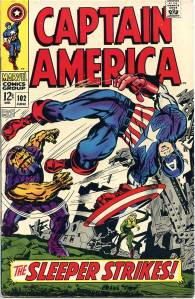
Tales of Suspense became Captain America with #100 (April 1968) This series — considered Captain America volume one by comics researchers and historians, following the 1940s Captain America Comics and its 1950s numbering continuation of Tales of Suspense — ended with #454 (Aug. 1996).
World’s Finest was initially a 96 page quarterly anthology, featuring various DC characters – always including Superman and Batman – in separate stories. Comics historian Les Daniels noted that “Pairing Superman and Batman made sense financially, since the two were DC’s most popular heroes.” When superheroes fell out of vogue in the early 1950s, DC shortened the size of the publication to that of the rest of its output, leaving only enough space for one story; this led to Superman and Batman appearing in the same story together starting with World’s Finest Comics #71 (July 1954).The series continued to feature Superman and Batman team-ups until issue #197. Noted Batman artist Neal Adams first drew the character in an interior story in “The Superman-Batman Revenge Squads” in issue #175 (May 1968).
Comics-artist contemporary John Severin recalled in an interview conducted in the early 2000s that in the late 1950s, Kirby had approached him to be partners on a syndicated, newspapercomic strip “set in Europe during World War Two; the hero would be a tough, cigar-chomping sergeant with a squad of oddball GIs — sort of an adult Boy Commandos“, referring to a 1940s wartime “kid gang” comics series Kirby had co-created for DC Comics.
Sgt. Fury and his Howling Commandos followed an elite special unit, the First Attack Squad, nicknamed the “Howling Commandos”, which was stationed in a military base in England to fight missions primarily, but not exclusively, in the European theatre of World War II. Under Captain “Happy Sam” Sawyer, Fury was the cigar-chomping noncom who led the racially and ethnically integrated unit, unusual for the time.
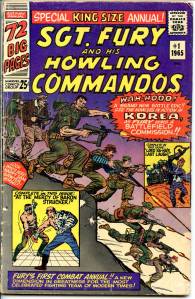
Sgt. Fury and his Howling Commandos Annual #1 G-VG $9
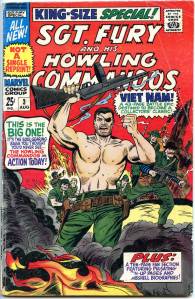
Sgt. Fury and HIs Howling Commandos King-Size Special #3 VG $12
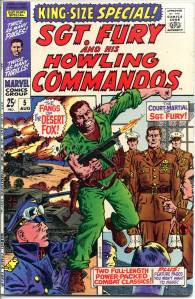
Sgt. Fury and his Howling Commandos King-Size Special #5 VG-F $8
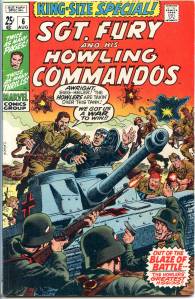
Sgt. Fury and his Howling Commandos King-Size Special #6 F $12