Aquaman (Silver Age)

Aquaman, published by DC Comics was created by Paul Norris and Mort Weisinger. The character debuted in More Fun Comics #73 (November 1941). Initially a backup feature in DC’s anthology titles, Aquaman later starred in several volumes of a solo title. During the late 1950s and 1960s superhero-revival period known as the Silver Age, he was a founding member of the Justice League of America. In the 1990s Modern Age, Aquaman’s character became more serious than in most previous interpretations, with storylines depicting the weight of his role as king of Atlantis.

Later accounts reconciled both facets of the character, casting Aquaman as serious and brooding, saddled with an ill reputation, and struggling to find a true role and purpose beyond his public side as a deposed king and a fallen hero.

Beware the Creeper (1968)

Following his debut in Showcase, the Creeper was given his own series Beware the Creeper, written by Dennis O’Neil; Steve Ditko plotted the first issue. It lasted six issues Most pitted him against a chameleonic villain called Proteus, whose true identity was revealed just before his violent death in the final issue.

The Atom (Silver Age)

The Atom introduced in Showcase #34 (1961) is physicist and university professor Dr. Raymond Palmer, Ph.D. (He was named for real-life science fiction writer Raymond A. Palmer, who was himself quite short.) After stumbling onto a mass of white dwarf star matter that had fallen to Earth, he fashioned a lens which allowed him to shrink down to subatomic size. Originally, his size and molecular density abilities derived from the white dwarf star material of his costume, controlled by mechanisms in his belt, and later by controls in the palms of his gloves. Much later, he gained the innate equivalent powers within his own body. After the events of Identity Crisis, Ray shrank himself to microscopic size and disappeared. Finding him became a major theme of the Countdown year long series and crossover event.

Not Brand Echh (1967)

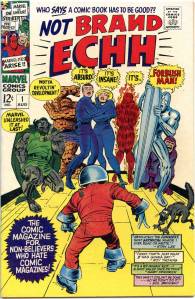
Not Brand Echh is a satiric comic book series published by Marvel Comics that parodied its own superhero stories as well as those of other comics publishers. Running for 13 issues (cover-dated Aug. 1967 to May 1969), it included among its contributors such notable writers and artists as Stan LeeJack KirbyGene ColanBill EverettJohn and Marie Severin, and Roy Thomas. With issue #9, it became a 68-page, 25¢ “giant”, relative to the typical 12¢ comics of the times. In 2017, a 14th issue was released.

Its mascot, Forbush Man, introduced in the first issue, was a superhero wannabe with no superpowers and a costume of red long johns emblazoned with the letter “F” and a cooking pot, with eye-holes, covering his never-revealed head. His secret identity was eventually revealed in issue #5 (Dec. 1967) as Irving Forbush, Marvel’s fictitious office gofer.

Strange Adventures (Silver Age)

Initially a science fiction anthology title with some continuing features starring SF protagonists, the series became a supernatural-fantasy title beginning with issue #202, for which it received a new logo. Deadman’s first appearance in Strange Adventures #205, written by Arnold Drake and drawn by Carmine Infantino, included the first known depiction of narcotics in a story approved by the Comics Code Authority. The “Deadman” feature served as an early showcase for the artwork of Neal Adams.

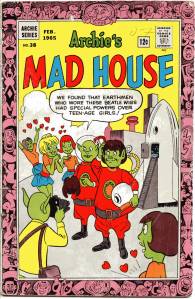
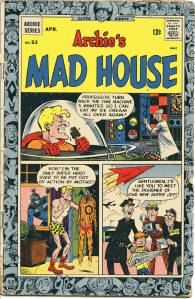
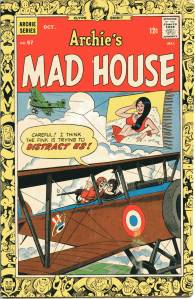
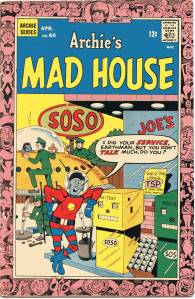
Archie’s Mad House (1959)

The first 18 issues featured the “Archie gang” in stories that were a bit more “off the wall” than the normal Archie series. The idea was to produce stories that made no sense. The title Mad House was written as two words instead of one to suggest a false connection to MAD Magazine and recapture its success. Beginning with issue 19, the Archie gang was dropped (though it was still called Archie’s Mad House), and the title began featuring monsters, space stories and other wacky short stories. The gags in the comics often parodied the latest fads and popular culture. For a time, it would focus on stories with what were intended to be one-off characters. There were, however, exceptions to this rule. Characters becoming popular enough would appear again.

DC Special (1968)

DC Special was a comic book anthology series published by DC Comics originally from 1968 to 1971; it resumed publication from 1975 to 1977. For the most part, DC Special was a theme-based reprint title, mostly focusing on stories from DC’s Golden Age; at the end of its run it published a few original stories. Issue #4 featured many supernatural characters and writer Mark Hanerfeld and artist Bill Draut crafted the first appearance of Abel, who later became (along with his brother Cain) a major character in Neil Gaiman‘s The Sandman. Paul Levitz and Joe Staton finished the series with a Justice Society of America story which revealed the team’s origin.

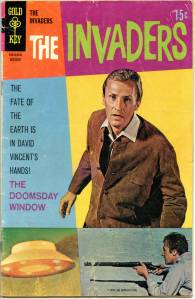
The Invaders (1967)

Comic book version of the 1960s TV series about one man’s crusade to convince people that an advance guard of alien creatures had infiltrated the world’s population and were preparing to conquer Earth.

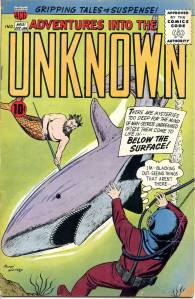
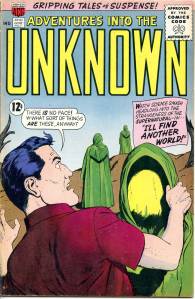
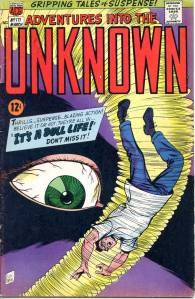
Adventures into the Unknown (1960’s)

Adventures Into the Unknown was best known as the medium’s first ongoing horror-comics title. Published by the American Comics Group, initially under the imprint B&I Publishing, it ran 174 issues (cover-dated Fall 1948 – Aug. 1967). The first two issues, which included art by Fred Guardineer and others, featured horror stories of ghosts, werewolves, haunted houses, killer puppets, and other supernatural beings and locales. The premiere included a seven-page abridged adaptation of Horace Walpole‘s seminal gothic novel The Castle of Otranto, by an unknown writer and artist Al Ulmer.

Unlike many American horror comics of the Golden Age, it weathered the public criticism of the early 1950s and survived the aftermath of the Senate Subcommittee on Juvenile Delinquency hearings of April and June 1954 when the comics industry attempted self-regulation with a highly restrictive Comics Code.

Four Color (1939-1962)

Four Color, also known as Four Color Comics and One Shots, was a long-running American comic book anthology series published by Dell Comics between 1939 and 1968. The title is a reference to the four basic colors used when printing comic books (cyan, magenta, yellow and black at the time).

More than 1,000 issues were published, usually with multiple titles released every month. An exact accounting of the actual number of unique issues produced is difficult because occasional issue numbers were skipped and a number of reprint issues were also included. Nonetheless, the Overstreet Comic Book Price Guide lists well over 1,000 individual issues, ending with #1354. It currently holds the record for most issues produced of an American comic book; its nearest rivals, Action Comics and Detective Comics, ended their initial runs in 2011 at 904 issues and 881 issues, respectively. The first 25 issues are known as “series 1”; after they were published, the numbering began again and “series 2” began. Four Color published many of the first comics featuring characters licensed from Walt Disney.