Fantastic Four (1970’s)

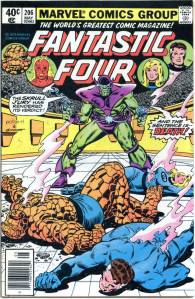
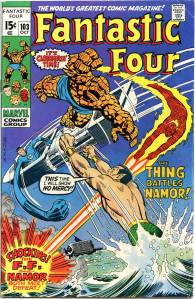
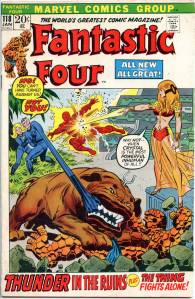
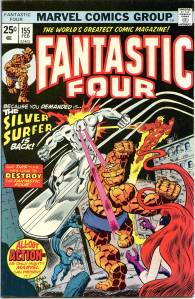
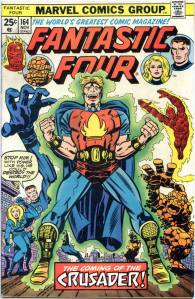
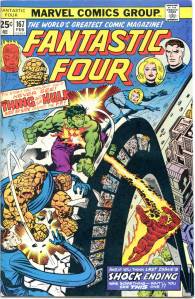
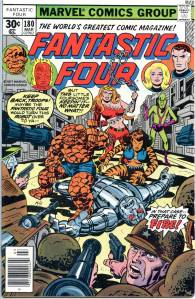
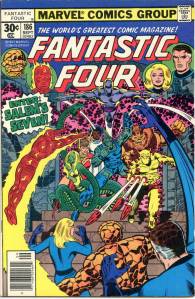
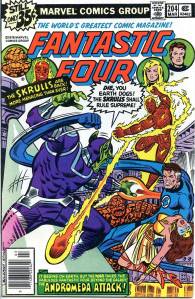
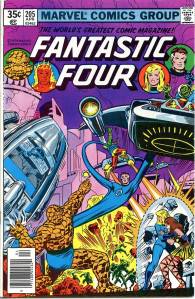
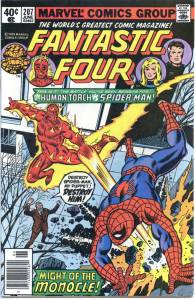
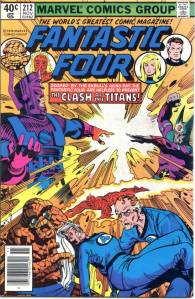
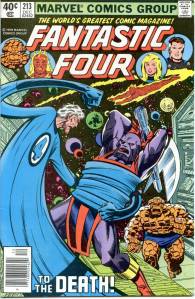
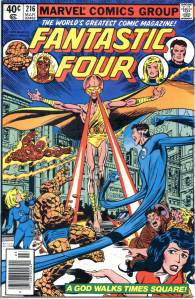
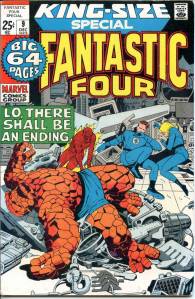
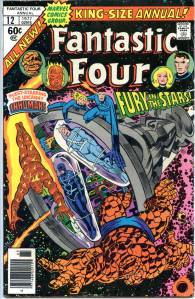
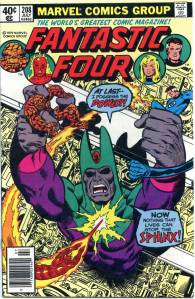
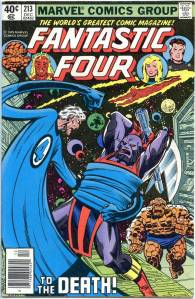
Stan Lee said he created a synopsis for the first Fantastic Four story that he gave to penciller Jack Kirby, who then drew the entire story. Kirby turned in his penciled art pages to Lee, who added dialogue and captions. This approach to creating comics, which became known as the “Marvel Method“, worked so well for Lee and Kirby that they used it from then on; the Marvel Method became standard for the company within a year.

Kirby recalled events somewhat differently. Challenged with Lee’s version of events in a 1990 interview, Kirby responded: “I would say that’s an outright lie”, although the interviewer, Gary Groth notes that this statement needs to be viewed with caution. Kirby claims he came up with the idea for the Fantastic Four in Marvel’s offices, and that Lee had merely added the dialogue after the story had been pencilled. Kirby has also sought to establish, more credibly and on numerous occasions, that the visual elements of the strip were his conceptions. He regularly pointed to a team he had created for rival publisher DC Comics in the 1950s, Challengers of the Unknown. “[I]f you notice the uniforms, they’re the same… I always give them a skintight uniform with a belt… the Challengers and the FF have a minimum of decoration. And of course, the Thing’s skin is a kind of decoration, breaking up the monotony of the blue uniform.” The characters wear no uniforms in the first two issues.

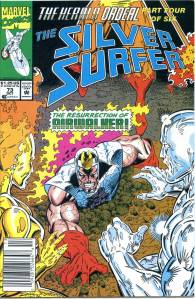
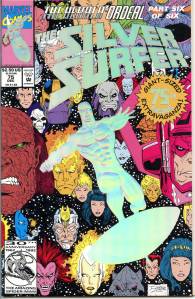
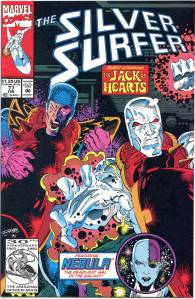
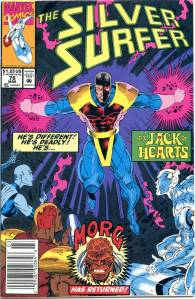
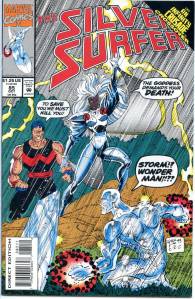
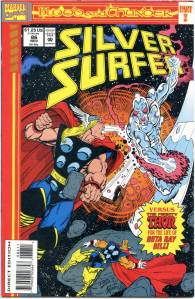
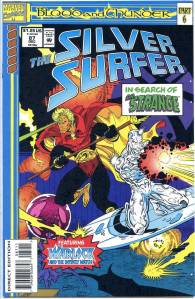
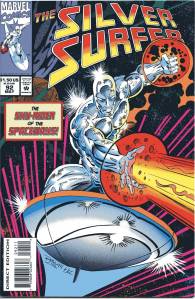
Silver Surfer V3 (1990’s)

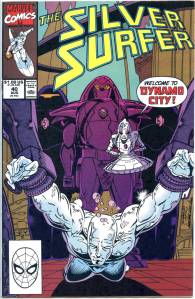
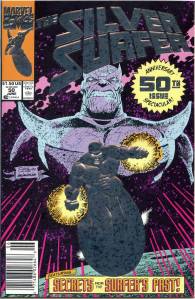
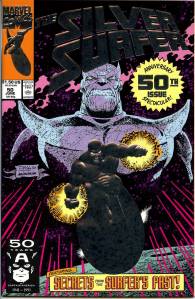
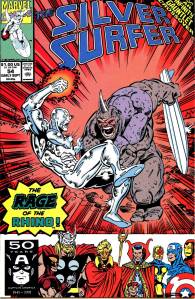
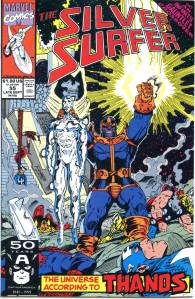
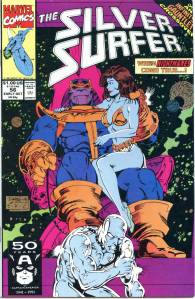
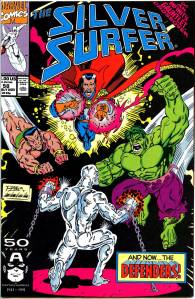
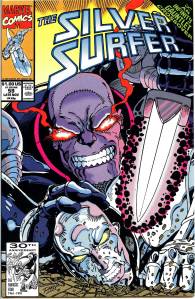
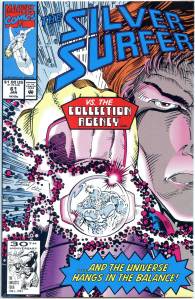
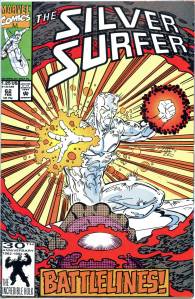
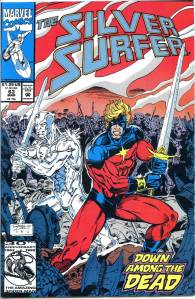
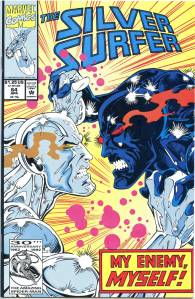
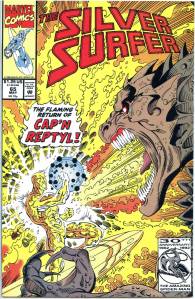
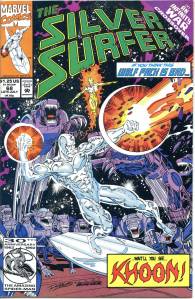
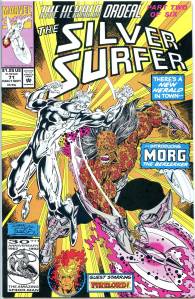
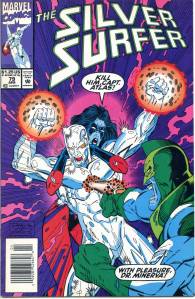
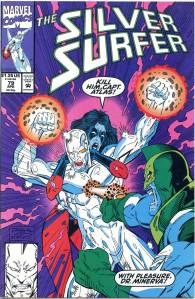
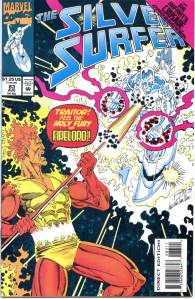
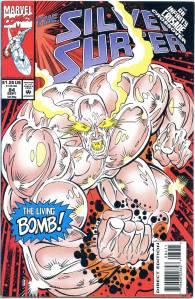
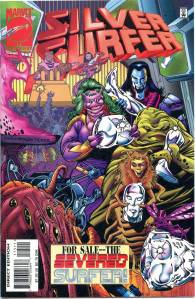
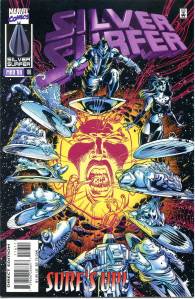
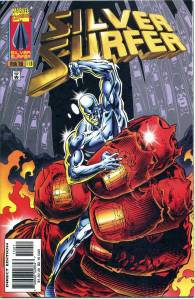
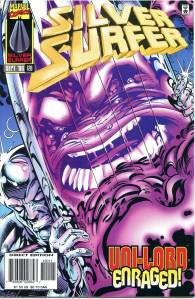
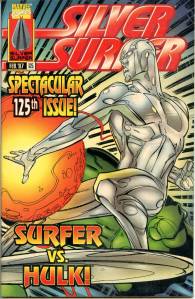
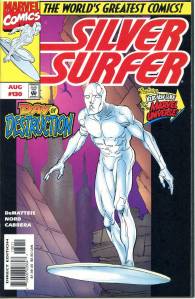
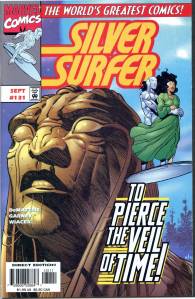
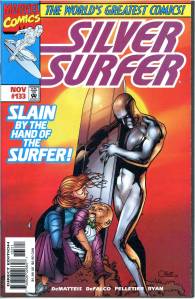
JIm Starlin took over as writer with issue #34 after several fill-in issues, and incorporated Thanos, Adam Warlock, and Drax the Destroyer into the series. Under Starlin and later Ron Marz, the series would receive acclaim and sales boost due to Silver Surfer’s involvement with Starlin’s Infinity Trilogy, with George Pérez and J. M. DeMatteis also having brief writing stints on the series as well. Additional artists included Tom GrindbergRon Garney, and Jon J. Muth, as well as periodic guest spots by John Buscema. The title experienced great initial success which allowed Marvel to push the character into other media, including a 1990 video game, 1992 trading card set, and 1998 animated series, as well as spinning off a variety of other comics series including Cosmic PowersCosmic Powers UnlimitedCaptain Marvel vol. 2, and Star Masters. It ran 146 issues, through 1998.

Tales to Astonish (Silver Age)

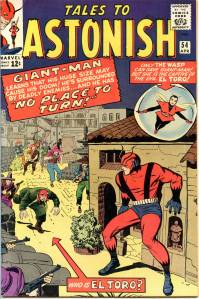
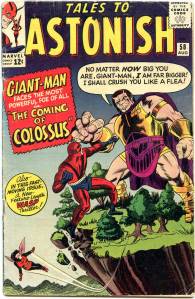
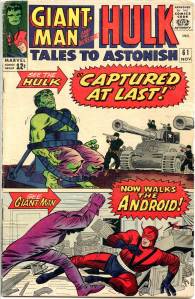
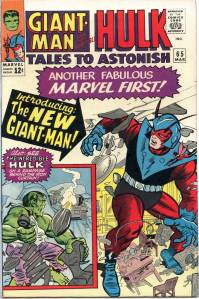
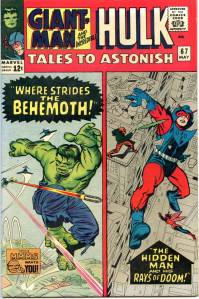
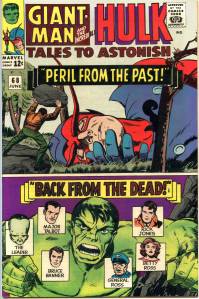
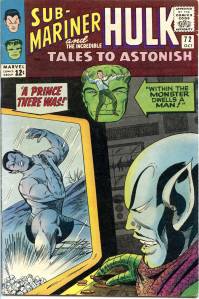
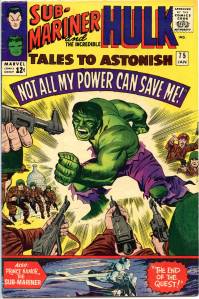
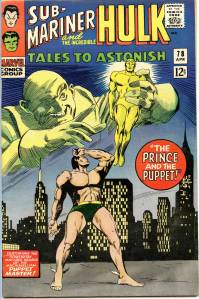
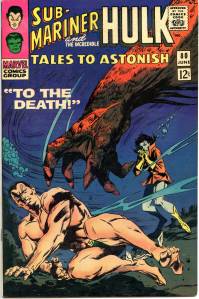
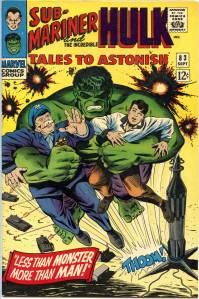
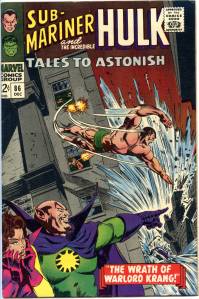
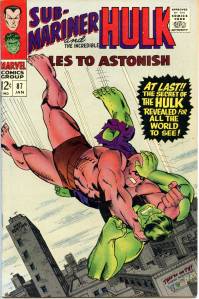
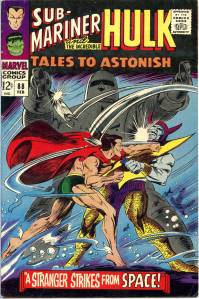
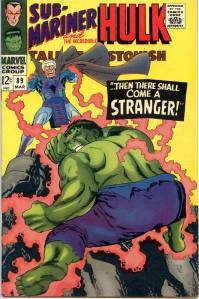
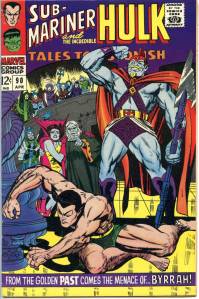
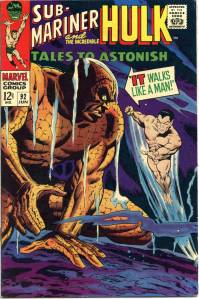
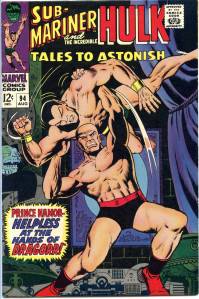
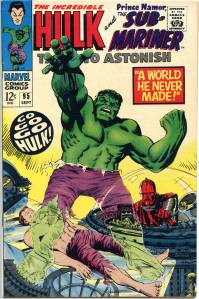
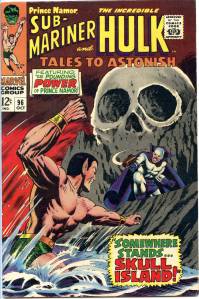
Tales to Astonish was published from January 1959 to March 1968 . It began as a science-finction anthology that served as a showcase for such artists as Jack Kirby and Steve Ditko. It became The Incredible Hulk with issue #102 (April 1968). Its sister title was Tales of Suspense.

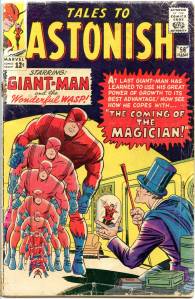
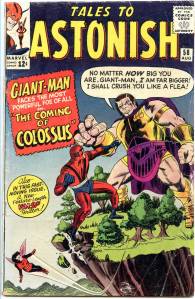
Following his one-shot anthological story in #27 (Jan. 1962), scientist Henry Pym returned donning a cybernetic helmet and red costume, and using size-changing technology to debut as the insect-sized hero Ant-Man in #35 (Sept. 1962). The series was plotted by Lee and scripted by Lieber, with penciling first by Kirby and later by Heck and others. The Wasp was introduced as Ant-Man’s costar in issue #44 (June 1963). Ant-Man and Pym’s subsequent iteration, Giant-Man, introduced in #49 (Nov. 1963), starred in 10- to 13-page and later 18-page adventures,

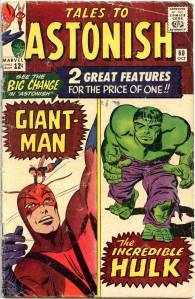
The Hulk, whose original series The Incredible Hulk had been canceled after a six-issue run in 1962-63, returned to star in his own feature when Tales to Astonish became a split book at issue #60 (Oct. 1964),]after having guest-starred as Giant-Man’s antagonist in a full-length story the previous issue. The Hulk had proven a popular guest-star in three issues of Fantastic Four and an issue of The Amazing Spider-Man. His new stories here were initially scripted by Lee and illustrated by the seldom-seen team of penciler Steve Ditko and inker George Roussos. This early part of the Hulk’s run introduced the Leader, who would become the Hulk’s nemesis, and this run additionally made the Hulk’s identity known, initially only to the military and then later publicly.

Tales from the Dark Multiverse (2019)

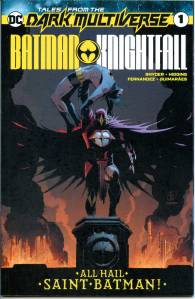
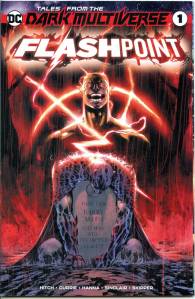
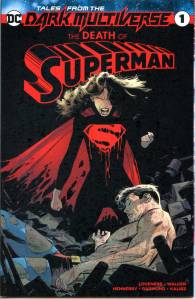
Tales from the Dark Multiverse is an American superhero/anthology comic book limited series published by DC Comics, beginning on October 16, 2019. The series takes some of the most famous events in the DC Universe and puts a twist on them.

Following the Source Wall being shattered at the end of Dark Nights: Metal, the mysterious watcher known as Tempus Fuginaut (introduced in Sideways) begins trying to recruit several “heroes” from across the Dark Multiverse in the wake of a coming crisis.

Oblivion Song (2018)

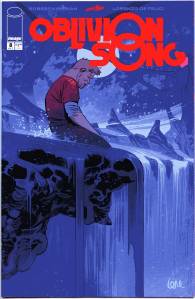
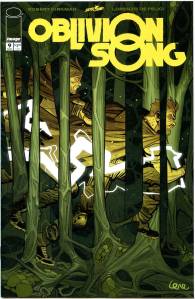
Oblivion Song is an ongoing American comic book series created by writer Robert Kirkman and artist Lorenzo de Felici.

It is a supernatural science fiction story that chronicles Nathan Cole, a man who makes daily trips to try and rescue those still living in the apocalyptic hellscape of Oblivion, a part of Philadelphia lost a decade ago along with 300,000 of its citizens.

In June 2019, it was revealed that Universal Pictures and Skybound Entertainment will produce an Oblivion Song movie with Sean O’Keefe writing the script.

Batman: Urban Legends (2021)

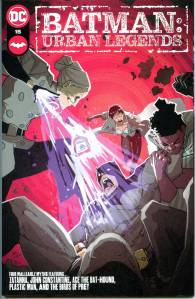
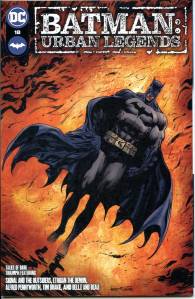
Batman: Urban Legends is an ongoing anthology series, published by DC Comics. It began publication in 2021. It features stories staring various allies of Batman either in multi-part or one offs.

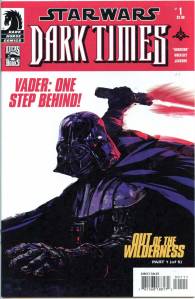
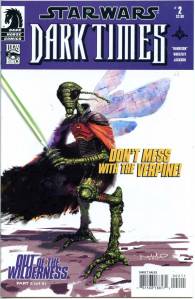
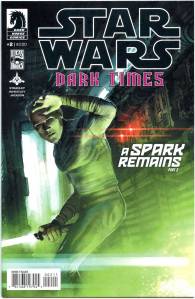
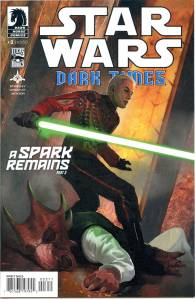
Star Wars – Dark Times (2011)

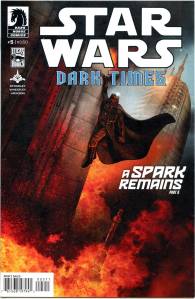
Dark Times is a 2006, 33 issue (32 + a ‘zero issue’) comic book mini-series published by Dark Horse Comics. It is part of their 30th anniversary retooling of its long-running Star Wars series of comics, replacing Star Wars: Republic.

The first issue was released on November 8, 2006, and is written by Mick Harrison from a plot by Welles Hartley.

The series is set in the Star Wars galaxy shortly after the events in Star Wars Episode III: Revenge of the Sith, and about 19 years before Star Wars Episode IV: A New Hope. The story begins in the days following the events in Purge by John Ostrander, and intertwines with the events of Dark Lord: The Rise of Darth Vader by James Luceno.

Wolverine V2 (1980’s)

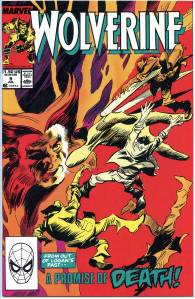
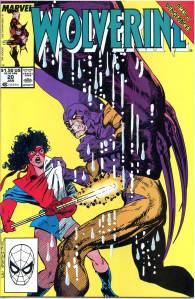
In November 1988, Marvel launched an ongoing Wolverine solo book written by Claremont with art by John Buscema. It ran for 189 issues. Larry Hama later took over the series and had an extensive run. Other writers who wrote for the two Wolverine ongoing series include Peter David, Archie Goodwin, Erik Larsen, Frank Tieri, Greg Rucka, Mark Millar, and Gregg Hurwitz. Many artists have also worked on the series, including John Byrne, Gene Colan, Marc Silvestri, Mark Texeira, Adam Kubert, Leinil Francis Yu, Rob Liefeld, Sean Chen,Darick Robertson, John Romita, Jr., and Humberto Ramos. During the 1990s, the character was revealed to have bone claws, after his adamantium is ripped out by Magneto in X-Men #25, which was inspired by a passing joke of Peter David’s.
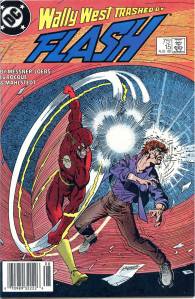
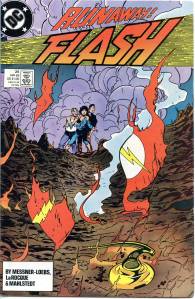
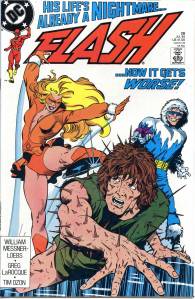
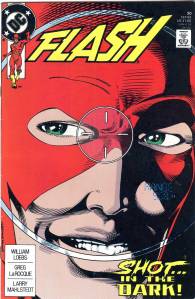
Flash V2 (1980’s)

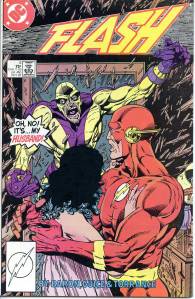
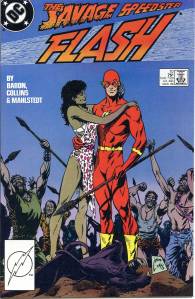
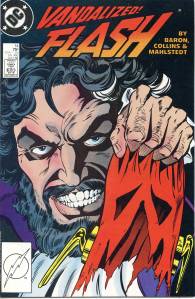
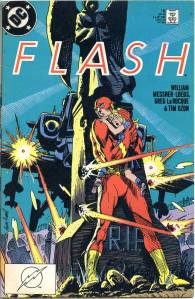
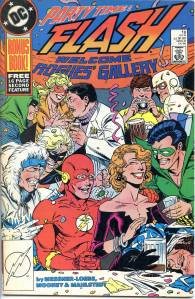
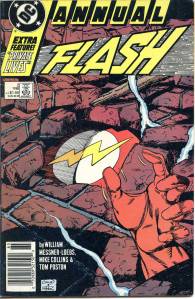
The third Flash was Wally West, introduced in The Flash (vol. 1) #110 (Dec. 1959) as Kid Flash. West, Allen’s nephew by marriage, gained the Flash’s powers through an accident identical to Allen’s. Adopting the identity of Kid Flash, he maintained membership in the Teen Titans for years. Following Allen’s death, West adopted the Flash identity in Crisis on Infinite Earths #12 and was given his own series, beginning with The Flash (vol. 2) #1 in 1987.[1] Many issues began with the catchphrase: “My name is Wally West. I’m the fastest man alive.”
Coda (2018)

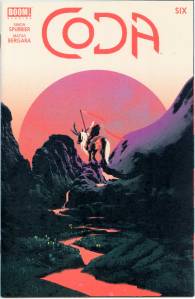
In the aftermath of an apocalypse which wiped out nearly all magic from a once-wondrous fantasy world, a former bard named Hum (a man of few words, so nicknamed because his standard reply is “hm”) seeks a way to save the soul of his wife with nothing but a foul-tempered mutant unicorn and his wits to protect him…but is unwillingly drawn into a brutal power struggle which will decide forever who rules the Weird Wasteland.