The series was published for 85 issues from February–March 1969 to October 1978. Its tagline was “It’s 12 o’clock… The Witching Hour!” and was changed to “It’s midnight…” from issue #14 onwards. The series was originally edited by Dick Giordano, who was replaced by Murray Boltinoff with issue #14.Nick Cardy was the cover artist for The Witching Hour for issues #1–6, 11–12, 15–16, 18–52, and 60. Stories in the comic were “hosted” and introduced by three witches, Morded, Mildred, and Cynthia.
After helping Barry Allen—the speedster superhero The Flash—restore the timeline back to its original state,Thomas Wayne—the vigilante Batman—finds himself once again in the aberrant timeline known as the Flashpoint, whose existence Batman is determined to change and replace with another version of the DC Universe (DCU), all for the sole purpose of erasing the death of his son Bruce.
In response to the restrictions imposed by the Comics Code Authority, DC began a new science-fiction series in 1956. The series featured artwork by Murphy Anderson, Gil Kane, and many others, with stories by John Broome, Gardner Fox, and additional writers. It was an anthology comic for many years, publishing a variety of science fiction stories. The series featured Space Ranger as of issue #40 and running through #82 (April–May 1964) Other features included the “Green Glob” (issues #85–98, 100, 102, 103) and “Automan” (issues #91, 94, 97). The series’ last issue as Tales of the Unexpected was #104 (December 1967–January 1968). As of issue #105 (February–March 1968), the title was shortened to The Unexpected.
Tales of the Unexpected #101 FN+ $24Tales of the Unexpected #103 FN+ $24
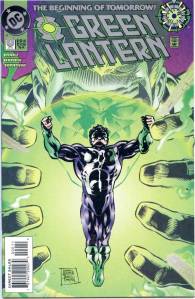
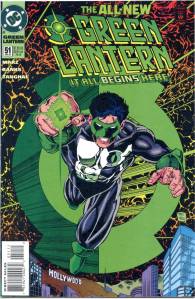
The fourth volume of Green Lantern began in 2005 in the aftermath of Green Lantern: Rebirth, which saw the return of fan favorite Hal Jordan. In the beginning of the series Hal tries to re-acclimate into society and life, both as Hal Jordan: Test Pilot and Hal Jordan: Green Lantern of Sector 2814. As critically acclaimed writer Geoff Johns reinvents Hal Jordan and reintroduces him into the DCU he comes across various problems and threats throughout the run. With Coast City being rebuilt Hal takes residence there, even if barely anyone else has. The Manhunter Androids, Cyborg-Superman, Shark, Hector Hammond and Black Hand cause serious problems for Hal. The Black Hand who becomes immensely important later on in the series.
The 2016 DC Comics title relaunch Rebirth incorporates several elements (such as the costume, the setting and some characters) from the Supergirl television series. The DC Rebirth initiative undid the New 52’s modern recreations, bringing DC’s heroes back to their more classic iterations. Supergirl’s new series (Volume 7) was titled Supergirl: Rebirth, written by Steven Orlando. The first arc was pencilled by Brian Ching, who also redesigned Supergirl’s costume in reference to a more classic look.
The New Teen Titans relaunched with a new #1 issue in August 1984 as part of a new initiative at DC informally referred to as “hardcover/softcover”. The New Teen Titans along with Legion of Super-Heroes and Batman and the Outsiders were the first and only titles included in this program. The same stories were published twice, first in a more expensive edition with higher-quality printing and paper distributed exclusively to comic book specialty stores, then republished a year later in the original format, distributed to newsstands. The title was renamed Tales of the Teen Titans with issue #41, while a new concurrently published series named The New Teen Titans vol. 2 launched with a new #1 following the release of Tales of the Teen Titans #44 and Annual #3, the conclusion of the “Judas Contract” storyline.
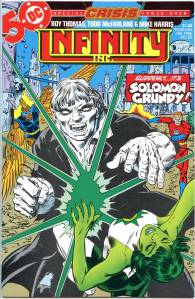
Pérez temporarily returned with issue #50, when the series took the name The New Titans without the “Teen” prefix, as the characters were no longer teenagers. Issue #50 told a new origin story for Wonder Girl, her link to Wonder Woman having been severed due to retcons created in the aftermath of Crisis on Infinite Earths. Issues #60 and #61 were part of a five-part crossover with Batman, “A Lonely Place of Dying” and along with issue #65, featured the debut of Tim Drake as the third Robin.
New Titans V2 #0 NM $4New Teen Titans V2 #1 CGC 9.8 White Pages $85New Teen Titans V2 #2 VF-NM $4New Teen Titans V2 #3 NM- $4New Teen Titans V2 #4 NM- $3New Teen Titans V2 #5 VF $2New Teen Titans V2 #6 VF-NM $2New Teen Titans V2 #7 NM- $3New Teen Titans V2 #9 NM $4New Teen Titans V2 #10 NM- $3New Teen Titans V2 #11 NM- $3New Teen Titans V2 #12 NM- $3New Teen Titans V2 #13 NM $4New Teen Titans V2 #14 NM $4New Teen Titans V2 #15 NM $4New Teen Titans V2 #16 NM $4New Teen Titans V2 #17 NM $4New Teen Titans V2 #18 NM $4New Teen Titans V2 #19 VF $2New Teen Titans V2 #20 NM $4New Teen Titans V2 #22 NM $4New Teen Titans V2 #23 NM $4New Teen Titans V2 #24 VF-NM $3New Teen Titans V2 #25 NM $4New Teen Titans V2 #26 NM $4New Teen Titans V2 #27 NM $4New Teen Titans V2 #28 NM $4New Teen Titans V2 #29 NM $4New Teen Titans V2 #30 NM $4New Teen Titans #41 NM $4New Teen Titans V2 #47 NM $4New Teen Titans #48 NM $4New Titans V2 #60 NM $7The New Titans #60 VF-NM $3The New Titans #61 NM- $5New Teen Titans #65 NM $9New Teen Titans #80 NM $4New Titans #81 NM $4New Titans #82 NM $4New Titans #84 NM $4New Titans #85 NM $4New Titans V2 #87 NM $4New Titans V2 #88 NM $4New Titans V2 #89 NM $4New Titans V2 #90 NM $4New Titans V2 #91 NM $4New Titans V2 #92 NM $4New Titans V2 #93 NM $4New Titans V2 #94 $4New Titans V2 #95 NM $4New Teen Titans V2 Annual #1 VF-NM $2New Teen Titans V2 Annual #2 NM- $3
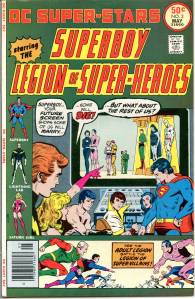
Paul Levitz returned to write the series with #284. Pat Broderick and Bruce Patterson illustrated the title for a short time before Keith Giffen began on pencils, with Patterson, and then Larry Mahlstedt, on inks. The creative team received enhanced popularity following “The Great Darkness Saga“, which ran from #287; #290–294; and Annual #3, featuring a full assault on the United Planets by Darkseid. Comics historian Les Daniels observed that “Working with artist Keith Giffen, Levitz completed the transformation of Legion into a science-fiction saga of considerable scope and depth.”
The Legion celebrated issue #300 (June 1983) by revisiting the “Adult Legion” storyline through a series of parallel world short stories illustrated by a number of popular Legion artists from previous years. The story served to free up Legion continuity from following the “Adult Legion” edict of previous issues.
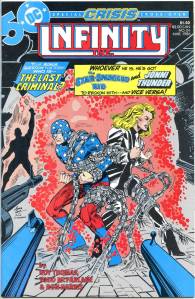
Legion of Super-Heroes #294 NM- $8Legion of Super-Heroes #303 NM- $3Legion of Super Heros Annual #3 VF-NM $3Tales of the Legion of Super-Heroes #316 VF $3
Writer Dennis O’Neil and artist Neal Adams had their first collaboration on Batman on the story “The Secret of the Waiting Graves” in issue #395 (Jan. 1970). The duo, under the direction of Schwartz, would revitalize the character with a series of noteworthy stories reestablishing Batman’s dark, brooding nature and taking the books away from the campy look and feel of the 1966–68 ABCTV series. Comics historian Les Daniels observed that “O’Neil’s interpretation of Batman as a vengeful obsessive-compulsive, which he modestly describes as a return to the roots, was actually an act of creative imagination that has influenced every subsequent version of the Dark Knight.” Adams introduced the Man-Bat with writer Frank Robbins in Detective Comics #400 (June 1970). O’Neil and artist Bob Brown crafted Batman’s first encounter with the League of Assassins in Detective Comics #405 (Nov. 1970) and created Talia al Ghul in issue #411 (May 1971).
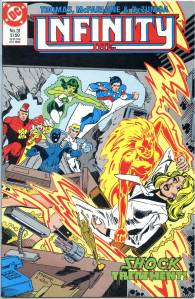
After publishing on a monthly schedule throughout its run, Detective Comics became a bi-monthly book from issues #435 (June–July 1973) to #445 (Feb.-March 1975). Issues #438 (Dec. 1973-Jan. 1974) to #445 (Feb.–March 1975) of the series were in the 100 Page Super Spectacular format. O’Neil and artist Dick Giordano created the Batman supporting character Leslie Thompkins in the story “There Is No Hope in Crime Alley” appearing in issue #457 (March 1976). Writer Steve Englehart and artist Marshall Rogers produced an acclaimed run of Batman stories in Detective Comics #471–476 (Aug. 1977 – April 1978), and provided one of the definitive interpretations that influenced the 1989 Batman movie and would be adapted for the 1990s animated series. The Englehart and Rogers pairing, was described in 2009 by comics writer and historian Robert Greenberger as “one of the greatest” creative teams to work on the Batman character. In their story “The Laughing Fish”, the Joker is brazen enough to disfigure fish with a rictus grin, then expects to be granted a federal trademark on them, only to start killing the bureaucrats who try to explain to him that obtaining such a claim on a natural resource is legally impossible. Writer Len Wein and Rogers co-created the third version of the supervillain Clayface in Detective Comics #478 (July–Aug. 1978). The original Katherine Kane also known as “Batwoman” was killed in the lead story in issue #485 (Aug.–Sept. 1979) by the League of Assassins.
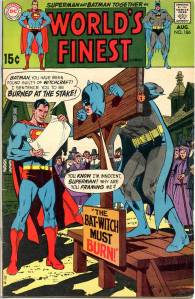
By 1964, sales of Batman titles had fallen drastically. Bob Kane noted that, as a result, DC was “planning to kill Batman off altogether”. In response to this, editor Julius Schwartz was assigned to the Batman titles. He presided over drastic changes, beginning with 1964’s Detective Comics #327 (May 1964), which was cover-billed as the “New Look”. Schwartz introduced changes designed to make Batman more contemporary, and to return him to more detective-oriented stories. He brought in artist Carmine Infantino to help overhaul the character. The Batmobile was redesigned, and Batman’s costume was modified to incorporate a yellow ellipse behind the bat-insignia. The space aliens, time travel, and characters of the 1950s such as Batwoman, Ace, and Bat-Mite were retired. Bruce Wayne’s butler Alfred was killed off (though his death was quickly reversed) while a new female relative for the Wayne family, Aunt Harriet, came to live with Bruce Wayne and Dick Grayson.
Batman #168 CGC 7.0 Off-White to White Pages $129Batman #180 FN+ $45Batman #201 VG- $18Batman #213 VF $89
Boy Commandos spun off into their own title with a ‘Winter 1942’ date. The title sold “over a million copies each month”, and was one of DC’s “three biggest hits” alongside Superman and Batman. Jack Kirby drew around five pages a day of the title, but Jack Liebowitz requested an even faster turn-around – fearing (as happened) that the two would be drafted, as had many other industry professionals. Simon & Kirby hired “inkers, [letterers], colorists, and writers, striving to create a year’s worth of tales” (Boy Commandos was also a quarterly title until Winter, 1945). Among those hired was a young Gil Kane.
Boy Commandos ran until issue #36 (Nov/Dec 1949), and was edited throughout by Jack Schiff. Among the individuals who assisted Simon and Kirby on the title (and its covers) were future-Superman legend Curt Swan, as well as Steve Brodie, Louis Cazeneuve and Carmine Infantino.
Boy Commandos #29 CGC 7.5 Cream to Off-White Pages $225