Moon Knight V1 (1980)

Moon Knight received his first ongoing series in 1980, with Doug Moench and Bill Sienkiewicz as its main creative team. The character received an expanded origin story in issue #1, which also introduced several recurring characters as well as recurring enemy Bushman. The series depicted several characters who doubted the moon god Khonshu was real and believed Marc Spector only experienced a hallucination while near death. It was never explained why other characters, such as Spector’s lover Marlene, concluded this when there was no other explanation for Marc’s spontaneous recovery from his wounds and a death-like state and when it was well known by this time that many gods of myth in the Marvel Universe (such as Thor and Zeus) were real, living entities from other dimensions and planets.

After early sales were good, Marvel made the Moon Knight series a flagship title available in comic shops starting with issue #15. The companion mini-series Moon Knight: Special Edition reprinted the Hulk and Marvel Preview Moon Knight stories in color and standard comic format, as opposed to their original magazine format. Sienkiewicz left the series after issue #30, though he continued to contribute covers until the series ended with issue #38.

Grendel Tales – Four Devils, One Hell

Too many devils are looking to rule the underworld. Some of them have to head for higher ground. The gambler, the detective, the madman, the artist — four displaced devils each in search of a hell to call his own. But while each follows his own path, they all end up on the night train to New Orleans. Four devils are fighting for one town, and an unknown threat with a thirst for power is lurking amongst them, unwilling to give up his town. There’s always somethin’ hot goin’ down in the Big Easy, but forecasts are predicting an all-time high!

Castlevania – The Belmont Legacy (2005)

It is 1576, and the legend of the Belmont family’s vampire-hunting prowess still echoes through the Romanian countryside. While Christopher Belmont celebrates his nuptials, dark forces conspire to raise Count Dracula from his unholy slumber. With this ancient evil unleashed once more, young Belmont must to prove he is worthy of the Belmont legacy. Based on the smash-hit Konami videogame series.

Outcast (2014)

Outcast, created by writer Robert Kirkman and artist Paul Azaceta is a supernatural horror story that chronicles Kyle Barnes, a man whose loved ones have been involved in demonic possession since his childhood. With the help of a clergyman, he tries as an adult to unveil what lies behind the supernatural manifestations and why he seems to carry special peculiarities.

The first issue of the monthly comic was published in 2014 by Image Comics. Before the first release, Kirkman also began to develop a television adaptation with Cinemax which began airing in June 2016.

Freaks of the Heartland (2004)

Trevor Owen has a younger brother who lives in the barn behind the house, too monstrous to be let into the house. The boy’s only six years old, but he towers over his older brother, and possesses monstrous strength. For years, Trevor has looked after his baby brother, keeping him from the light, but now that’s all about to change. His family’s profane secret is about to be revealed, uncovering the horrible truth of the small mid-western town the boys have grown up in.

The Shadow V1 (1973)

During the mid-1970s, DC Comics published an “atmospheric interpretation” of the character by writer Dennis O’Neil and artist Michael Kaluta in a 12-issue series (Nov. 1973 – Sept. 1975). Kaluta drew issues 1–4 and 6 and was followed by Frank Robbins and then E. R. Cruz. Attempting to be faithful to both the pulp-magazine and radio-drama character, the series guest-starred fellow pulp fiction hero the Avenger in issue #11.
Mystery in Space – Silver Age

 “Menace of the Robot Raiders!” (Mystery In Space #53, October 1959) featured one of the most enduring and fondly remembered space heroes of the next ten years, Adam Strange, in a 10-page tale which led to the best known period for the Mystery In Space title. Adam Strange had begun in a three-issue run in Showcase #17 (November–December 1958), and although DC considered that those issues had not sold sufficiently to warrant granting him his own title, his return a year later in Mystery In Space#53 was to last an impressive 42 appearances over the next seven years. The Adam Strange space opera tales were crafted by Gardner Fox in the best Flash Gordon tradition, with the hero caught between two planets and a love a galaxy away, giant menacing robots, dust devils, perils on two worlds, and distinctive art by Carmine Infantino and Murphy Anderson who drew almost all issues until #92 (June 1964). A number of these stories are considered among the finest of the 1960s, including the full-issue tale “The Planet That Came to a Standstill!” (Mystery In Space #75, May 1962), which won comic fandoms Alley Award for the “Best Book-Length Story” of 1962, and was fairly unusual for the time inasmuch as it featured a cross-over with other major DC characters, the Justice League of America.

Superman V2 (1987)

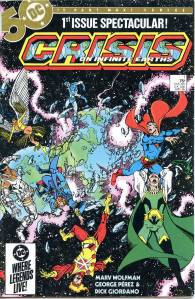
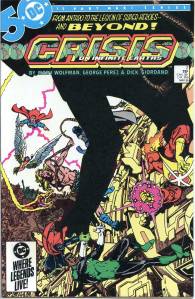
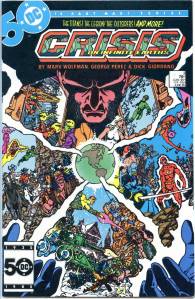
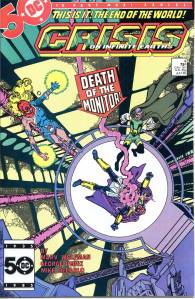
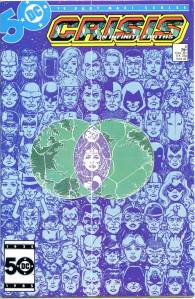
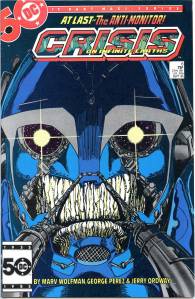
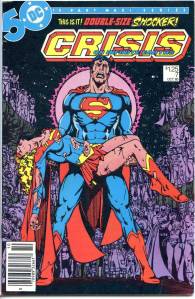
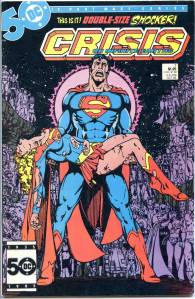
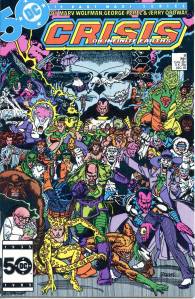
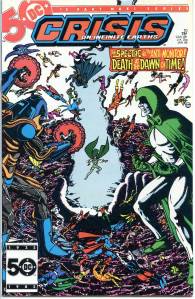
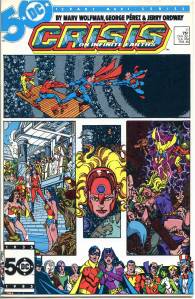
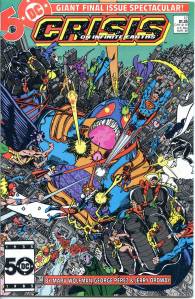
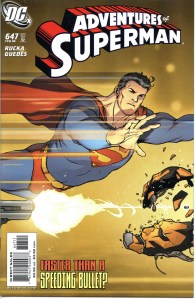
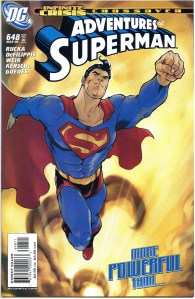
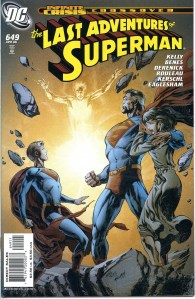
This series was launched after John Byrne revamped the Superman character in 1986 in The Man of Steel limited series, introducing the post-Crisis on Infinite Earths version of the Superman character.

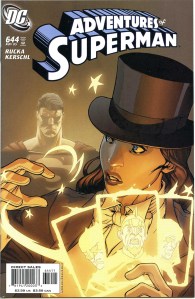
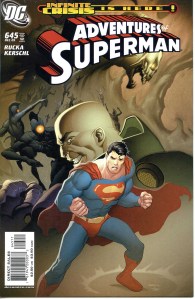
After that limited series, Action Comics returned to publication and Superman vol. 2, #1 was published. The original Superman series (volume 1) became The Adventures of Superman starting with issue #424. Superman vol. 2 continued publishing until April 2006 at which point DC restored The Adventures of Superman to its original title and canceled the second Superman series.

Superman / Batman (2003)

Superman/Batman was a monthly series published by DC Comics that features the publisher’s two most popular characters: Superman and Batman. Superman/Batman premiered in August 2003 and was an update of the previous series, World’s Finest Comics, in which Superman and Batman regularly joined forces.

Superman/Batman explored the camaraderie, antagonism, and friendship between its titular characters. Jeph Loeb, the series’ first writer, introduced a dual-narrator technique to present the characters’ often opposing viewpoints and estimations of each other, which subsequent series writers have maintained. Before the 1985 limited series Crisis on Infinite Earths, the two iconic characters were depicted as the best of friends. Frank Miller‘s landmark series The Dark Knight Returns was the first DC story that depicts the heroes at odds with each other, as opposed to pre-Crisis incarnations. This dynamic became DC Universe canon with John Byrne‘s The Man of Steel, a Superman reboot published in 1986.

Big Crap Scare: A Celebration of Hell’s Christmas (1997)

Big Crap Scare: A Celebration of Hell’s Christmas. A wonderful holiday anthology comic from the maniacs that brought you The Disposable Assassin! Bill Marvell by Mondy Carter & Ruben Martinez… Dr. Grave by Edvis… Zombie Kid by Jim Mahfood… Crazy Train by Rob Schrab & Tony Elwood.