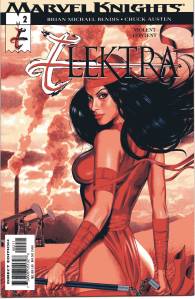
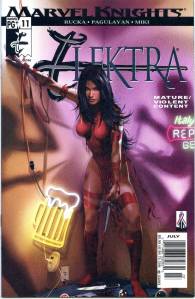
She was killed, but got over it. Now the enigmatic assassin named Elektra begins a new life! In the deadly world of international espionage, Elektra is a hot commodity ? and the top-secret organization known as S.H.I.E.L.D. wants her for a mission so dirty that no one else could even think of pulling it off! But Elektra can’t be bought, bribed or threatened. And if she takes the job, she’ll do it her way, no matter how many people may die!
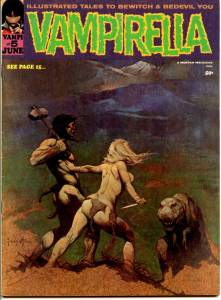
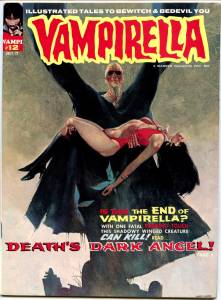
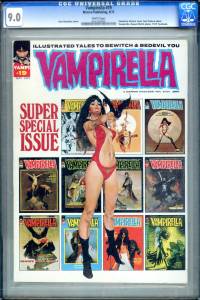
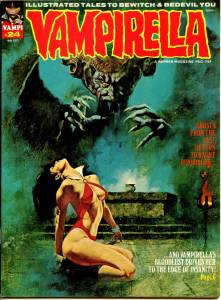
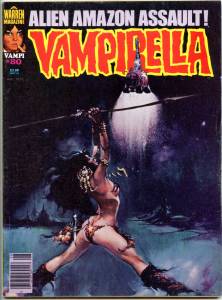
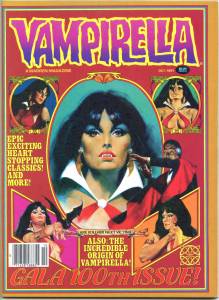
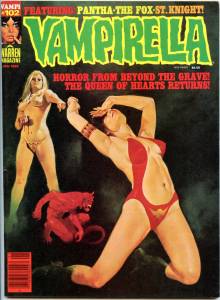
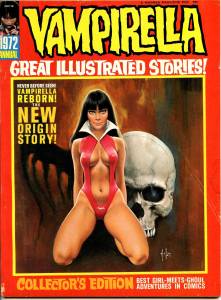
Vampirella is a vampire superheroine created by Forrest J Ackerman and costume designer Trina Robbins in Warren Publishing‘s black-and-white horror comics magazine Vampirella #1 (Sept. 1969). Writer-editor Archie Goodwin later developed the character from horror-story hostess, in which capacity she remained through issue #8 (Nov. 1970), to a horror-drama leading character. Vampirella was ranked 35th in Comics Buyer’s Guide‘s “100 Sexiest Women in Comics” list.
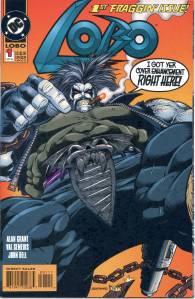
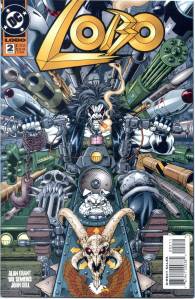
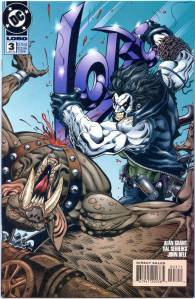
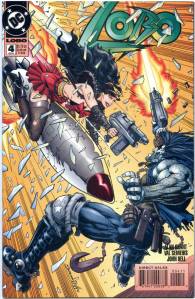
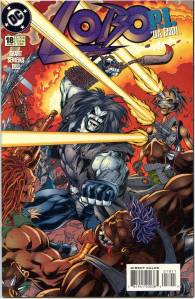
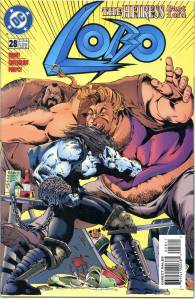
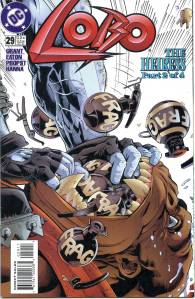
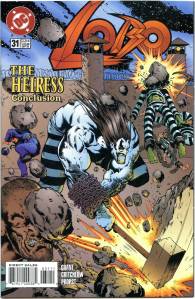
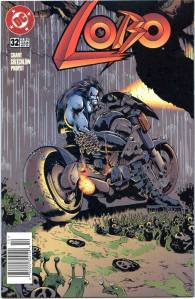
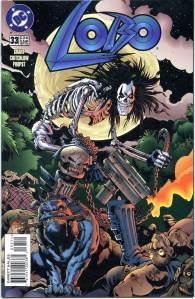
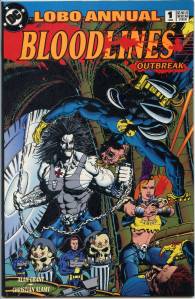
Lobo starred in his own DC title for 64 issues, from 1993 to 1999. Lobo was first introduced as a hardened villain in the 1980s, but soon fell out of use with writers. He remained in limbo until his revival as an anti-hero biker with his own comic in the early 1990s. Writers attempted to use Lobo as a parody of the 1990s trend towards “grim and gritty” superhero stories, epitomized by such Marvel Comics characters as Cable, Wolverine, and Punisher, but he was instead enthusiastically accepted by fans of the trend. This popularity led to the character having a much higher profile in DC Comics stories from then on, as well as starring roles in various series in the decades since.
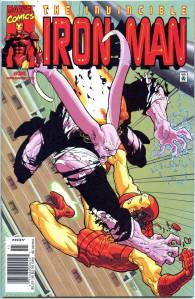
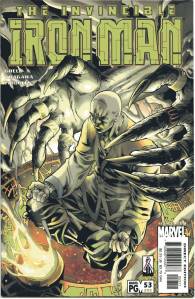
Volume 3, whose first 25 issues were written by Kurt Busiek and then by Busiek and Roger Stern, ran 89 issues (Feb. 1998 – Dec. 2004). Later writers included Joe Quesada, Frank Tieri, Mike Grell, and John Jackson Miller. Issue #41 (June 2001) was additionally numbered #386, reflecting the start of dual numbering starting from the premiere issue of volume one in 1968. The final issue was dual-numbered as #434.
Iron Man V3 #33 NM $4Iron man V3 #34 NM- $3Iron Man V3 #53 NM $4Iron Man V3 #58 NM- $3Iron Man V3 #66 NM $4
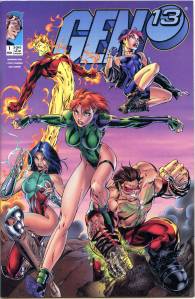
Gen 13 (Volume 2) was an ongoing series, published by WildStorm Productions. It ran from 1995 until 2002. Despite outrageous story arcs and many artist collaborations, the popularity of the book dwindled to the point where Wildstorm decided to blow up the entire team with a 6-megaton bomb (Gen¹³ vol. 2, #76, June 2002). This served as the catalyst to revamp the series with a new first issue written by Chris Claremont with pencils by Ale Garza.
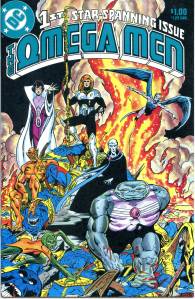
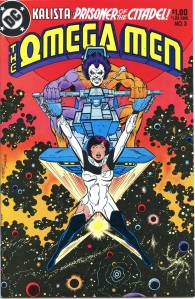
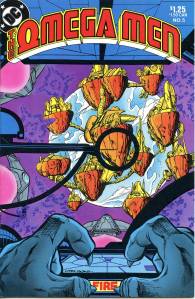
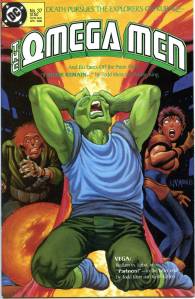
The Omega Men are a team of extraterrestrial superheroes who have appeared in various comic book series published by DC Comics. They first appeared in Green Lantern#141 (June 1981), and were created by Marv Wolfman and Joe Staton.
After appearances in Green Lantern, Action Comics and The New Teen Titans, the Omega Men were featured in their own comics series which ran for 38 issues from April 1983 to May 1986. During its run, writer Roger Slifer and artist Keith Giffen created the mercenary anti-hero Lobo.
The Omega Men were assembled as a group of renegades and representatives of conquered Vegan worlds to fight Citadelian aggression. Pre-Infinite Crisis the team was based on the planet Kuraq. The Omega Men are important peacekeepers in their sector because the Green Lantern Corps is not allowed into Vegan space, due to a long standing agreement with the Psions.
Omega Men #1 NM $4Omega Men V1 #1 VF-NM $3Omega Men #3 NM $120Omega Men #5 NM $9Omega Men #10 NM $14Omega Men #37 NM $14
After being elected New York City’s mayor due to his activities under the Darkforce Dome, Wilson Fisk has been quietly amassing both political power and an underground army of super villains. To test the effectiveness of his recruited villains, the Thunderbolts Units were dispatched against the Symbiote Invasion to a desired outcome. Now, with meticulous intelligence gathering and patient machinations, Fisk is ready to use his accumulated resources in order to finally rid his city of its costumed vigilante problem. Outlawing vigilantism to declare war on heroes from street level to even earth’s mightiest, Fisk will unleash even their own dark secrets against them. No hero is safe from Fisk bringing his vision of order to fruition.
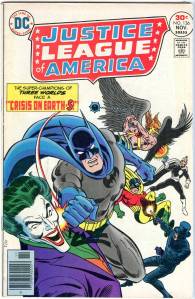
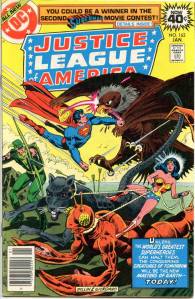
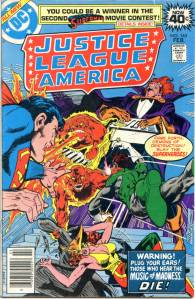
In need of a new secure headquarters, the Justice League moved into an orbiting satellite headquarters in Justice League of America #78 (February 1970). The Elongated Man, the Red Tornado, Hawkwoman, Zatanna, and Firestorm joined the team, and Wonder Woman returned during this period.
Len Wein wrote issues #100–114, in which he and Dillin re-introduced the Seven Soldiers of Victory in issues #100-102 and the Freedom Fighters in issues #107-108. In the fall of 1972, Wein and writers Gerry Conway and Steve Englehart crafted a metafiction an unofficial crossover spanning titles from both Marvel and DC. Each comic featured Englehart, Conway, and Wein, as well as Wein’s first wife Glynis, interacting with Marvel or DC characters at the Rutland Halloween Parade in Rutland, Vermont.
Beginning in Amazing Adventures #16 (by Englehart with art by Bob Brown and Frank McLaughlin), the story continued in Justice League of America #103 (by Wein, Dillin and Dick Giordano), and concluded in Thor #207 (by Conway and penciler John Buscema). As Englehart explained in 2010, “It certainly seemed like a radical concept and we knew that we had to be subtle (laughs) and each story had to stand on its own, but we really worked it out. It’s really worthwhile to read those stories back to back to back — it didn’t matter to us that one was at DC and two were at Marvel — I think it was us being creative, thinking what would be really cool to do.” Justice League of America #103 also featured the Justice League offering membership to the Phantom Stranger. Len Wein commented on the Phantom Stranger’s relationship with the JLA in a 2012 interview stating that the character “only sort of joined. He was offered membership but vanished, as per usual, without actually accepting the offer. Over the years, other writers have just assumed [he] was a member, but in my world, he never really said yes.” Libra, a supervillain created by Wein and Dillin in Justice League of America #111 (May–June 1974), would play a leading role in Grant Morrison‘s Final Crisisstoryline in 2008.
Justice League of America #84 VG+ $7Justice League of America #115 VG-FN $10Justice League of America V1 #131 F $7Justice League of America #134 VF+ $18Justice League of America V1 #136 VF- $19Justice League of America #140 VF $9Justice League of America V1 #161 VF+ $14Justice League of America V1 #162 FN+ $5Justice League of America V1 #163 FN+ $5Justice League of America V1 #164 FN-VF $6Justice League of America V1 #165 F-VF $5Justice League of America #171 VF- $6
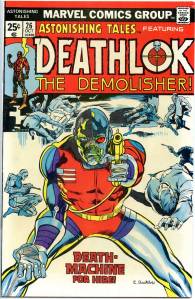
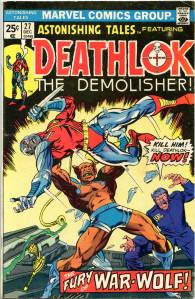
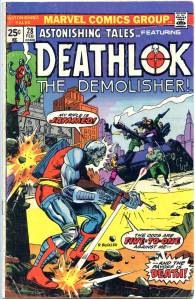
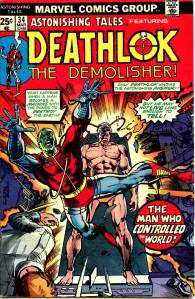
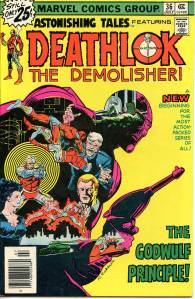
The final feature in Astonishing Tales starred and introduced Deathlok, a conflicted cyborg who predated the popular movie character RoboCop by several years and has become one of the most enduring Marvel characters among those introduced in the 1970s; at least two major iterations of the character, featuring different individuals, starred in series in the 1990s and 2000s. Created by artist Rich Buckler, who devised the initial concept, and writer Doug Moench, the feature ran from #25-28 and 30-36 (Aug. 1974 – Feb. 1975 and June 1975 – July 1976), the final issue. Bill Mantlo scripted issues #32-35, with Buckler himself scripting the finale. Buckler described Deathlok as “an extension of a paranoid fantasy. He was a representation of part of my outlook and world view. He was a culmination of many of the messages in some of the music of the time. He was part of some of the things going wrong in our country at the time. Maybe he was the science that was going wrong.Artist George Pérez made his professional comics debut with a two-page backup feature in issue #25.