Moon Knight vol. 5, was launched in April 2006, written by Charlie Huston with art by David Finch. The series revises Marc Spector’s history by saying he fought in the Gulf War. Starting with issue #14 of this series, Mike Benson took over writing duties while Huston acted as a story/plot adviser according to Benson. The 2006 series ended with #30 (July 2009), and only one Annual issue for the series was printed in 2008. Peter Milligan wrote a 2008 seasonal one-shot titled Moon Knight: Silent Knight with artist Laurence Campbell.
Author: EHT Comics
Saga (2012)
Writer Brian K. Vaughan conceived Saga in his childhood, calling it “a fictional universe that I created when I was bored in math class. I just kept building it.” He was inspired by such influences as Star Wars,Flash Gordon and children’s books, and has also invoked the awe and wonder of first seeing the Silver Surfer, which seemed an “incredible and different” concept to him. It was not until his wife became pregnant with his second daughter, however, that he conceived of the protagonists, the winged Alana and the horned Marko, two lovers from warring extraterrestrial races who struggle to survive with their newborn daughter, Hazel, who occasionally narrates the series. It was also at this point that the central theme that Vaughan wanted for the book emerged. Vaughan explains, “I wanted to write about parenthood, but I wanted to Trojan-horse it inside some sort of interesting genre story, to explore the overlap between artistic creation and the creation of a child.”] Vaughan, who intended to return to writing a comics series following the 2010 conclusion of his previous series, Ex Machina, and who notes that the publication of Saga #1 coincided with the birth of his daughter, saw parallels between the caution advised by colleagues against launching a new book in the poor economy and those who cautioned against bringing a new child into the world.
Adventures of Superman (1986)
When the series was relaunched in late 1986 under its new title, the creative team initially was writer Marv Wolfman and artist Jerry Ordway. John Byrne replaced Wolfman with issue #436 (January 1988) and Ordway became both writer and artist with issue #445 (October 1988). Writer/artist Dan Jurgens worked on the title from 1989–1991. Hank Henshaw, a character who would later become the Cyborg Superman, first appeared in issue #466 (May 1990). By the late 1980s, the plots of the Superman books were often linked. To coordinate the storyline and sequence of event, from January 1991 to January 2002, “triangle numbers” (or “shield numbers”) appeared on the cover of each Superman comic book. During these years, the Superman storylines ran with the story continuing through the titles Superman, Action Comics and later in two further series, Superman: The Man of Steel and Superman: The Man of Tomorrow.
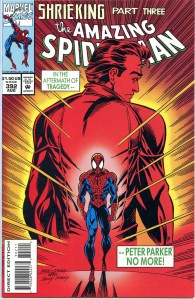
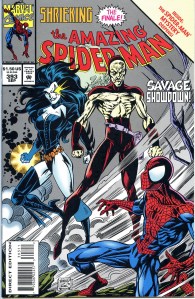
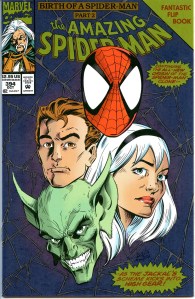
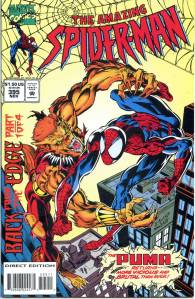
Amazing Spider-Man (Silver Age)
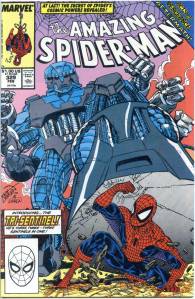
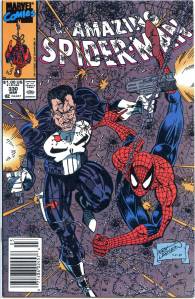
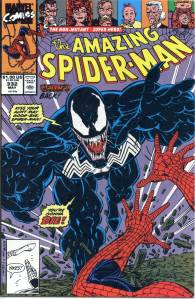
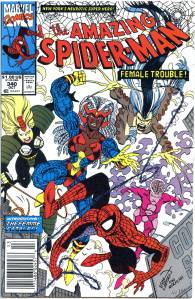
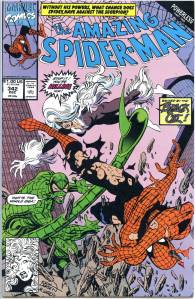
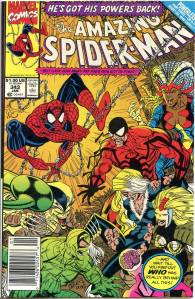
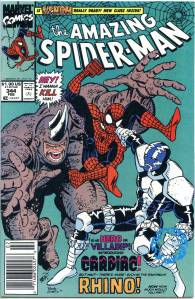
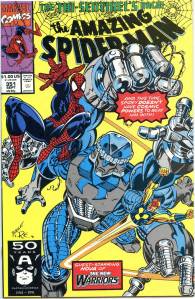
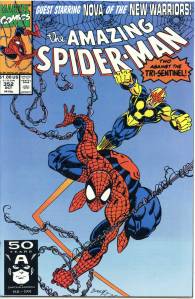
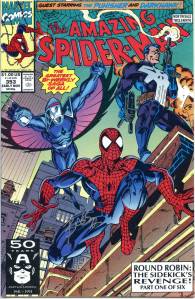
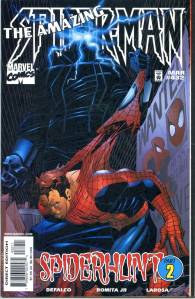
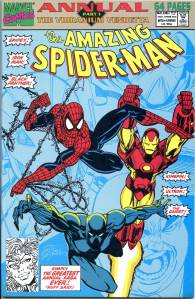
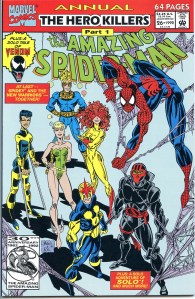
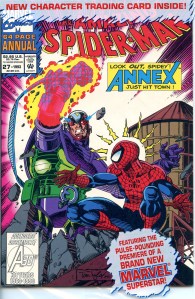
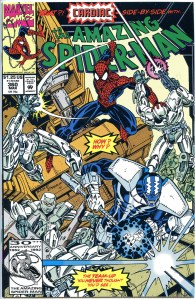
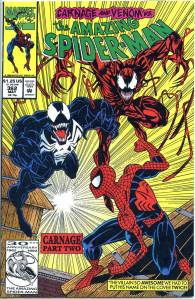
Due to strong sales on the character’s first appearance in Amazing Fantasy #15, Spider-Man was given his own ongoing series in March 1963. The initial years of the series, under Lee and Ditko, chronicled Spider-Man’s nascent career with his civilian life as hard-luck yet perpetually good-humored teenager Peter Parker. Peter balanced his career as Spider-Man with his job as a freelance photographer for The Daily Bugle under the bombastic editor-publisher J. Jonah Jameson to support himself and his frail Aunt May. At the same time, Peter dealt with public hostility towards Spider-Man and the antagonism of his classmates Flash Thompson and Liz Allan at Midtown High School, while embarking on a tentative, ill-fated romance with Jameson’s secretary, Betty Brant.
By focusing on Parker’s everyday problems, Lee and Ditko created a groundbreakingly flawed, self-doubting superhero, and the first major teenaged superhero to be a protagonist and not a sidekick. Ditko’s quirky art provided a stark contrast to the more cleanly dynamic stylings of Marvel’s most prominent artist, Jack Kirby, and combined with the humor and pathos of Lee’s writing to lay the foundation for what became an enduring mythos.
Duckman V1 1 (1990)
Story and art by Everett Peck. He’s been up–he’s been down–he’s fallen asleep with the TV on! New, hot from this previous engagement in Dark Horse Presents, the tough duck private dick, stars in his first feature length special. The story wouldn’t be complete without Cornfed, Fluffy, and Uranus hanging around waiting for the next dose of abuse from their feathered “friend.”
Lobo V2 (1993)
Lobo starred in his own DC title for 64 issues, from 1993 to 1999. Lobo was first introduced as a hardened villain in the 1980s, but soon fell out of use with writers. He remained in limbo until his revival as an anti-hero biker with his own comic in the early 1990s. Writers attempted to use Lobo as a parody of the 1990s trend towards “grim and gritty” superhero stories, epitomized by such Marvel Comics characters as Cable, Wolverine, and Punisher, but he was instead enthusiastically accepted by fans of the trend. This popularity led to the character having a much higher profile in DC Comics stories from then on, as well as starring roles in various series in the decades since.
Uncanny X-Men (1980’s)
The “Dark Phoenix Saga” in 1980 led to a change in the line-up of the team, with the death of Phoenix (Jean Grey), and Cyclops leaving the team to mourn for her. Comics writers and historians Roy Thomas and Peter Sanderson observed that “‘The Dark Phoenix Saga’ is to Claremont and Byrne what ‘the Galactus Trilogy‘ is to Stan Lee and Jack Kirby. It is a landmark in Marvel history, showcasing its creators’ work at the height of their abilities.” The storyline also saw the introduction of recurring antagonists the Hellfire Club, and its Inner Circle consisting of Sebastian Shaw, Emma Frost, Harry Leland, Donald Pierce, along with Mastermind, previously a member of Magneto’s Brotherhood. The new teenage mutant Kitty Pryde was introduced in #129 (Jan. 1980) and joined the X-Men in #139. The Dazzler, a disco-singing, roller-skating mutant, was introduced in #130 (Feb. 1980), but did not join the team, instead headlining her own solo title.
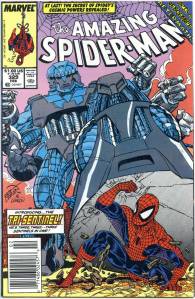
A new Brotherhood of Evil Mutants, led by Mystique, was introduced in the “Days of Future Past” storyline (#141-#142, Jan–Feb 1981) in which a time-travelling Kitty Pryde tried to avert a dystopian future caused by the Brotherhood assassinating Presidential candidate Senator Robert Kelly. Byrne plotted the story wanting to depict the Sentinels as a genuine threat to the existence of the mutant race. He then left the series after #143, being replaced by a returning Cockrum, who in turn was succeeded by Paul Smith and John Romita Jr.
Fear and Loathing in Las Vegas (2016)
“What were we doing out here…? What was the meaning of this trip? Did I actually have a big red convertible out there on the street? Was I just roaming around these Mint Hotel escalators in a drug frenzy of some kind, or had I really come out here to Las Vegas to work on a story?” — Hunter S. Thompson, Fear and Loathing in Las Vegas
Aquaman (Silver Age)
Aquaman, published by DC Comics was created by Paul Norris and Mort Weisinger. The character debuted in More Fun Comics #73 (November 1941). Initially a backup feature in DC’s anthology titles, Aquaman later starred in several volumes of a solo title. During the late 1950s and 1960s superhero-revival period known as the Silver Age, he was a founding member of the Justice League of America. In the 1990s Modern Age, Aquaman’s character became more serious than in most previous interpretations, with storylines depicting the weight of his role as king of Atlantis.
Later accounts reconciled both facets of the character, casting Aquaman as serious and brooding, saddled with an ill reputation, and struggling to find a true role and purpose beyond his public side as a deposed king and a fallen hero.
Captain America V9 (2018)
IT IS WINTER IN AMERICA. For over 70 years, he has stood in stalwart defense of our country and its people. But in the aftermath of Hydra’s takeover of the nation, Captain America is a figure of controversy, carrying a tarnished shield…and a new enemy is rising! Who are the Power Elite? And how do they intend to co-opt and corrupt the symbol that is Captain America?