DC Super-Stars (1976)

The tagline “The Line of DC Super-Stars” was used as a brand emblem on comic books published by DC Comics beginning in December 1973 and ending January 1977. The DC Super Stars series began with a March 1976 cover date. A recurring feature of the title’s early run was “DC Super-Stars of Space”, special issues reprinting Silver Age science-fiction stories starring such characters as Adam StrangeHawkman, the Atomic KnightsSpace CabbieCaptain CometTommy Tomorrow, the Star Rovers, and Space Ranger.

The series’ middle period was marked by theme issues — Aquaman, heroes with guns, sports, magic-users — until issue #12, which heralded the title’s second original story, featuring SuperboyFrom that point until DC Super Stars was cancelled after issue #18, the series contained new stories about a range of different characters (some being showcased for their own titles), as well as a collection of “secret origin” stories. The Bronze Age Huntress made her first appearance in DC Super Stars #17 (November/December 1977) in a story written by Paul Levitz and drawn by Joe Staton and Bob Layton.

Marvel Knights: Spider-Man (2000’s)

The underlying difference between this title and the other Spider-Man titles was that Marvel Knights Spider-Man was done with a more mature slant (in style if not content), thus the “Marvel Knights” prefix.

Intended to replace the canceled Spider-Man’s Tangled Web series, Marvel Knights Spider-Man was originally supposed to be written by Kevin Smith, but due to scheduling problems he was replaced by Mark Millar. When Millar completed his year-long story arc, he was followed by writer Reginald Hudlin.
With the consolidation of the Marvel Knights line, Marvel Knights Spider-Man was renamed The Sensational Spider-Man as of issue 23. At this time, Roberto Aguirre-Sacasa took over writing duties on the book.

Aliens: Earth Angel (1994)

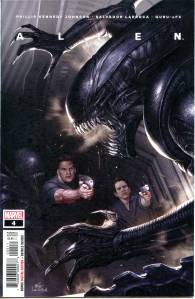
Into the age of diners, black leather jackets, and Buddy Holly comes a monster worse than any that ever made popcorn fly in front of a drive-in screen — the Alien. Legend creator John Byrne has long been a fan of the Aliens films and he jumped at the opportunity to tell his story of the first Alien invasion, the one that took place in 1950’s suburban America! When you Byrne an Alien, you gotta figure it’s gonna give off some heat!
Detective Comics (1990’s)

Chuck Dixon became the writer of the series with issue #644 (May 1992). He and Tom Lyle co-created the Electrocutioner in Detective Comics #644 (May 1992) and Stephanie Brown in Detective Comics #647 (August 1992).
The “Batman: Legacy” storyline began in issue #700 (August 1996). The “No Man’s Land” storyline crossed over into Detective Comics in issues #730–741.

Silver Surfer V1 (1968)

The Silver Surfer debuted as an unplanned addition to Fantastic Four #48 (March 1966). The comic’s writer-editor, Stan Lee, and its penciller and co-plotter, Jack Kirby, had by the mid-1960s developed a collaborative technique known as the “Marvel Method“: the two would discuss story ideas, Kirby would work from a brief synopsis to draw the individual scenes and plot details, and Lee would finally add the dialog and captions. When Kirby turned in his pencil art for the story, he included a new character he and Lee had not discussed. As Lee recalled in 1995, “There, in the middle of the story we had so carefully worked out, was a nut on some sort of flying surfboard”. He later expanded on this, recalling, “I thought, ‘Jack, this time you’ve gone too far'”. Kirby explained that the story’s agreed-upon antagonist, a god-like cosmic predator of planets named Galactus, should have some sort of herald, and that he created the surfboard “because I’m tired of drawing spaceships!” Taken by the noble features of the new character, who turned on his master to help defend Earth, Lee overcame his initial skepticism and began adding characterization. The Silver Surfer soon became a key part of the unfolding story.
Hate (1990)

Hate is a comic book by writer-artist Peter Bagge. First published by Fantagraphics in 1990 it ran for 30 issues, and was one of the best-selling alternative comics of the 1990s, at its height selling 30,000 copies an issue. In 2000 Bagge revived the series in Hate Annual, a yearly comic that continues the story after Hate in short stories, and includes writings on libertarianism, culture, and topical cartoons.

Hate follows the life of Buddy Bradley, in a continuation of events from Bagge’s strip “The Bradleys” from former publications Neat Stuff. It is set for the first half in Seattle and later in suburban New Jersey. Buddy has to deal with the end of adolescence, reluctantly growing up, his relationships with a host of unpleasant acquaintances he has to class as friends, working in dead-end jobs and having no direction in life. Bagge used memories of events from his own life as material.

Justice League (1987)

The 1986 company-wide crossover “Legends” concluded with the formation of a new Justice League. The new team was dubbed “Justice League” then “Justice League International” (JLI) and was given a mandate with less of an American focus. The new series, written by Keith Giffen and J. M. DeMatteis with art by Kevin Maguire (and later Adam Hughes), added quirky humor to the team’s stories. In this incarnation, the membership consisted partly of heroes from Earths that, prior to their merging in the Crisis on Infinite Earths, were separate. The Giffen/DeMatteis team worked on Justice League for five years and closed out their run with the “Breakdowns” storyline in 1991 and 1992. The series’ humorous tone and high level of characterization proved very popular.

Wolverine – Mini Series (1982)

The first Wolverine series was a limited series written by Chris Claremont with pencils by Frank Miller, inks by Joe Rubinstein, letters by Tom Orzechowski, and colors by Glynis WeinMarvel Comics published the series from September to December 1982. This story arc covers the events leading up to Wolverine’s engagement to Mariko Yashida.

G.I. Joe V2 (2001)

In July 2001, Devil’s Due acquired the rights to G.I. Joe, and released a four-issue limited series through Image Comics, written by Josh Blaylock with John Larter and Steve Kurth as the artists. The title quickly became known to the fans as A Real American Hero vol. 2 (following from Marvel’s original series), or G.I. Joe Reinstated (the title of the first four-issue arc). Strong sales on the limited series led to it being upgraded to an ongoing series, with the publication of a fifth issue and a monthly schedule.

Ghost Rider 2099 (1994)

The series is set in the year 2099, in a dystopian possible future of the Marvel Universe, and features Kenshiro “Zero” Cochrane, a hacker who was killed but resurrected as the Ghost Rider — his mind controlling a powerful and well-armed robot. As with most of the Marvel 2099 titles, the protagonist was a futuristic version of a commercially successful Marvel Universe character. The series was heavily influenced by cyberpunk science fiction.