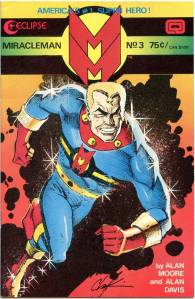
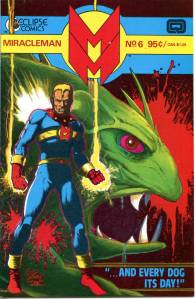
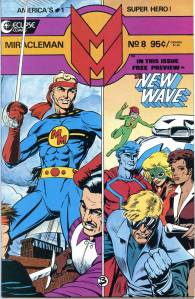
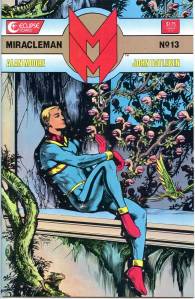
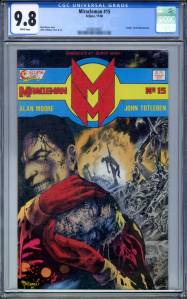
Doomsday Clock is part of the DC Rebirth initiative, and it continues the narrative that was established with the 2016 one-shot DC Universe: Rebirth Special, the 2017 crossover event “The Button” and other related stories. It is a follow-up to the 1986–1987 miniseries Watchmen by Alan Moore, Dave Gibbons and John Higgins, and it introduces that story’s characters into the DC Universe, alongside a few original characters created for the book. Although Dan DiDio (then DC’s co-publisher) confirmed that it is a sequel to that miniseries, Johns originally declined to characterize it as such, viewing it as a standalone story, saying, “It is something else. It is Watchmen colliding with the DC Universe.”
In 2008, a new Deadpoolongoing series written by Daniel Way with artist Paco Medina began as a Secret Invasion tie-in. In the first arc, the character is seen working with Nick Fury to steal data on how to kill the Skrull queen Veranke. Norman Osborn steals the information that Deadpool had stolen from the Skrulls, and subsequent stories deal with the fallout from that. Writer Daniel Way explained, “the first thing Osborn does to try and take care of the situation is to bring in a hired gun to take Deadpool down, which would be Tiger-Shark. That would be the standard thing to do, but of course everything about Deadpool is non-standard. So it goes completely awry and Norman has to get more serious about things.” The story also sees the return of Bob, Agent of HYDRA; “I don’t want the book to become ‘Deadpool and Friends’ so characters will drift in and out, but Bob was someone I definitely wanted to bring in. It just had to be at the perfect moment and when I was putting this storyline together that moment presented itself.”
The next regular writer after James Tynion IV was Peter Tomasi who began on the series with issue #994, published December 2018. Tomasi’s run as writer continued for two years until issue #1033, published December 2020.
On March 27, 2019, DC Comics released the series’ 1,000th issue, marking the second American comic book in history to reach that milestone after Action Comics in 2018. The issue, which coincided with Batman’s 80th anniversary, is an anthology featuring several stories from a variety of different creative teams.
Writer Mariko Tamaki began on the series with issue #1034 as part of the Infinite Frontier line-wide relaunch. In April 2022, it was announced that Ram V and Rafael Albuquerque would serve as the new creative team starting with issue #1062.
After Claremont’s run, the X-Men were divided into two color-coded squads, with a Blue team headlining the adjectiveless X-Men title, while the Gold team, consisting of Archangel, Colossus, Jean Grey, Iceman and Storm, appeared in Uncanny. This roster was later joined by Bishop, another refugee from the future.After Claremont’s departure, Jim Lee continued as plotter, while John Byrne scripted from #281 to #286. Byrne was replaced as scripter from #286 by Scott Lobdell, who was fully credited as writer from #289. The “X-Cutioner’s Song” crossover was released in the fall of 1992 and resulted in the outbreak of the Legacy virus, a mutant-specific plague which continued as a story element in X-Men comics until 2001.
The 1986 company-wide crossover “Legends” concluded with the formation of a new Justice League. The new team was dubbed “Justice League” then “Justice League International” (JLI) and was given a mandate with less of an American focus. The new series, written by Keith Giffen and J. M. DeMatteis with art by Kevin Maguire (and later Adam Hughes), added quirky humor to the team’s stories. In this incarnation, the membership consisted partly of heroes from Earths that, prior to their merging in the Crisis on Infinite Earths, were separate. The Giffen/DeMatteis team worked on Justice League for five years and closed out their run with the “Breakdowns” storyline in 1991 and 1992. The series’ humorous tone and high level of characterization proved very popular.
Justice League #0 NM- $3Justice League #1 VF+ $8Justice League #2 NM- $5Justice League #2 VF+ $3Justice League #3 NM $6Justice League #5 VF+ $4Justice League #6 VF+ $3Justice League #9 NM- $3Justice League #10 NM $4Justice League #11 NM $4Justice League #12 NM $4Justice League #13 NM $4Justice League #16 NM $4Justice League #17 NM- $3Justice League #18 NM $26Justice League #19 NM $14Justice League #20 NM $9Justice League #21 NM $6Justice League #22 NM $4Justice League #23 NM $4Justice League #24 NM $4Justice League #25 NM $4Justice League #26 NM $4Justice League #27 NM $4Justice League #28 NM $4Justice League #29 NM $4Justice League #30 NM- $3Justice League #31 NM $9Justice League #32 NM $5Justice League #33 NM $4Justice League #34 NM $6Justice League #35 NM $4Justice League #36 NM $4Justice League #37 NM $4Justice League #38 NM $4Justice League #39 NM $4Justice League #40 NM $5Justice League #41 NM $4Justice League #42 NM $4Justice League #43 NM $4Justice League #47 NM $4Justice League #48 NM $4Justice League #49 NM $4Justice League #50 NM $4Justice League #51 NM- $3Justice League #52 NM- $3Justice League #53 NM $4Justice League #54 NM $4Justice League #56 NM $5Justice League #57 NM $4Justice League #59 NM $4Justice League #60 NM $4Justice League #61 NM $5Justice League #62 NM $4Justice League #63 NM $4Justice League #64 NM $4Justice League #65 NM $4Justice League #66 NM $4Justice League #67 NM $4Justice League #69 NM $9Justice League #70 NM $4Justice League #71 NM $3Justice League #73 NM $4Justice League #75 NM $4Justice League #76 NM $5Justice League #77 NM- $4Justice League #79 NM $4Justice League #80 NM $4Justice League #81 NM $4Justice League #84 NM $4Justice League America #85 NM $4Justice League America #87 NM $4Justice League #89 NM $4Justice League America #90 NM $4Justice League #92 NM $3Justice League America #93 NM $5Justice League America #94 NM $4Justice League America #95 NM $4Justice League Annual #5 NM $4Justice League Annual #6 NM $4Justice League Annual #7 NM $4
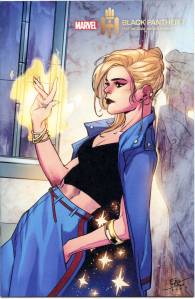
A new Sorcerer Supreme rises! Doctor Strange is dead! And a new Sorcerer Supreme has taken the title, or should we say Sorceress? Haunted by her recently returned memories, Clea longs to bring Stephen Strange back from the dead! But when a mysterious group attacks the magical realm, Clea must rise to the duties of Sorcerer Supreme. For she is now the sole protector of Earth against magical threats.
A notable difference from the comic version is that Becky survives the final gunfight by hiding in a nook in the alley, leaving her alive for the final “epilogue” scene of the movie which ends when she meets The Salesman from The Customer is Always Right, who had been introduced in the movie’s prologue. He then offers her a cigarette just like he did in The Customer is Always Right, and Becky seems to sense why he’s there and tells her mother she loves her before hanging up.
Sin City TBFK #1 NM $8Sin City TBFK #2 NM $6Sin City TBFK #3 NM $6Sin City TBFK #4 NM $6Sin City TBFK #5 NM $6
The Law comes to DC Comics! Judge Dredd storms North America in all-new, all-different adventures. In the post-apocalyptic future world of Mega-City One, where crime and corruption are rampant, the pseudo-militaristic Judges are the only true force for order in a world of seething anarchy. And the most uncompromising of these 21st-century law men is Judge Dredd, a man who lives by the law – and the gun – as he redefines crime and punishment in the not-too-distant future.
“Infinite Crisis” is a 2005–2006 comic book storyline published by DC Comics, consisting of an eponymous, seven-issue comic booklimited series written by Geoff Johns and illustrated by Phil Jimenez, George Pérez, Ivan Reis, and Jerry Ordway, and a number of tie-in books. The main miniseries debuted in October 2005, and each issue was released with two variant covers: one by Pérez, and one by Jim Lee and Sandra Hope.
The series storyline was a sequel to DC’s 1985 limited series Crisis on Infinite Earths, which “rebooted” much of the DC continuity in an effort to fix 50 years of contradictory character history. It revisited characters and concepts from that earlier Crisis, including the existence of DC’s Multiverse. Some of the characters featured were alternate versions of comic icons such as an alternate Superman named Kal-L, who came from a parallel universe called Earth-Two. A major theme was the nature of heroism, contrasting the often dark and conflicted modern-day heroes with memories of “lighter” and ostensibly more noble and collegial heroes of American comic books’ earlier days.