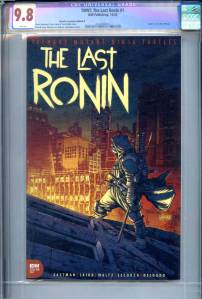
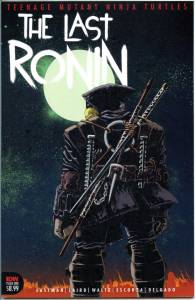
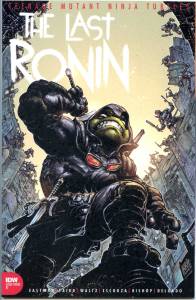
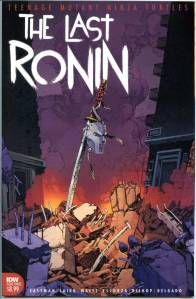
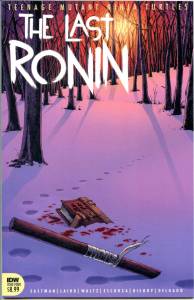
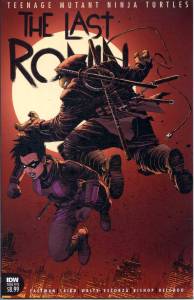
In a future NYC far different than the one we know today, a lone surviving Turtle goes on a seemingly hopeless mission to obtain justice for his fallen family and friends. Kinetic layouts from Eastman, moody inks from Andy Kuhn and a thrilling script full of surprises from longtime TMNT scribe Tom Waltz all combine to make this one of the most memorable TMNT stories you will ever read! This is a perennial TMNT tale that can’t be missed!
The Last Ronin #1 1:25 Retailer Variant CGC 9.8 White Pages $139
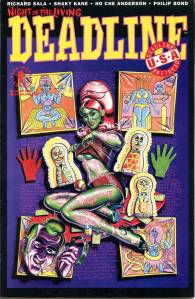
You’ve seen him on MTVs Liquid Television–Richard Sala continues his all-new, ultraterrifying 13 O’clock! He’s harder than hard-boiled, he’s Johnny Nemo by the ultrascientific Peter Milligan and Brett Ewins! It’s sex, it’s rock n’ roll, but is it drugs? It’s Doe, the latest graphic vortex from Harvey Award ultranominee Ho Che Anderson! They play the game, God makes the rules! They’re the A-Men by the ultraconservative Shaky Kane! Plus work by Julie Hollings, Philip Bond, Alec Stevens, D’Israeli and never forget GWAR, puny human! And an ultraspecial music feature! And another ultraschizophrenic cover painting from the corkscrewed psyche of Mitch O’Connell!
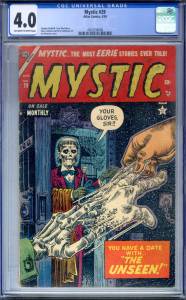
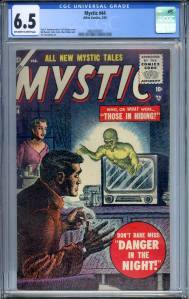
Titled simply Mystic and published by Marvel’s 1950s iteration, Atlas Comics, this was a 61-issue horror-suspense anthology (March 1951-Aug. 1957).
Mystic debuted shortly before Atlas’ Strange Tales, increasing the company’s science fiction/fantasy/horror line from four titles to six. Begun prior to the creation of the comic-book industry’s self-censorship board, the Comics Code Authority, Mystic softened its horror when it went under the auspices of the Comics Code beginning with issue #37 (May 1955). The series’ contributors included artists Bill Everett and John Severin.
Mystic #29 CGC 4.0 Off-White to White Pages $225
Mystic #44 CGC 6.5 Off-White to White Pages Blur $399
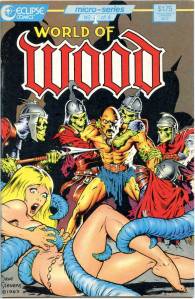
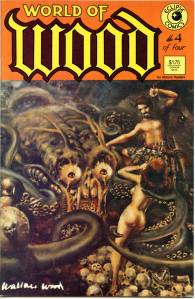
Color anthology reprint series of Wally Wood stories that included the following and more:
The Curse: Originally published in Vampirella Magazine #9 (Harris, 1971)
Overworked: Originally published in Eerie Magazine #131 (Warren, 1966)
The Misfits: Originally published in Heroes, Inc. Presents Cannon #1 (self published, 1969)
ME – 262!: Originally published in Blazing Combat #4 (Warren, 1966)
Prelude To Armageddon: Originally presented in Creepy #41 (Warren, 1971)
The Battle Of Britain!: Originally presented in Blazing Combat #3 (Warren, 1966)
The Manhunters: Originally presented in Eerie #60 (Warren, 1974)
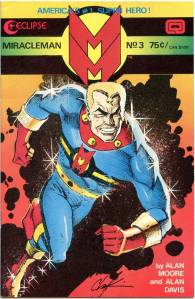
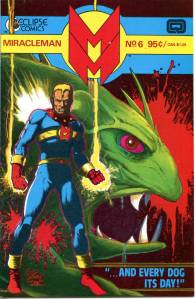
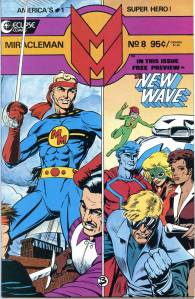
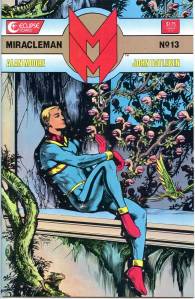
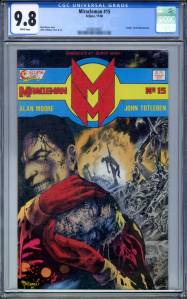
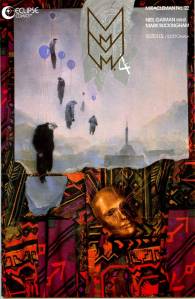
In August 1985, Eclipse began reprinting the Marvelman stories from Warrior, colored, and re-sized. They were renamed and re-lettered throughout as Miracleman to avoid further problems with Marvel Comics.Issues 1-6 reprinted all the Warrior content, after which Eclipse began publishing new Miracleman stories from Alan Moore and new artist Chuck Beckum (now better known as Chuck Austen), soon replaced by Rick Veitch and then John Totleben. Eclipse split the rights to the character, with 2/3 going to Eclipse and 1/3 split between the current writer and artist of the series. Moore wrote the series until issue 16.
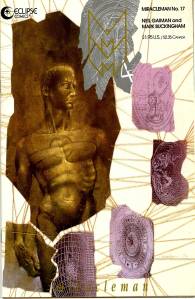
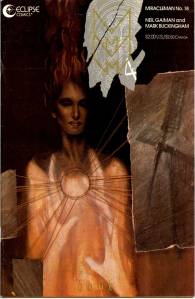
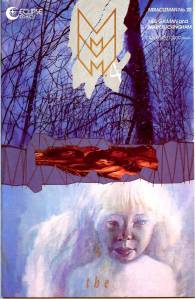
Writer Neil Gaiman picked up the series at #17 and developed it further in the 1990s, working with artist Mark Buckingham. He planned three books, consisting of six issues each; they would be titled “The Golden Age”, “The Silver Age” and “The Dark Age”.
Panic was a bi-monthly humor comic that was published by Bill Gaines‘ EC Comics line during the mid-1950s as a companion to Harvey Kurtzman‘s Mad, which was being heavily imitated by other comic publishers.
Panic was edited by Al Feldstein (who became the editor of Mad a few years later). Beginning with its first issue (February–March 1954), Panic had a 12-issue run over two years. Feldstein was the primary cover artist, with stories illustrated by Jack Davis, Will Elder, Jack Kamen, Joe Orlando, Basil Wolverton and Wally Wood. Some story ideas were by Nick Meglin, later the co-editor of Mad. Scripts were by Feldstein, Elder and Jack Mendelsohn, later a co-screenwriter of Yellow Submarine (1968) and an Emmy-nominated TV comedy writer.
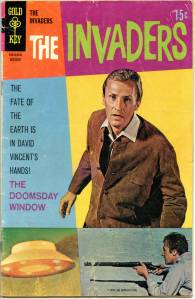
Comic book version of the 1960s TV series about one man’s crusade to convince people that an advance guard of alien creatures had infiltrated the world’s population and were preparing to conquer Earth.
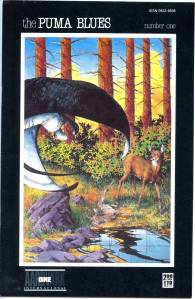
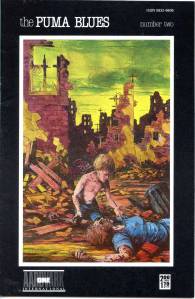
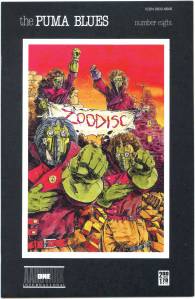
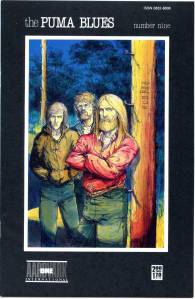
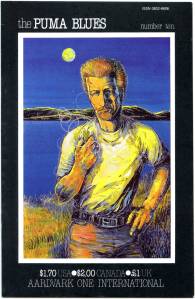
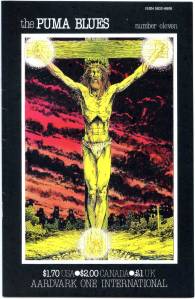
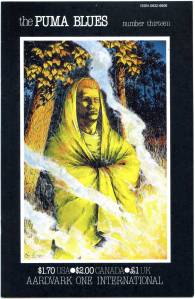
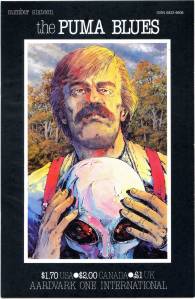
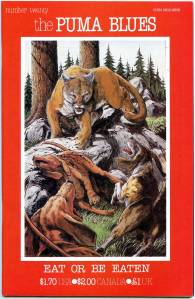
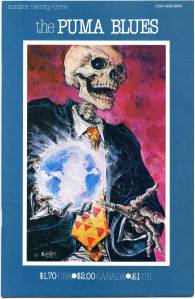
The comic book’s detailed artwork by Michael Zulli, which focused primarily on wildlife and nature, was superposed to a loose narrative with a druggy, dreamy, new age apocalyptic atmosphere. This de-structuralizing of the main narrative increased dramatically in later issues, with the second half of the series often taking the form of illustrated prose poetry within an associative narrative.
Murder Incorporated would’ve been an obvious title for a hard-hitting true-crime comic book in 1948. The real-life Murder Incorporated, the infamous hit squad of New York City organized crime had been shut down by the early 1940s, but their legend lived on in other media. This Fox Feature Syndicate series was true to its title as it featured true crime tales with a focus on mob killers and other notorious murderers. Murder Incorporated‘s notoriety was such that the series was mentioned by both Fredric Wertham in Seduction of the Innocent, and Geoffrey Wagner in Parade of Pleasure, and it landed on countless municipal government ban lists around the country in 1948, along with much of the rest of Victor Fox’s comic book line. An interesting series in the context of both comic book history and from a true-crime perspective.
Murder Incorporated #1 CGC 4.0 Off-White to White pages $495
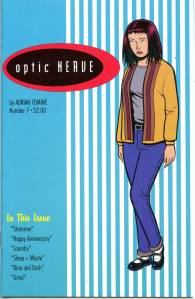
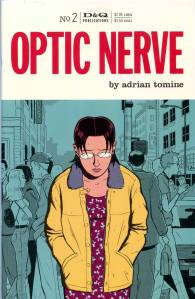
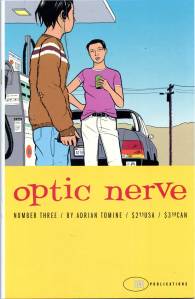
Tomine’s style and subject matter are restrained and realistic. Many are set in Northern California. Many of his stories for Optic Nerve feature Asian American characters, including “Hawaiian Getaway,” “Six-Day Cold,” “Layover,” and “Shortcomings.” Adrian Tomine is Asian American and lives in Brooklyn, New York. Many topics of his stories are at least partly autobiographical.
In the initial self-published issues, as well as the first eight Drawn & Quarterly issues (1995-2001), Optic Nerve was typically a collection of short stories. After an extended hiatus, Tomine resumed the comic in fall of 2004 and began his first multi-issue storyline, “Shortcomings,” with #9. The most recent issue, #13, was published in July 2013.






















 EHT Comics