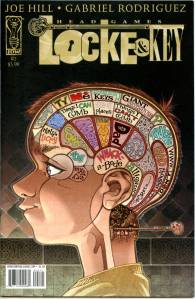
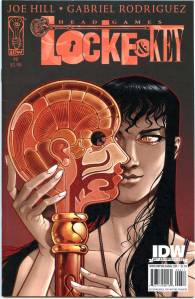
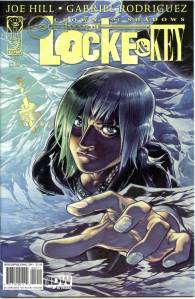
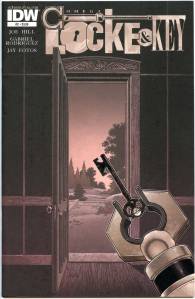
Following their father’s gruesome murder in a violent home invasion, the Locke children return to his childhood home of Keyhouse in secluded Lovecraft, Massachusetts. Their mother, Nina, is too trapped in her grief—and a wine bottle—to notice that all in Keyhouse is not what it seems: too many locked doors, too many unanswered questions. Older kids Tyler and Kinsey aren’t much better. But not youngest son Bode, who quickly finds a new friend living in an empty well and a new toy, a key, that offers hours of spirited entertainment. But again, all at Keyhouse is not what it seems, and not all doors are meant to be opened. Soon, horrors old and new, real and imagined, will come ravening after the Lockes and the secrets their family holds.
Tag: Independent
Marvel Tales – Atlas (1949)
The first Marvel Tales was the direct continuation of the superhero anthology Marvel Mystery Comics, published by Marvel Comics‘ initial iteration, Timely Comics. This series ran through issue #92 (cover-dated June 1949). Beginning with issue #93 (Aug. 1949), it became Marvel Tales, an anthology of horror, fantasy, and science fiction stories. The bulk of this series was published under the company name Atlas Comics.
Marvel Tales included among its contributors writer and editor-in-chief Stan Lee and such comics artists as Golden Age veterans Harry Anderson, Carl Burgos, Bill Everett, Fred Kida, Mike Sekowsky, Syd Shores, and Ogden Whitney, and, early in their careers, Dick Ayers, Gene Colan, Tony DiPreta, Mort Drucker, Russ Heath, Bernard Krigstein, Joe Maneely, Joe Sinnott, and Basil Wolverton, among others. Issue #147 featured one of Steve Ditko‘s first stories for Marvel, “The Vanishing Martians”. The series ran 67 issues under the new title, through #159 (Aug. 1957). It ended because of the collapse of Atlas’s distributor, American News Company, and the subsequent restructuring that limited the number of comics the company could publish in a month.
An issue of Marvel Tales was included in a display of covers representative of the “Crime, Horror & Weird Variety” at the April 1954 hearings of the United States Senate Subcommittee on Juvenile Delinquency.
Strangers in Paradise V3 (1996)
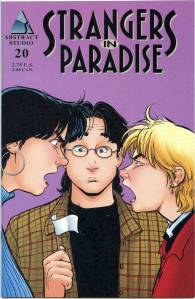
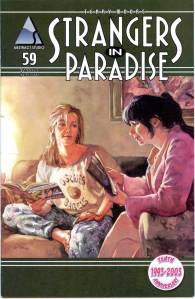
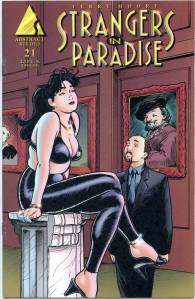
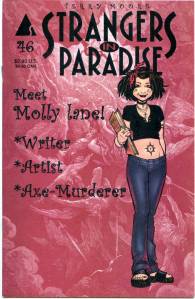
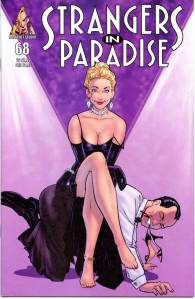
Strangers in Paradise is the entertaining and poignant look at the relationship of two young women and the twists and turns that life throws at them. Francine and Katchoo are high-school best friends who are reunited when Francine comes back to town after years away from her hometown. David is their new friend entangled in their complicated lives. From creepy ex-boyfriends and insensitive bosses to the reality of AIDS and underworld prostitution, you never know what will come up next – but you can always count on laughing and crying at the same time.
Coda (2018)
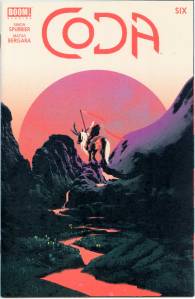
In the aftermath of an apocalypse which wiped out nearly all magic from a once-wondrous fantasy world, a former bard named Hum (a man of few words, so nicknamed because his standard reply is “hm”) seeks a way to save the soul of his wife with nothing but a foul-tempered mutant unicorn and his wits to protect him…but is unwillingly drawn into a brutal power struggle which will decide forever who rules the Weird Wasteland.
Dawn – The Return of the Goddess (1999)
With only two witches left, one of them takes her own life rather than fall prey to her enemies. With her dying breath, she summons Dawn, the Goddess of the earth, of birth and rebirth, and protector of the witches. Lucifer, prince of lies, and Ahura-Mazda, master of Heaven, may try to bar her path with treachery and swords, but neither Heaven nor Hell is safe from Dawn’s quest for answers – and for bloody vengeance.
Married… with Children (1990)
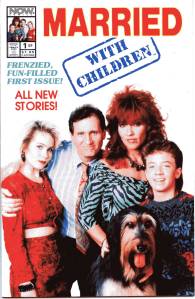
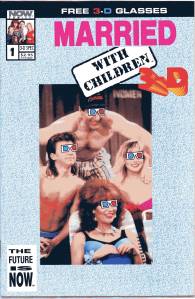
Married… with Children was adapted into a comic book series by NOW Comics starting in 1990. Featuring all the characters you know and love — Al Bundy, Peggy Bundy, Bud Bundy, Kelly Bundy, Snake Face, Greg Miller, Dean Keller and Suzy!
Archie’s Mad House (1959)
The first 18 issues featured the “Archie gang” in stories that were a bit more “off the wall” than the normal Archie series. The idea was to produce stories that made no sense. The title Mad House was written as two words instead of one to suggest a false connection to MAD Magazine and recapture its success. Beginning with issue 19, the Archie gang was dropped (though it was still called Archie’s Mad House), and the title began featuring monsters, space stories and other wacky short stories. The gags in the comics often parodied the latest fads and popular culture. For a time, it would focus on stories with what were intended to be one-off characters. There were, however, exceptions to this rule. Characters becoming popular enough would appear again.
Terminator – The Burning Earth (1990)
The story is set as part of the background history of John Connor‘s future war with the machines. It is also set after the events of the 17 part The Terminator (1988–1989) series also penned by Fortier. The story starts with members of the resistance fighting against the machines with John (nicknamed Bear) giving a commentary on how the war has been. Later he is seen having what could only be described as a loss of faith as he is shown putting a pistol to his mouth. However, after watching two lone fighters (one injured) firing on an oncoming Hunter Killer tank only to be run over, John regains his resolve to never stop and never give up.
E-Man (1983) First Comics
When Staton became art director at First Comics, the publisher acquired the rights to the character from Charlton and launched a series. Cuti was asked to write the title, but his obligations to DC Comics prevented him from accepting. The series was initially written by Martin Pasko, who had previously worked with Staton on Plastic Man and Metal Men. After Pasko’s run, Staton and Paul Kupperberg wrote the series until Cuti took over as writer with issue #24.
As a direct-market publisher not distributed to newsstands, the First series was not obligated to seek Comics Code Authority approval and could address more mature topics than Code-approved comics. Where the Charlton series featured broad whimsical themes, the First Comics series engaged in more specific satire directed at targets including the X-Men, Steven Spielberg, and Scientology.
The first 10 issues each contained a one-page parody of the Hostess snack advertisements that ran in comics through the 1970s and 1980s. These parodies were written and drawn by different creators and featured characters from across the independent comics industry.
Tales from the Crypt (1950)
Tales from the Crypt was an American bi-monthly horror comic anthology series published by EC Comics from 1950 to 1955, producing 27 issues (the first issue with the title was #20, previously having been International Comics (#1–5); International Crime Patrol (#6); Crime Patrol (#7–16) and The Crypt of Terror (#17–19) for a total of 46 issues in the series). Along with its sister titles, The Haunt of Fear and The Vault of Horror, Tales from the Crypt was popular, but in the late 1940s and early 1950s comic books came under attack from parents, clergymen, schoolteachers and others who believed the books contributed to illiteracy and juvenile delinquency. In April and June 1954, highly publicized congressional subcommittee hearings on the effects of comic books upon children left the industry shaken. With the subsequent imposition of a highly restrictive Comics Code, EC Comics publisher Bill Gaines cancelled Tales from the Crypt and its two companion horror titles, along with the company’s remaining crime and science fiction series in September 1954.