JSA (2000’s)

The JSA remained inactive for some time after the events of “Zero Hour“, but the surviving members (the Flash, Wildcat, and Alan Scott, (now going by the name Sentinel) have remained active throughout the DC Universe, having been placed as reserve JLI members, as evidenced in Justice League Europe #50.

The Justice Society was revived as a monthly series called JSA in 1999 which mixed the few remaining original members with younger counterparts. This incarnation of the team focused on the theme of generational legacy and of carrying on the heroic example established by their predecessors. The series was launched by James Robinson and David S. Goyer.  Goyer later co-wrote the series with Geoff Johns, who continued to write the series solo after Goyer’s departure. The series featured the art of Stephen SadowskiLeonard Kirk, and Don Kramer, among others. It featured a story by Pulitzer Prize winner Michael Chabon.

During the events of Infinite Crisis, some of the surviving Golden Age characters, such as Wildcat and the Flash, are transported to the new “Earth-Two”, as created by Alexander Luthor, and seem to recall the existence of the original one, albeit vaguely.


DK III: The Master Race (2015)

The series is a sequel to Miller’s 1986 Batman miniseries The Dark Knight Returns and the 2001 miniseries The Dark Knight Strikes Again, continuing the story of an aged Bruce Wayne resuming his identity as a crimefighter, aided by his sidekick Carrie Kelley (Robin) and featuring an ensemble of DC Universe characters including SupermanGreen Lantern, and Wonder Woman. In DK IIIRay Palmer restores the inhabitants of Kandor to full-size, but they immediately begin to terrorize the Earth. Batman sets out to assemble his former allies against the invaders.

The series is accompanied by a series of one-shots which fill in events between issues. They are written and drawn by Frank Miller, which continues his experimentation with noir-style writing and divisive art style.

Green Lantern V1 (1980’s)

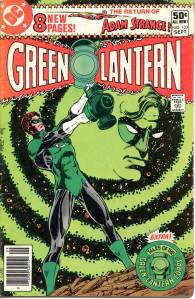
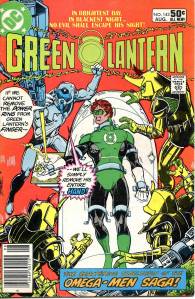
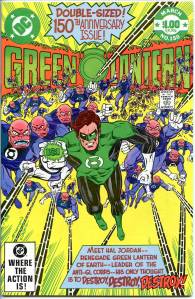
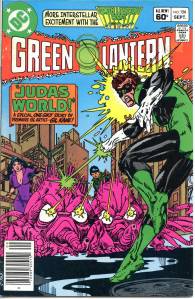
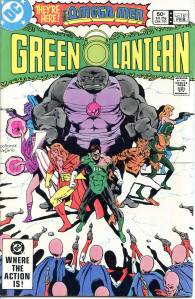
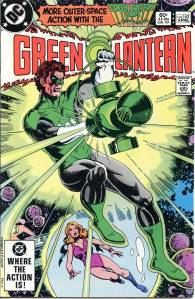
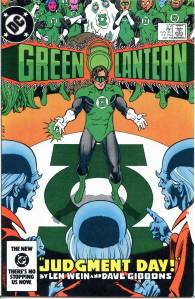
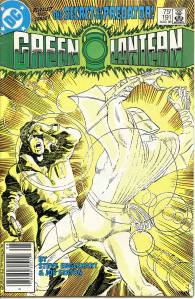
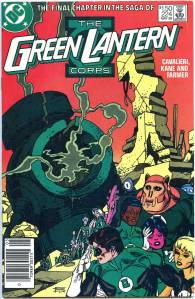
Green Lantern would know a number of revivals and cancellations. Its title would change to Green Lantern Corps at one point as the popularity rose and waned. During a time there were two regular titles, each with a Green Lantern, and a third member in the Justice League.

The Flash (1970’s)

In 1956, DC Comics successfully revived superheroes, ushering in what became known as the Silver Age of comic books. Rather than bringing back the same Golden Age heroes, DC rethought them as new characters for the modern age. The Flash was the first revival, in the aptly named tryout comic book Showcase #4 (Oct. 1956).

This new Flash was Barry Allen, a police scientist who gained super-speed when bathed by chemicals after a shelf of them was struck by lightning. He adopted the name The Flash after reading a comic book featuring the Golden Age Flash. After several more appearances in Showcase, Allen’s character was given his own title, The Flash, the first issue of which was #105 (resuming where Flash Comics had left off).

The Atom (Silver Age)

The Atom introduced in Showcase #34 (1961) is physicist and university professor Dr. Raymond Palmer, Ph.D. (He was named for real-life science fiction writer Raymond A. Palmer, who was himself quite short.) After stumbling onto a mass of white dwarf star matter that had fallen to Earth, he fashioned a lens which allowed him to shrink down to subatomic size. Originally, his size and molecular density abilities derived from the white dwarf star material of his costume, controlled by mechanisms in his belt, and later by controls in the palms of his gloves. Much later, he gained the innate equivalent powers within his own body. After the events of Identity Crisis, Ray shrank himself to microscopic size and disappeared. Finding him became a major theme of the Countdown year long series and crossover event.
The Nice House on the Lake (2021)

Everyone who was invited to the house knows Walter—well, they know him a little, anyway. Some met him in childhood; some met him months ago. And Walter’s always been a little…off. But after the hardest year of their lives, nobody was going to turn down Walter’s invitation to an astonishingly beautiful house in the woods, overlooking an enormous sylvan lake. It’s beautiful, it’s opulent, it’s private—so a week of putting up with Walter’s weird little schemes and nicknames in exchange for the vacation of a lifetime? Why not? All of them were at that moment in their lives when they could feel themselves pulling away from their other friends; wouldn’t a chance to reconnect be…nice?
Batman and Robin V1 (2009)

Batman and Robin is an ongoing series, created by Grant Morrison and featuring Batman and Robin. The debut of the series followed the events of “Batman R.I.P.“, Final Crisis, and “Battle for the Cowl” in which the original Batman, Bruce Wayneapparently died at the hands of DC Comics villain Darkseid and features the winner of the “Battle for the Cowl” as the new Batman. The conclusion of Battle for the Cowl shows Dick Grayson ascending to the role of Batman, while Damian Wayne becomes the new Robin.

Batman and Robin V2 (2011)

The relaunched DC Universe features several notable differences from its previous incarnation, making all of the established heroes roughly five years younger than their previous versions before the relaunch. While much of Batman’s history from the previous DC Universe remains intact, Bruce Wayne is again the only hero serving as Batman and as such, he has replaced Dick Grayson in this title. Volume 2 features the exploits of Bruce and Damian, father and son, as Batman and Robin.

Detective Comics – New 52 (2011)

Detective Comics #1 vol. 2 (Nov. 2011) is the relaunch of Detective Comics. Story by Tony Daniel; art by Tony Daniel and Ryan Winn. The first issue of the relaunched Detective Comics has received six printings, second only to the relaunched Justice League which had seven printings.The series seventh issue was also DC Comic’s sixth highest selling digital comic, ranking above many other series in the Batman category. Scott West of Sciencefiction.com gave the series’ third arc a positive review, stating that “After last month’s disappointing ‘Night of the Owls’ tie-in issue, it’s nice to see ‘Detective Comics’ getting back to where it should be… good detective stories.” The relaunched Detective Comics received the award for “Best Series” at the 2012 Stan Lee Awards. The series’ first collected edition would reach the number one spot on The New York Times Best Seller list in the category of “Hardcover Graphic Books”.

Lobo: The Last Czarnian (1990)

Lobo was introduced as a regular character in Keith Giffen and Roger Slifer’s Green Lantern and Teen Titans spin-off Omega Men. At that time, he was a Velorpian whose entire race had been exterminated by Psions and was partnered with Bedlam, whom he later killed; his origin was later retconned.

After a well-received appearance in Justice League International, Lobo became a regular character in L.E.G.I.O.N. and its successor series R.E.B.E.L.S..

In 1990, he appeared in his four-issue own miniseries, Lobo: The Last Czarnian, plotted by Giffen, written by Alan Grant and with art by Simon Bisley, which changed his origin story: he became the last Czarnian after violently killing every other member of the species. That miniseries led to many subsequent miniseries and specials.