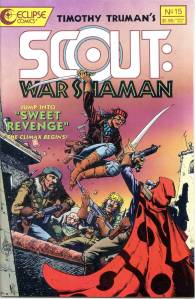
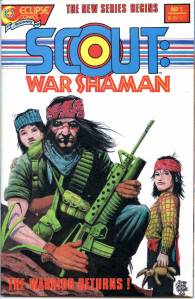
Scout: War Shaman (1988)

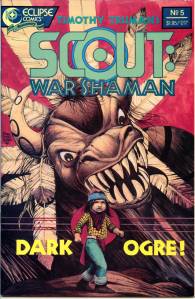
Picking up the main character’s story over a decade after the events of Scout #24, with the lead now a widowed father of two. To promote the new series, retailers were encouraged to create a display for the series in order to win original Truman artwork. The first issue reached #98 on Diamond Comic Distributors‘ chart in January 1988, a solid performance for an Eclipse title. Truman also produced the Scout Handbook, a collection of profiles, maps and other material, while Eclipse collected Scout #1-7 in the trade paperback Scout – The Four Monsters. While War Shaman #2 was delayed due to colourist Sam Parsons falling ill, War Shaman became monthly from #3. Scout: War Shaman #8-9 featured the character Beau La Duke (a fictionalized version of Eclipse sales manager Beau Smith), who then appeared in a backup strip in #14-16. As planned by Truman, the series ended after 16 issues, ending with Rosa killing Scout. Truman stated that Santana would not be resurrected, with the series instead slated to continue with the wider supporting cast he had built up.
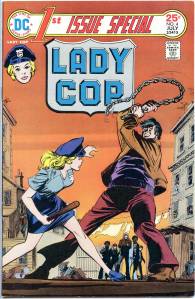
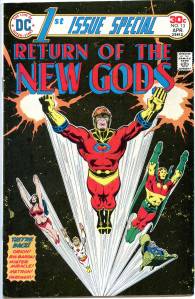
1st Issue Special (1975)

1st Issue Special was a comics anthology series from DC Comics, done in a similar style to their Showcase series. It was published from April 1975 to April 1976. The goal was to showcase a new possible first issue of an ongoing series each month, with some issues debuting new characters and others reviving dormant series from DC’s past. No series were actually launched from 1st Issue Special but the Warlord made his first appearance in the title and the character’s ongoing series was already slated to debut a few months later.

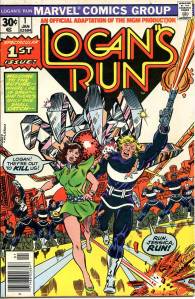
Logan’s Run (1977)

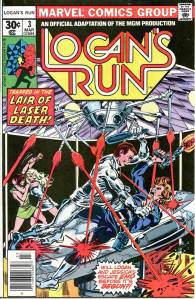
Marvel Comics published Logan’s Run in 1977, with George Pérez drawing five issues between January and May 1977, with “acceptable” sales. The comics adapted the film’s story in five issues and briefly continued beyond. In his art, Pérez sought to follow the art direction of the film. The book was cancelled after issue #7 in July 1977.

Batman Returns (1992)

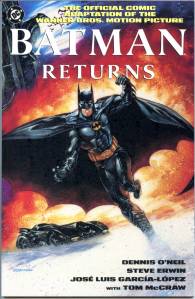
This Prestige format one-shot is an adaptation of Tim Burton’s 1992 Batman Returns feature film, which starred Michael Keaton as Bruce Wayne/Batman, Michelle Pfeiffer as Catwoman, Danny DeVito as the Penguin, and Michael Gough as Alfred.

Batman Returns NM $14

What If… V3 (2005)

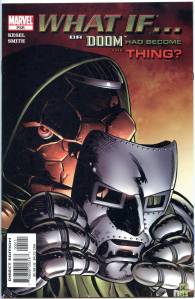
In February 2005, Marvel published a further six issues of What If. They were all in the “one-shot” format. The editor, Justin Gabrie, attributed the publication of Volume 3 to a suggestion from C. B. Cebulski. Uatu the Watcher narrates some issues and there is a cameo by Brian Michael Bendis as narrator (see “The narrator” above). In Volume 3, there is a “nod” to a Volume 1 story, What if Uncle Ben had lived? In a conversation between a comic shop customer and an attendant, the customer asks,”What if Aunt May had died instead of Uncle Ben?” Leading to another alternative plot. Marvel published a single parody edition called Wha… Huh?!? in August 2005.

Secrets of Haunted House (1975)

The series began in April–May 1975. Like its predecessor Secrets of Sinister House, Secrets of Haunted House was originally “hosted” by Cain, Abel, Eve, and Destiny who had moved over from Weird Mystery Tales. By issue #10 (Feb.–March 1978), Destiny was the only one of these who remained a regular. In issue #40 (Sept. 1981), Abel returned with no further mention of Destiny.

A Secrets of Haunted House Special was published in 1978 as part of the DC Special Series umbrella title. Secrets of Haunted House was a temporary victim of the “DC Implosion.” With issue #14 (Oct.–Nov. 1978), it was cancelled but revived a year later with issue #15 (Aug. 1979). The title continued until issue #46 (March 1982).

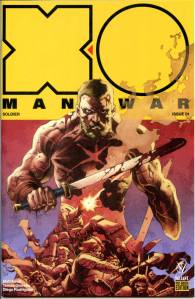
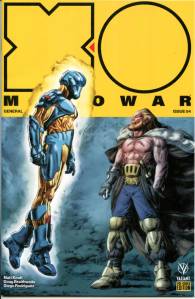
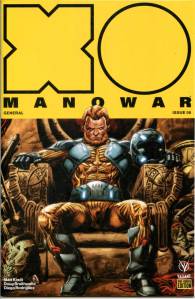
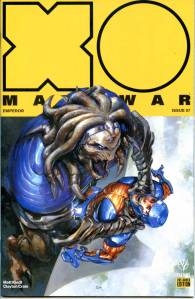
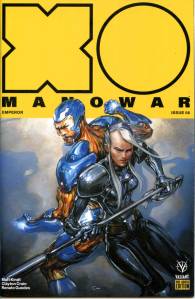
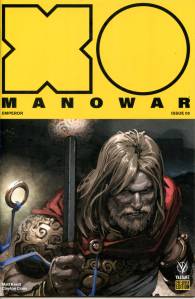
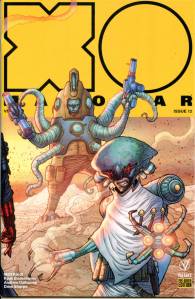
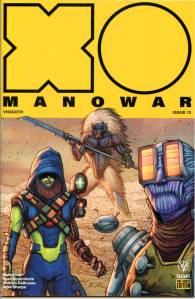
X-O Manowar V4 (2017)

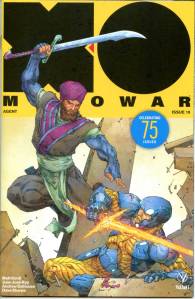
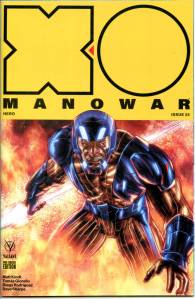
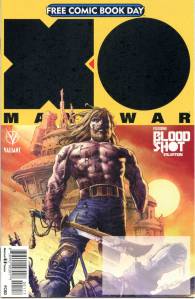
Born under the oppressive thumb of the Roman Empire, Aric of Dacia learned warfare at an early age. It was amid such violence that he was abducted by an alien race. Forced into slavery, he survived where others perished. His escape would come from bonding with a weapon of immeasurable power: the X-O Manowar armor. With it, he returned to Earth…only to find himself stranded in the modern day.

But that was a lifetime ago.

Now, far from home on a strange and primitive new world, Aric has begun a new life. Liberated from his past, he tends to his crops. Free from war. Free from violence. Free from the armor.

But the machinery of death marches his way once again. Conscripted into an alien army and thrown into an unforgiving conflict, the fury inside him finds voice as he is forced to embrace the armor once more. With it, he will decimate armies, topple empires and incite interplanetary warfare as he rises from SOLDIER to GENERAL to EMPEROR to VISIGOTH. They wanted a weapon. He will give them war!

X-Men ’92 (2015)

The team is seen living a fairly peaceful life in the Battlezone called Westchester. The baron of this region is Senator Kelly. He has little difficulty since most of the villains were wiped out in a previous war and the remaining villains were sent to “Bureau of Super-Powers” run by Cassandra Nova for rehabilitation. After a rogue Sentinel attack the X-Men are invited to the facility to learn about process. The X-Men are then put into the virtual training pods, but were really sent into the Astral Plane, since Nova was actually possessed by the Shadow King. The team is saved by Jubilee, who Nova didn’t consider a big enough threat and didn’t put into the VR pod and by the X-Force, who assault the facility. Xavier is able to repel the Shadow King and the X-Men save Baron Kelly, but a mega-Sentinel is released against the X-Mansion. The X-Men and X-Force combine to defeat the machine before it causes too much damage.

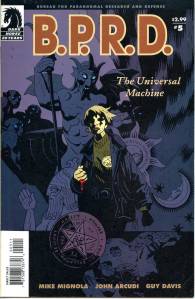
B.P.R.D. (2002)

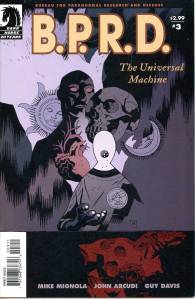
The Bureau made its first appearance in the pages of the Hellboy miniseries Seed of Destruction (4 issues, March–June 1994) and was a major part of the comic until Hellboy leaves the B.P.R.D. at the end of Conqueror Worm. At this point the B.P.R.D. series began, following the agents of the B.P.R.D. such as Abe Sapien, Liz Sherman, Roger and Johann Krauss.

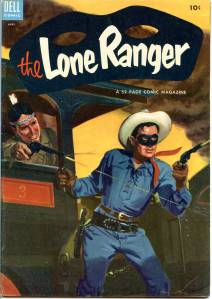
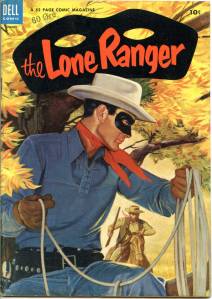
The Lone Ranger (1954)

In 1948, Western Publishing, with its publishing partner Dell Comics, launched a comic book series which lasted 145 issues. This originally consisted of reprints from the newspaper strips (as had all previous comic book appearances of the character in various titles from David McKay Publications and from Dell). However, new stories by writer Paul S. Newman and artist Tom Gill began with issue #38 (August 1951). Some original content was presented as early as #7 (January 1949), but these were non-Lone Ranger fillers. Newman and Gill produced the series until its final issue, #145 (July 1962).

Tonto got his own spin-off title in 1951, which lasted 31 issues. Such was the Ranger’s popularity at the time that even his horse Silver had a comic book, The Lone Ranger’s Famous Horse Hi-Yo Silver, starting in 1952 and running 34 issues; writer Gaylord DuBois wrote and developed Silver as a hero in his own right. In addition, Dell also published three big Lone Ranger annuals, as well as an adaptation of the 1956 theatrical film.

The Dell series came to an end in 1962. Later that same year, Western Publishing ended its publishing partnership with Dell Comics and started up its own comic book imprint, Gold Key Comics. The new imprint launched its own Lone Ranger title in 1964. Initially reprinting material from the Dell run, original content did not begin until issue #22 in 1975, and the magazine itself folded with #28 in 1977. Additionally, Hemmets Journal AB published a three-part Swedish Lone Ranger story the same year.