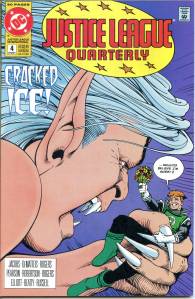
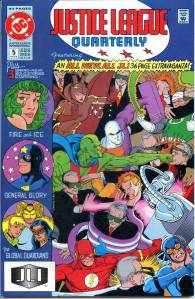
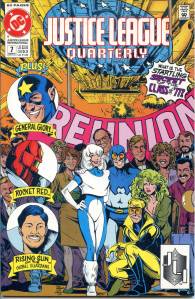
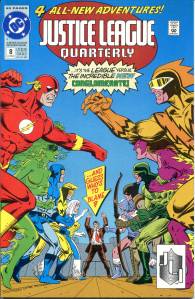
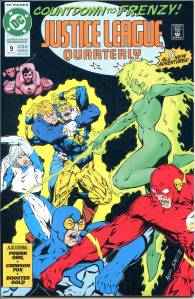
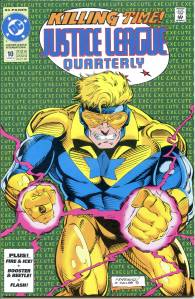
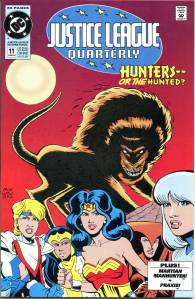
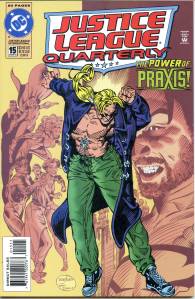
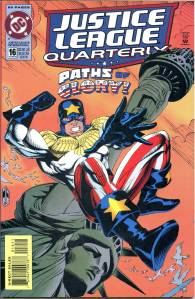
Justice League Quarterly (JLQ) was published from Winter 1990 to Winter 1994; it lasted 17 issues. It had a variable cast, pulling from the Justice League membership. The title centered on short stories featuring a differing number of characters, often solo stories, and in later issues often featured a pin-up section of members of the Justice League. Various writers and artists have worked on the title.
Simon eventually took a break from being an Avenger to concentrate on his acting career. He desired to build a normal life for himself and to come to terms with who he was. In particular he wondered what kind of person he truly was and whether or not he was truly human, given his transformation into ionic energy.
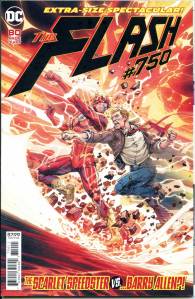
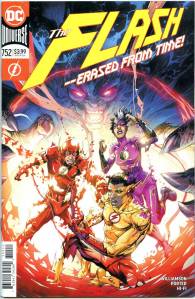
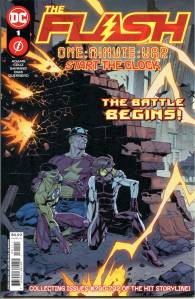
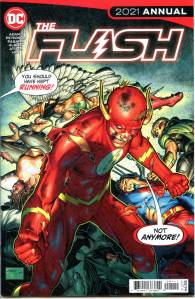
Meet Paradox: a new time-traveling villain with a tragic backstory who poses a big threat–and carries a big grudge against the Flash. He’s determined to destroy the Flash legacy at all costs, and he’s powerful enough to do it! With the Flash about to be erased from time and space, only one ally can help him defeat this seemingly insurmountable foe…Eobard Thawne, the Reverse-Flash? Can Barry Allen really trust his greatest enemy? And does he even have a choice?
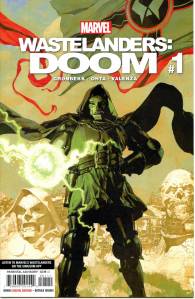
The Once and Future King! Doctor Doom helped wipe out the heroes on the Day the Villains Won, but even as he rules his domain in the Wastelands, a greater destiny calls to him. When a mysterious power blocks his oversight of a particular region, what he discovers will have ripple effects across the Wastelanders stories!
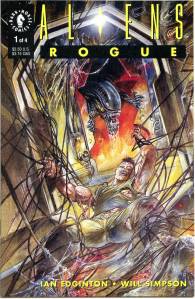
The mysterious Mr. Kray, a corporate spy, is sent to Charon Base to investigate Research Director Ernst Kleist’s genetic experiments on Xenomorphs. Kleist is attempting to breed the creatures into something controllable, but workers on the base are disappearing. Kray and his pilot, Palmer, must uncover Kleist’s schemes while surviving his “pet” Aliens.
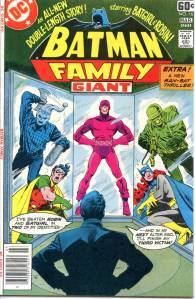
The Batman Family ran twenty issues from September-October 1975 to October-November 1978 and featured solo and team-up stories starring Batgirl and Robin. The lead story in the first issue teaming Batgirl and Robin was originally intended for publication in an issue of 1st Issue Special.The series additionally featured reprints of Golden Age and Silver Age stories. Many issues of Batman Family featured Batman supporting characters such as Alfred Pennyworth, Vicki Vale, the Elongated Man, the Huntress, and Ace the Bat-Hound. Writer Bob Rozakis introduced the Duela Dent character in issue #6 (July–August 1976)and revived the original Batwoman in issue #10 (March–April 1977).The series began featuring only new material as of issue #11 (May-June 1977) and Man-Bat began appearing as a regular feature. Batman Family converted to the Dollar Comics format with issue #17 (April–May 1978).
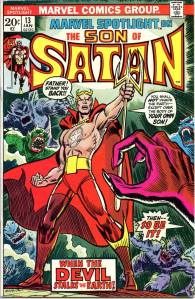
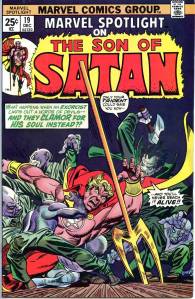
Encouraged by the success of Ghost Rider and The Tomb of Dracula, both of which starred occult characters, Stan Lee proposed a series starring Satan, to be titled The Mark of Satan. Editor Roy Thomas had reservations about this idea and suggested a series focusing on the son of Satan instead. (Due to an oversight, “The Mark of Satan” is mentioned in a blurb in Ghost Rider #1).
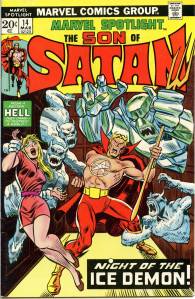
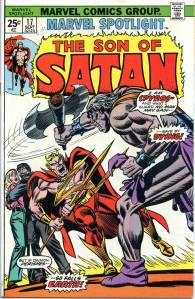
The character Daimon Hellstrom first appeared in Ghost Rider vol. 1, #1 (Sept. 1973), then was spun off into a feature, “Son of Satan”, in Marvel Spotlight #12–24 (Oct. 1973 – Oct. 1975). During the “Son of Satan” run, Marvel Spotlight was a controversial series, with numerous readers writing to object to the depictions of satanism and wiccanism as being either inaccurate or furthering the cause of evil. Nonetheless, sales were strong, prompting Marvel to launch the character into his own series, Son of Satan, written by John Warner. The character’s success faded soon after the series launch, and Son of Satan was cancelled with issue #7, though an unused fill-in was published as Son of Satan #8 (Feb. 1977).
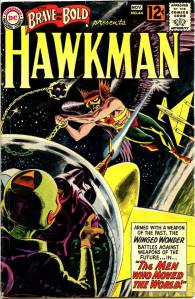
The first volume of the series ran for 200 issues from August/September 1955 to July 1983. Originally, The Brave and the Bold was an anthology series featuring adventure tales from past ages with characters such as the Silent Knight, the Viking Prince, the Golden Gladiator, and Robin Hood. With issue #25, the series was reinvented as a try-out title for new characters and concepts, starting with the Suicide Squad created by writer Robert Kanigher and artist Ross Andru. Gardner Fox and Joe Kubert created a new version of Hawkman in issue #34 (February–March 1961) with the character receiving his own title three years later.
What if “The Smoking Man” from X-Files was a real person, and his daughter found out what he did for a living? The daughter of an assassinated globalist kingpin breaks out of an internment camp and leads her fellow escaped prisoners in a battle against an elitist conspiracy of shadow governments, megabanks, and military juntas in this edgy and subversive thriller that channels Fight Club by way of Girl With The Dragon Tattoo.