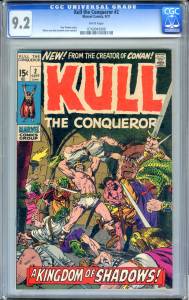
Kull has been adapted to comics by Marvel Comics with three series between 1971 and 1985. The first was drawn by Marie Severin and her brother John Severin. He also appeared several times in The Savage Sword of Conan series and other anthology books. Another graphic novel, Kull: The Vale of Shadow, was published in 1989.
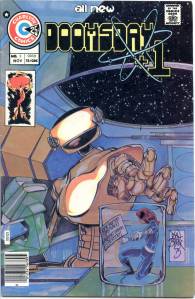
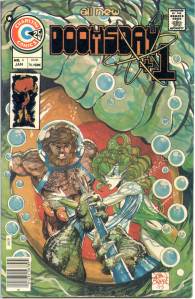
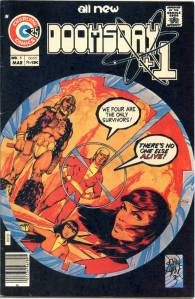
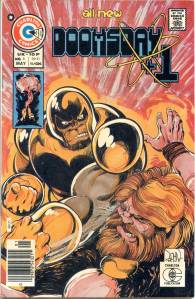
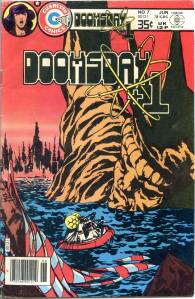
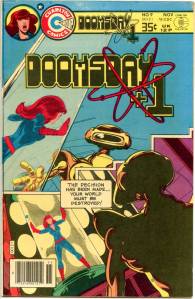
The series takes place in a near future in which a South American despot named Rykos launches his sole two atomic missiles on New York City in the U.S. and Moscow in the U.S.S.R. The two superpowers, each believing the other has launched a first strike, retaliate. By the time American president Cole and a Russian premier with the first name Mikhail have realized their errors, their fully automated nuclear-missile systems can not be countermanded.
Only hours before the apocalypse begins, a Saturn VIrocket launches bearing three astronauts: Captain Boyd Ellis, United States Air Force; his fiancée, Jill Malden; and Japanesephysicist Ikei Yashida. Weeks later, after the post-apocalyptic radiation has subsided to safe levels, their space capsule lands upon a melting Greenland ice field, where the three ally themselves with Kuno, a 3rd-century Goth revived from his ice-encased suspended animation.
The four encounter a Russian scientist/cyborg in Canada, where they commandeer a futuristic jet plane; undersea dwellers; and brutish U.S. military survivors, among others.
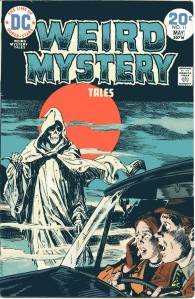
The Weird Mystery Tales ongoing series was launched in July–August 1972 and was originally hosted by Destiny. The hosting role was gradually taken over by Eve, who fully assumed the title with issue #15 (December 1974–January 1975). The title’s name was partially inspired by the sales success of Weird War Tales and Weird Western Tales. Early issues printed material by Jack Kirby that had been intended for his black-and-white, magazine-size DC comic series, Spirit World, which lasted only one issue. These stories featured Dr. E. Leopold Maas as host, sometimes with an appended hosting segment by Destiny.
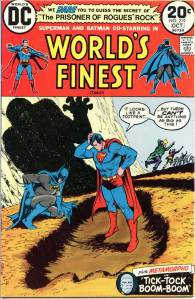
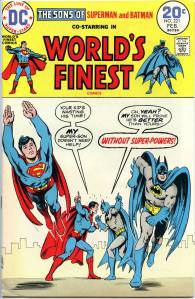
World’s Finest featured Superman and Batman team-ups until issue #197. Noted Batman artist Neal Adams first drew the character in an interior story in “The Superman-Batman Revenge Squads” in issue #175 (May 1968). The title briefly featured Superman teaming with heroes other than Batman in the early 1970s beginning with issue #198 (November 1970). That issue featured the first part of a two-issue team-up with the Flash. The series reverted to Superman and Batman team-ups after issue #214, initially with a unique twist, featuring the children they might one day have, Superman Jr. and Batman Jr. These characters, billed as the Super-Sons, were co-created by writer Bob Haney and artist Dick Dillin in issue #215 (January 1973).
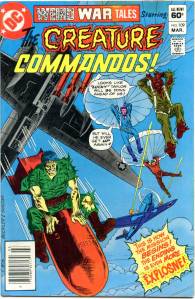
The original title ran for 12 years and 124 issues. It was an anthology series that told war stories with horror, mystery, fantasy and science fiction elements. Changes in the Comics Code Authority made the use of horror elements possible. The first seven issues were reprinted material. Each issue beginning with issue #8 was hosted by Death, usually depicted as a skeleton dressed in a different military uniform each issue. The title’s name was inspired by editor Joe Orlando.Walt Simonson‘s first professional published comic book work appeared in Weird War Tales #10 (January 1973).Roger McKenzie and Frank Miller‘s first collaboration was on a two-page story published in Weird War Tales #68 (October 1978). Recurring characters began to appear late in the series run, notably the G.I. Robot, and the return of “The War that Time Forgot” which originally ran in Star Spangled War Stories. Writer J. M. DeMatteis and penciler Pat Broderick created the Creature Commandos in Weird War Tales #93 (November 1980).
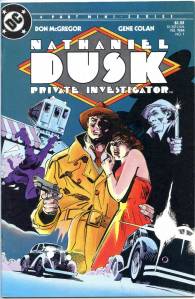
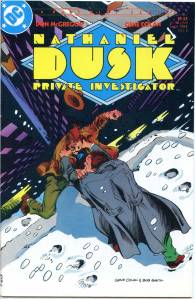
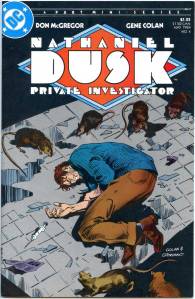
Nathaniel Dusk is a private investigator from New York City whose adventures in the 1930s are portrayed in the stories. He served in the United States armed forces in World War I and was hired by the New York City police force. Dusk fell deeply in love with Joyce Gulino, a beautiful young saleswoman with two children, Jennie and Anthony. Gulino’s ex-husband was a gangster named Joseph Costilino. Costilino later killed his family.
The 2017-2019 miniseries Doomsday Clock, by Geoff Johns and Gary Frank features Nathaniel Dusk in the DC Universe as a noir film character portrayed by a fictional actor named Carver Colman. Colman plays a key role in the story.
The title was one of four launched by Marvel Comics editor-in-chief Roy Thomas to form a line of science fiction and horror anthologies with more thematic cohesiveness than the company’s earlier attempts that decade, which had included such series as Chamber of Darkness and Tower of Shadows. Whereas those titles generally presented original stories, these new books would instead adapt genre classics and other works.
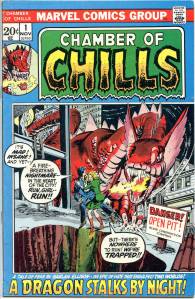
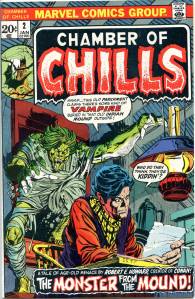
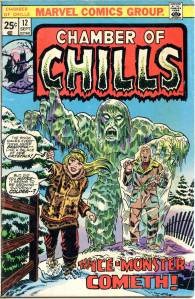
With the four titles’ debuts set to be staggered over the course of four months, Marvel premiered Journey into Mystery vol. 2 (Oct. 1972),Chamber of Chills (Nov. 1972), Supernatural Thrillers (Dec. 1972), and, with a late start, Worlds Unknown (May 1973). The first issue features an original six-page story by science fiction novelist George Alec Effinger, “Moon of Madness, Moon of Fear”, penciled by P. Craig Russell (then credited as Craig Russell), and a slightly retitled adaptation of the Harlan Ellison short story “Delusions for a Dragon Slayer”, by writer Gerry Conway and artist Syd Shores; in-between was a story by writer Stan Lee and artist Russ Heath, “They Wait in Their … Dungeon”, reprinted from Menace #1 (March 1953), from Marvel’s 1950s forerunner, Atlas Comics.
The bimonthly series ran exclusively new material through issue #4, with one reprinted story added to the mix for the following two issues, and only one new story in issue #7, after which the series became all-reprint. Most of the reprinted stories were 1950s “pre-Code” horror stories, which the industry self-censorship organization the Comics Code Authority had forbidden on Code-approved comics until a loosening of the Code in 1971.
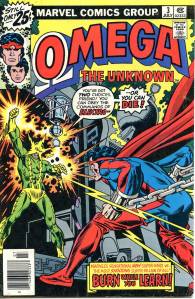
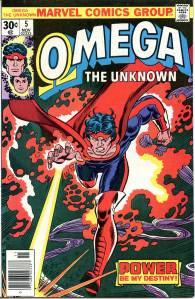
Omega the Unknown was published by Marvel Comics from 1976 to 1977, featuring the eponymous fictional character. The series, written by Steve Gerber and Mary Skrenes and illustrated by Jim Mooney, ran for 10 issues before cancellation for low sales. Despite its short run, it has remained as a cult classic due to its intriguing characters and unusual storytelling. A 10-issue series revamping the character was published from 2007 to 2008, written by novelist Jonathan Lethem and illustrated by Farel Dalrymple.
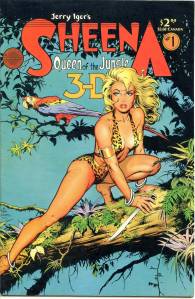
The first issue of Blackthorne’s long-running 3-D series, featuring Jerry Igers classic jungle princess, hero of pulps, comics, and the big and small screens. Absent from comics for almost three decades, this presents some of her 1950s adventures in 3-D format, including one by legendary good-girl artist Matt Baker. But the main draw for many fans will be the stunning cover by beloved artist (and Rocketeer creator) Dave Stevens. Also featuring an introduction by creator Jerry Iger, a Snarzan the Ape spoof from Great Comics (1941) #1, and a Congo King story with art by legendary good-girl artist Matt Baker. Heroine in the Jungle; Sargasso of Lost Safaris; Snarzan the Ape in Mein Kemp Von Der Chungle; Congo King; Spoor of the Dancing Skeletons. 32 pages, B&W with 3-D effects.