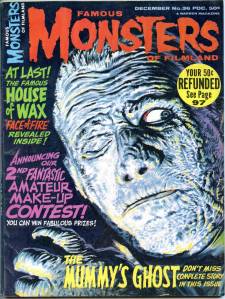
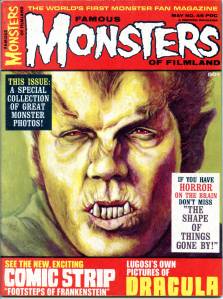
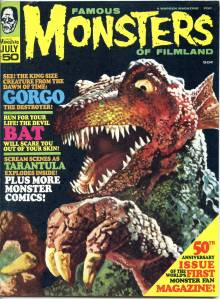
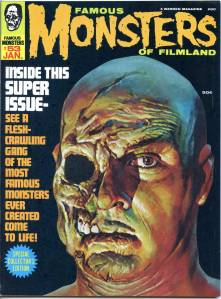
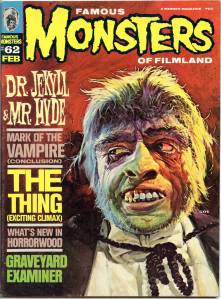
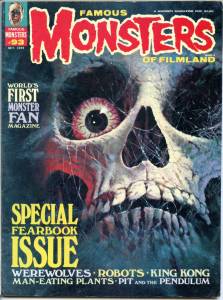
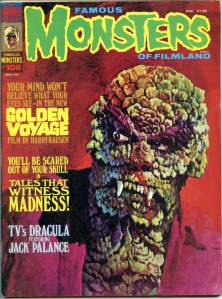
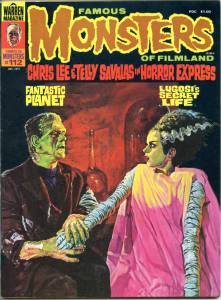
Famous Monsters of Filmland was originally conceived as a one-shot publication by Warren and Ackerman, published in the wake of the widespread success of the Shock Theater package of old horror movies syndicated to American television in 1957. But the first issue, published in February 1958, was so successful that it required a second printing to fulfill public demand. Its future as part of American culture was immediately obvious to both men. The success prompted spinoff magazines such as Spacemen, Favorite Westerns of Filmland, Screen Thrills Illustrated, Creepy, Eerie, and Vampirella.
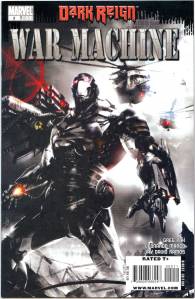
Controversy erupts as War Machine picks a target on U.S. soil in “Homeland.” When Jim Rhodes returns home he comes face-to-face with American Eagle, last seen in the pages of Thunderbolts, as two visions of America clash with earth-shattering results that may irrevocably change War Machine – and the nation he loves!
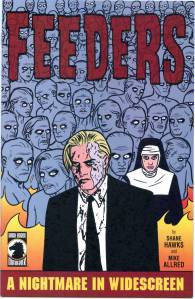
In a hospital filled with hungry souls and evil spirits, a nun forms an unholy obsession with a confused patient. Their bizarre journey leads them deep into a religious madness, where the symbol of blood takes on a dark reality. Experience the forbidden realm of Feeders in this prequel to the film Eyes to Heaven. Guaranteed to disturb–so absolutely not for the squeamish. Written by Eyes to Heaven screenwriter and director Shane Hawks, with art by Michael Allred, in two-color widescreen format.
In Volume 1 Machine Man entering the mainstream Marvel Universe. Jack Kirby wrote and drew the first nine issues, which dealt with the title character’s status as a fugitive from the military after the death of his creator, and his first interactions with mankind. The book was canceled at the end of 1978 with X-51 finally standing up to the military. Machine Man appeared next in a three issue story arc within the pages of The Incredible Hulk vol. 2 #235–237, battling the Hulk within the suburban setting of his human friend, Dr. Peter Spaulding. By the end of the storyline, he incurred a complete system shutdown, leading to the events portrayed in his relaunched monthly series. The title was relaunched in issue #10 after a nine-month hiatus. Status quo in the book changed with Machine Man now living amongst humanity, and dealing with his own new-found emotions. Marv Wolfman came aboard as the new writer, partnered with artist Steve Ditko, which helped set a different tone from Kirby’s previous stories. Issue #15 saw a new writer, Tom DeFalco, taking over the writing chores. The title lasted until issue #19, ending in Feb. 1980.
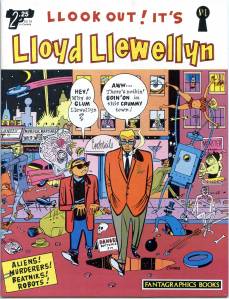
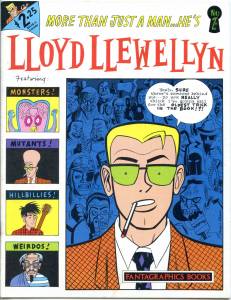
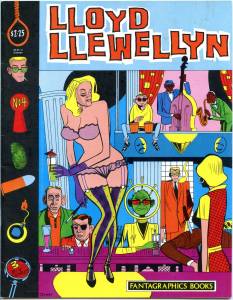
Lloyd Llewellyn (sometimes abbreviated LLLL) is a comic book by Daniel Clowes. The black-and-white series, published by Fantagraphics Books, ran for six issues from April 1986 to June 1987. A final “special” issue was published in December 1988.
The series’ title character is a detective who has humorous adventures inspired by film noir and stereotypical 1950s lounge culture. Llewellyn has a sidekick who goes by the name of Ernie Hoyle. The series’ police sergeant is called “Red” Hoerring. The series’ visual style is influenced by lowbrow art.
The story “The Nightmare” from Lloyd Llewellyn #6 foreshadowed the approach of Clowes’s next comic, Eightball, by breaking the conventions of the series’ crime setting and turning to social satire. Also in that issue, the author announces:
… And who knows … somewhere along that lonesome road we might see a new LLLL mag with a brand new format so dazzling, so breathtaking, so monumentally fantastic that I haven’t even thought of it yet!
Early issues of Eightball included several additional Lloyd Llewellyn episodes. The character also made various cameo appearances in other Eightball stories.
In 1957, the USSR launched the dog, Laika, into Earth’s orbit. Two years later, the USA responded with two monkeys, Able and Baker. These animals never returned. But, unbeknownst to everyone, they did not die in orbit…they were taken. And now they are coming home.
Returned from their adventures on a secret island, Hellboy and the Professor move with the B.P.R.D. from New Mexico to Connecticut. The relocation is tough on Hellboy: is he just homesick, or have scrambled memories from the island gripped the supernatural whippersnapper? Meanwhile, word of Hellboy’s survival has also reached an unknown enemy, who failed to kill him once before but is determined not be foiled again . .
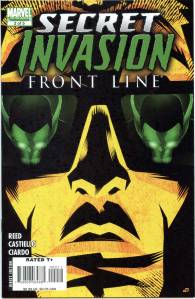
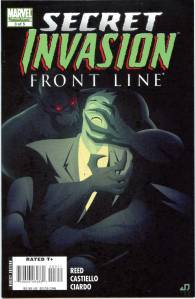
As Skrull warships fill the skies, and heroes battle for their very survival in the Savage Land, the citizens of New York struggle to survive the worst day of their lives. Brian Reed and Marco Castiello bring you a stunning ground-level look at Secret Invasion!
After the launch of the Superman/Batman comic book series, Executive Editor Dan DiDio had been looking for a way to simplify the Supergirl character from her convoluted post-crisis history; the simplest version of course, was Superman’s cousin. Jeph Loeb and editor Eddie Berganza found an opening to reintroduce the character following the conclusion of the first story arc of Superman/Batman.
The modern version of Kara Zor-El made her debut in Superman/Batman #8 (2004). Kara takes the mantle of Supergirl at the conclusion of the storyline. The Supergirl comic book series would later be relaunched, now starring Kara Zor-El as “The Girl of Steel”. The first arc of the new series was written by Jeph Loeb and illustrated by Ian Churchill.












 EHT Comics