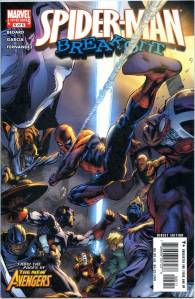
The New Avengers riot hits in Spider-Man: Breakout! — the jailbreak of the century causes havoc in the Marvel U, as a flood of the most dangerous villains on the planet pour into the streets of New York City…and our favorite web-slinger finds himself caught between two warring cliques of escaped convicts!
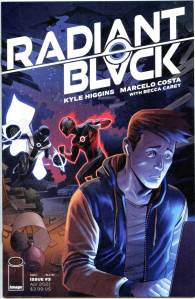
Nathan Burnett has just turned thirty, and things aren’t great: He’s working (and failing) at two jobs, his credit card debt is piling up, and his only move… is moving back home with his parents. But when Nathan discovers and unlocks the ethereal, cosmic RADIANT, he’s given the power to radically change his fortunes! There’s just one problem: The powers don’t belong to him. And the COSMIC BEINGS who created them want them back… by any means necessary.
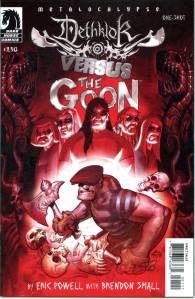
From Eric Powell and the creators of Adult Swim’s Metalocalypse: since 2006, Metalocalypse has been bringing its special brand of dark comedy to the masses through the American/Scandinavian death-metal band Dethklok. And, since 1999, The Goon has contributed the best in bucktoothed zombie brawls to the world of comics. Now, the twain shall meet . . .
Dethklok Versus The Goon – Metalocalypse VF-NM $14
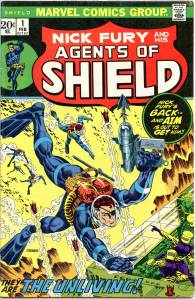
This series inspired the ABC television series Agents of SHIELD! This reprint comic features 2 classic stories from Marvel’s Silver Age. Classic Stan Lee & Jack Kirby stories with covers by Jim Steranko.
After four issues as The Sinister House of Secret Love, which featured Gothic romance/horror stories written by Michael Fleisher and others, the title changed to Secrets of Sinister House, and the original format and romance angle were abandoned the following issue.
In the same vein as House of Mystery and House of Secrets (as well as its successor, Secrets of Haunted House), Secrets of Sinister House was “hosted” by Eve (the character debuted in issue #6) and included guest appearances by Eve’s cousins Cain and Abel. In issue #16, Eve was removed as host — as editor Joe Orlando departed from the title, replaced by Jack C. Harris — to focus on the concept of the “sinister houses”. The following month, she began nudging Destiny out of Weird Mystery Tales.
Mail-offer exclusive giveaway only obtainable by redeeming coupons found in very early issues of various Image titles. The cover art is the collaborative work of Todd McFarlane, Erik Larsen, Marc Silvestri, Jim Valentino, Rob Liefeld, Whilce Portacio, and Jim Lee, with each character being penciled by their respective creator. Contains an anthology of abridged comic teasers: Rob Liefeld’s Troll (1st appearance), Jim Lee’s Stormwatch, Erik Larsen’s Savage Dragon, Marc Silvestri’s Stryker, and Jim Valentino’s Shadowhawk. Plus, Todd McFarlane provides 4 full-page character pin-ups (where he introduces the “Freak” for the first time, who would next appear in Spawn #34).
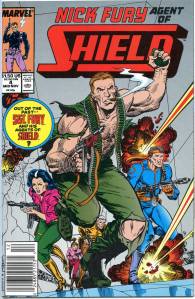
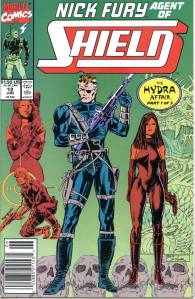
Nick Fury, Agent of S.H.I.E.L.D. vol. 3 was released in 1989. The series lasted 47 issues (Sept. 1989 – May 1993); its pivotal story arc was “the Deltite Affair”, in which many S.H.I.E.L.D. agents were replaced with Life Model Decoys in a takeover attempt.
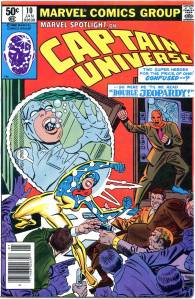
Marvel Spotlight was revived in 1979, initially as simply a place to publish inventory stories from the recently cancelled Captain Marvel. However, once these leftover tales were exhausted, the series went on to feature other characters. Tako Shamara first appeared in Marvel Spotlight vol. 2 #5 (March 1980), in a story by Marv Wolfman and Steve Ditko. In his first appearance the character battled a huge dragon from the past called a Wani, a monster that destroyed his ancestors’ villages in 1582. The creature that Tako battled was intended to be Godzilla but since Marvel no longer had the rights to the character, which lapsed the previous year, the creature was modified to a dragon called The Wani. Issue #8 featured the final Captain Marvel solo story before the character’s death.
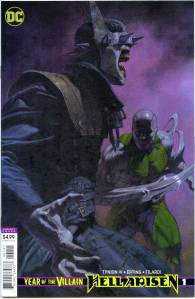
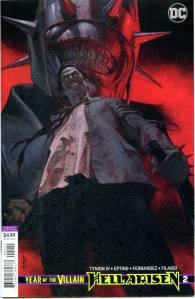
After the Source Wall was shattered, four entities known as the Omega Titans began invading Colu, forcing Brainiac to summon the Justice League for help. But as Amanda Waller and the new Task Force XI destroyed him, his great-great-grandson Brainiac 5 informs the League that Brainiac was using them to make sure the Omega Titans would destroy Earth, so there can be no interference for him.
Over time, Lex Luthor found a mysterious object related to an unknown force known as the Totality, while forging a new Legion of Doom, which includes a revived Brainiac and The Batman Who Laughs. The Totality is presumed to be linked to Perpetua, an ancient goddess who was made to vanish by her three children, the Monitor, the Anti-Monitor and the World Forger.
After faking his death through a bombing and with Perpetua’s help, Luthor manages to transform himself into a human/Martian hybrid version of himself called “Apex Lex”.
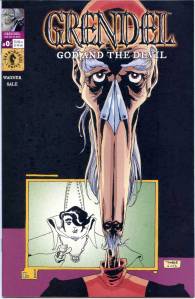
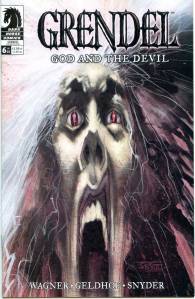
The year is 2512, and the kingdom of Grendel is at hand! Several centuries have passed since the mask of Grendel has been worn, and in that time humanity’s survived a third World War, the fall of Western Civilization, and the rise of an all-powerful church state. But as the new Catholic Vatican stands as a towering fortress, anchored in the mountains of Colorado and fanatically driven by the depraved Pope Innocent XLII, two men rise up against the church’s corrupting influence. The first is Orion Assante, a man determined to expose the pope for who and what he really is. The second is a mysterious madman wearing the all-too-familiar face of Grendel. The Devil has risen again!