Murder Incorporated (1948)

Murder Incorporated would’ve been an obvious title for a hard-hitting true-crime comic book in 1948.   The real-life Murder Incorporated, the infamous hit squad of New York City organized crime had been shut down by the early 1940s, but their legend lived on in other media.  This Fox Feature Syndicate series was true to its title as it featured true crime tales with a focus on mob killers and other notorious murderers.  Murder Incorporated‘s notoriety was such that the series was mentioned by both Fredric Wertham in Seduction of the Innocent, and Geoffrey Wagner in Parade of Pleasure, and it landed on countless municipal government ban lists around the country in 1948, along with much of the rest of Victor Fox’s comic book line.  An interesting series in the context of both comic book history and from a true-crime perspective.

Superman V5 (2018)

A bold new chapter for the greatest superhero of all time begins here as writer Brian Michael Bendis and artist Ivan Reis begin their run on the all-new SUPERMAN! The fallout from the Man of Steel miniseries has Clark Kent looking at the world through new eyes…with new ideas about what Superman could and should do for the city of Metropolis and the planet Earth. His first job? Getting the planet back out of the Phantom Zone!

Call of Duty: Black Ops 3 (2015)

Call of Duty: Black Ops III is a comic book series developed by Dark Horse Comics as a prequel to Call of Duty: Black Ops III. The series is written by Larry Hama and drawn by artist Marcelo Ferreira. It also has art done by colorist Dan Jackson. The first issue of the series was released on November 4. 2015.

Lobo: The Last Czarnian (1990)

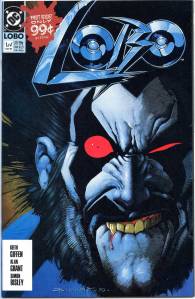
Lobo was introduced as a regular character in Keith Giffen and Roger Slifer’s Green Lantern and Teen Titans spin-off Omega Men. At that time, he was a Velorpian whose entire race had been exterminated by Psions and was partnered with Bedlam, whom he later killed; his origin was later retconned.

After a well-received appearance in Justice League International, Lobo became a regular character in L.E.G.I.O.N. and its successor series R.E.B.E.L.S..

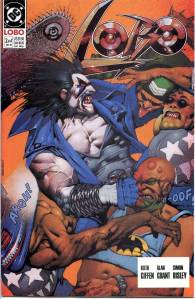
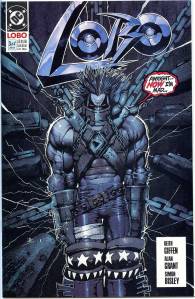
In 1990, he appeared in his four-issue own miniseries, Lobo: The Last Czarnian, plotted by Giffen, written by Alan Grant and with art by Simon Bisley, which changed his origin story: he became the last Czarnian after violently killing every other member of the species. That miniseries led to many subsequent miniseries and specials.

Uncanny Avengers V1 (2012)

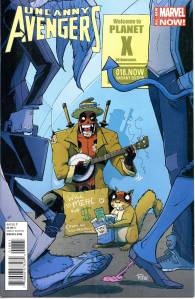
Marvel Comics announced Uncanny Avengers by the creative team of Rick Remender and John Cassaday in August 2012. Uncanny Avengers is a new team of Avengers that features a line-up of both classic Avengers and X-Men including Captain America (Steve Rogers), Havok, Rogue, the Scarlet Witch, Thor and Wolverine. The team is formed in response to the events of Avengers vs. X-Men.

Remender said, “There’s something that Cyclops said to (Captain America) on Utopia that’s ringing in his head. He didn’t do enough to help. And Steve (Captain America) is taking that to heart. Coming out of AvX with the landscape shifted and changed as much as it is, there are events that lead Steve to recognizing that he needs to do more”.

Optic Nerve (1995)

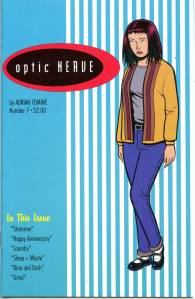
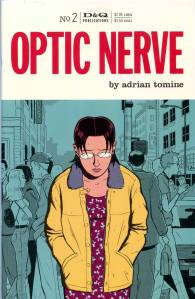
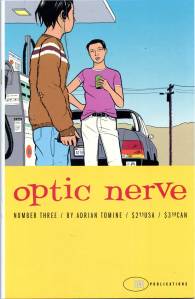
Optic Nerve is a series by cartoonist Adrian Tomine. Originally self-published by Tomine in 1991 as a series of mini-comics (which have later been collected in a single volume,32 Stories), the series has been published by Drawn and Quarterly since 1995.

Tomine’s style and subject matter are restrained and realistic. Many are set in Northern California. Many of his stories for Optic Nerve feature Asian American characters, including “Hawaiian Getaway,” “Six-Day Cold,” “Layover,” and “Shortcomings.” Adrian Tomine is Asian American and lives in Brooklyn, New York. Many topics of his stories are at least partly autobiographical.

In the initial self-published issues, as well as the first eight Drawn & Quarterly issues (1995-2001), Optic Nerve was typically a collection of short stories. After an extended hiatus, Tomine resumed the comic in fall of 2004 and began his first multi-issue storyline, “Shortcomings,” with #9. The most recent issue, #13, was published in July 2013.

Blue Devil (1984)

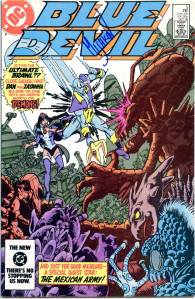
Blue Devil (Dan Cassidy) first appeared in a special insert published in Fury of Firestorm #24 (June 1984). That story led directly into Blue Devil #1, also cover dated June 1984. He was created by Dan MishkinGary Cohn, and Paris Cullins. The Blue Devil comic book ran for 32 issues with Blue Devil later appearing as a regular character in Shadowpact that ran for 25 issues.

Dan Cassidy was working as a stuntman and special effects specialist in Hollywood when he created the Blue Devil full body suit, complete with a built in exoskeleton, specifically designed for the Blue Devil movie being produced by Verner Brothers Studios.

During filming on The Blue Devil, the demon Nebiros was accidentally unleashed from within an ancient temple and, thinking Cassidy was an actual demon, tried to drain his demonic powers with blasts of magic. Instead, the blasts permanently bonded the suit to Cassidy. This unnatural fusion of magic and technology caused Cassidy to experience unusual events and draw the attention of otherworldly beings, a condition known in occult circles as a “weirdness magnet”.

Forbidden Tales of Dark Mansion (1971)

After four issues as The Dark Mansion Of Forbidden Love, the romance angle was abandoned and the title changed to Forbidden Tales of Dark Mansion. Very much in the same vein as House of Mystery and House of Secrets, Forbidden Tales of Dark Mansion was “hosted” by Charity (the character debuted in issue #7).

The character of Charity later became part of the supporting cast in the Starman series and at some point after the last issue married the policeman Mason O’Dare and is pregnant with his child.

Nextwave (2006)

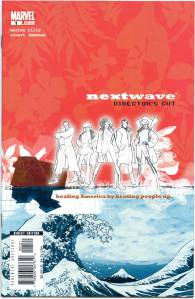
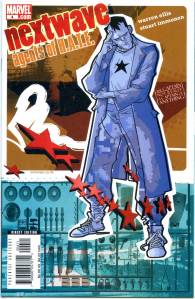
Nextwave is a humorous comic book series by Warren Ellis and Stuart Immonen, published by Marvel Comics between 2006 and 2007. Nextwave consistently features extreme violence and comedy, and simultaneously satirizes and celebrates Marvel’s superhero comics. The series frequently uses flashback scenes in which existing Marvel characters such as Captain AmericaUlysses Bloodstone and the Celestials act grossly out of character for comedic purposes. In an interview, Ellis said, “I took The Authority and I stripped out all the plots, logic, character and sanity.” “It’s an absolute distillation of the superhero genre. No plot lines, characters, emotions, nothing whatsoever. It’s people posing in the street for no good reason. It is people getting kicked, and then exploding. It is a pure comic book, and I will fight anyone who says otherwise. And afterwards, they will explode.”

The Amazing Screw-On Head (2002)

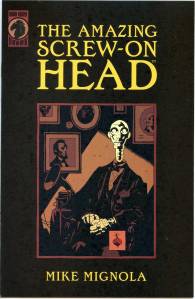
The Amazing Screw-On Head is a one-shot comic book written and drawn by Mike Mignola and published by Dark Horse Comics in 2002, starring the character of the same name. Similar in tone and theme to Mignola’s better known HellboyThe Amazing Screw-On Head is a black comedy that stars a robot living during the Lincoln administration whose head can be attached to different bodies with different tactical abilities, and who functions as an agent of the U.S. government.

The idea for the character was inspired by action figures, particularly Batman ones, which seemed to Mignola to be the same figurines with different paint jobs. Mignola imagined a robot with a head that screwed onto different bodies to suit the occasion, hence “Screw-on Head”. An animated pilot, based on the plot of the comic, was produced by the Sci-Fi Channel in 2006, with Bryan Fuller as writer and executive producer and Chris Prynoski as director.