DC 100 Page Super Spectacular was published by DC Comics from 1971 through 1973, featuring only reprints initially and later including new stories. The “100 Page” count included both sides of the front and back covers as pages. Each numbered issue appearing under this title featured a wrap-around cover with all editorial content and no advertisements. Versions after late 1973 included advertisements.
The title was the first to feature Neal Adams‘ version of Batman, generating fan interest that led to Adams’ style defining the modern Batman image to this day. In addition, Adams updated Green Arrow‘s visual appearance by designing a new costume for the character in issue #85 (Aug.–Sept 1969). The primary artist for the second half of the run was Jim Aparo, starting with #98 (October–November 1971). Haney frequently disregarded continuity by scripting stories which contradicted DC’s canon or by writing major heroes in an out-of-character fashion. Issue #100 (Feb.–March 1972) featured Batman and “4 Famous Co-Stars” (Green Lantern, Green Arrow, Black Canary, and Robin) in a story by Haney and Aparo. Issues #112 (April–May 1974) to #117 (Feb.–March 1975) of the series were in the 100 Page Super Spectacular format.
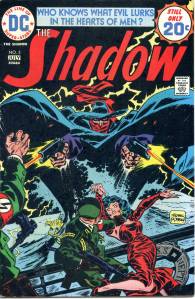
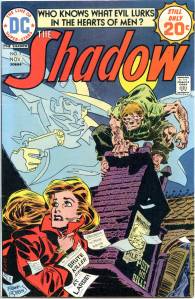
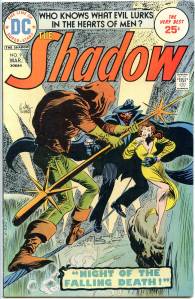
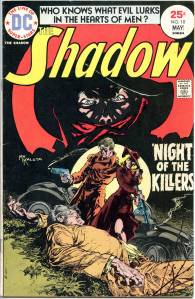
During the mid-1970s, DC Comics published an “atmospheric interpretation” of the character by writer Dennis O’Neil and artist Michael Kaluta in a 12-issue series (Nov. 1973 – Sept. 1975). Kaluta drew issues 1–4 and 6 and was followed by Frank Robbins and then E. R. Cruz. Attempting to be faithful to both the pulp-magazine and radio-drama character, the series guest-starred fellow pulp fiction hero the Avenger in issue #11.
Supergirl starred in her first solo eponymous monthly series beginning in 1972 until October 1974, when her monthly title merged with Superman’s Girl Friend, Lois Lane, and Superman’s Pal Jimmy Olsen to produce a new title: then-highest DC selling series called The Superman Family, where she eventually became the steady lead story. Linda worked as a student advisor at New Athens Experimental School, before leaving for New York to follow a career in acting with daytime soap Secret Hearts.
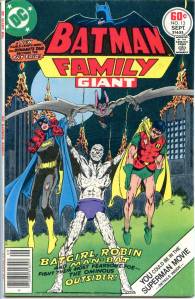
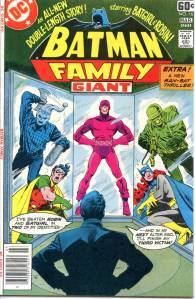
The Batman Family ran twenty issues from September-October 1975 to October-November 1978 and featured solo and team-up stories starring Batgirl and Robin. The lead story in the first issue teaming Batgirl and Robin was originally intended for publication in an issue of 1st Issue Special.The series additionally featured reprints of Golden Age and Silver Age stories. Many issues of Batman Family featured Batman supporting characters such as Alfred Pennyworth, Vicki Vale, the Elongated Man, the Huntress, and Ace the Bat-Hound. Writer Bob Rozakis introduced the Duela Dent character in issue #6 (July–August 1976)and revived the original Batwoman in issue #10 (March–April 1977).The series began featuring only new material as of issue #11 (May-June 1977) and Man-Bat began appearing as a regular feature. Batman Family converted to the Dollar Comics format with issue #17 (April–May 1978).
Kong the Untamed is a comic book series published by DC Comics that ran for five issues. It was created in 1975 by writer Jack Oleck and artist Alfredo Alcala. The title character, Kong, is an intelligent caveman who is a direct descendant of Anthro, another DC Comics caveman character.
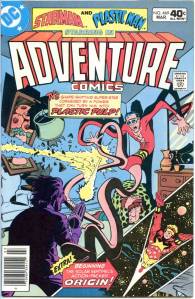
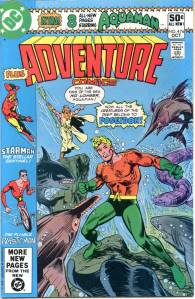
As of #425 (December 1972), Adventure Comics theme changed from superhero adventure to fantasy/supernatural adventure. That issue debuted one new feature along with three non-series stories, the pirate saga “Captain Fear”. The next edition added a semi-anthology series, “The Adventurers’ Club”. Soon, editor Joe Orlando was trying out horror-tinged costumed heroes, first Black Orchid, then the Spectre. Before long, though, conventional superheroes returned to the book, beginning behind the Spectre, first a three-issue run of Aquaman (issues #435–437, an early assignment for Mike Grell) and then a newly drawn 1940s Seven Soldiers of Victory script (issues #438–443). Aquaman was promoted to lead (issues #441-452), and backing him up were three-part story arcs featuring the Creeper (#445–447), the Martian Manhunter (#449–451), bracketed by issue-length Aquaman leads. He was awarded his own title and Superboy (#453-458) took over Adventure with Aqualad (#453–455) and Eclipso (#457–458) backups. Following this was a run as a Dollar Comic format giant-sized book (issues #459-466), including such features as the resolution of the Return of the New Gods (cancelled in July–August 1978), “Deadman“, and “Justice Society of America“.
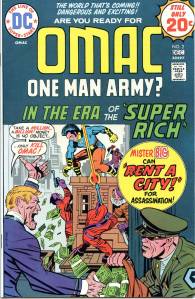
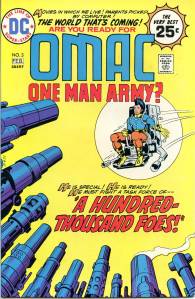
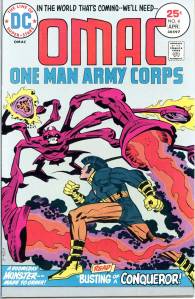
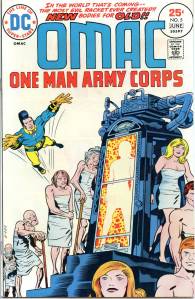
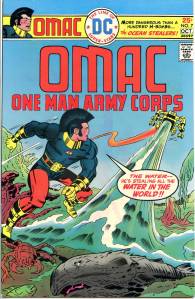
OMAC (Buddy Blank) was created in 1974 by Jack Kirby and published by DC Comics. The character was created towards the end of Kirby’s contract with the publisher, following the cancellation of his New Gods series and was reportedly developed strictly due to Kirby needing to fill his contractual quota of 15 pages a week.As envisioned by Kirby, OMAC is essentially Captain America set in the future, an idea Kirby had toyed with some years earlier while at Marvel Comics, but had never realized.
Set in the near future (“The World That’s Coming”), OMAC is a corporate nobody named Buddy Blank who is changed via a “computer-hormonal operation done by remote control” by an A.I. satellite called Brother Eye into the super-powered One-Man Army Corps (OMAC).
Created and designed by Jack Kirby, The New Gods first appeared in February 1971 in New Gods #1.
Kirby’s production assistant of the time, Mark Evanier, remarked that: “Folks forget but the New Gods saga was intended to be a limited series … There was no intention that these characters would go on forever. After Jack’s books started getting good sales figures, DC demanded that we keep them going and use guest stars like Deadman, which we were very much against doing. So Kirby had this novel he was forever stuck in the middle of – he could never get to the last chapter. … You can spot the issues where Jack kind of gave up trying to advance the story of Darkseid and Orion and was marking time. If those books had been intended from the start to run indefinitely, they would have been done very differently.”
New Gods #1 marks the first appearance of Orion, Highfather, and Metron, among others.