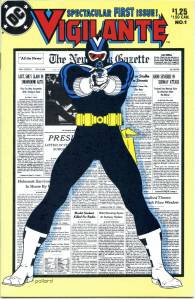
Vigilante was an ongoing series published from November of 1983 to February 1988. The series featured the honorable Adrian Chase, who was first introduced in the pages of New Teen Titans Annual #2. Spanning a total of fifty issues and two Annuals, the series ended with the death of the main character.
DC Comics was a hotbed of experimentation during the 1970s, and in 1975 the character became the first villain to feature as the title character in a comic book series, The Joker. The series followed the character’s interactions with other supervillains, and the first issue was written by O’Neil. Stories balanced between emphasizing the Joker’s criminality and making him a likable protagonist whom readers could support. Although he murdered thugs and civilians, he never fought Batman; this made The Joker a series in which the character’s villainy prevailed over rival villains, instead of a struggle between good and evil. Because the Comics Code Authority mandated punishment for villains, each issue ended with the Joker being apprehended, limiting the scope of each story.
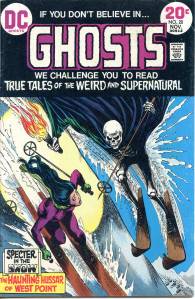
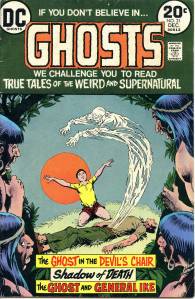
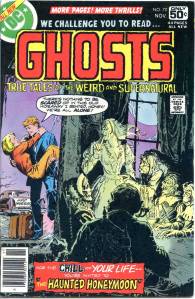
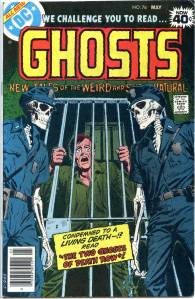
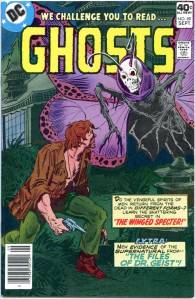
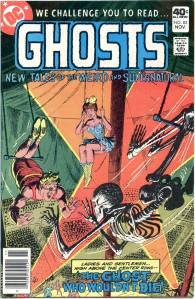
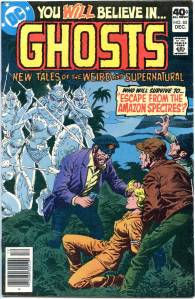
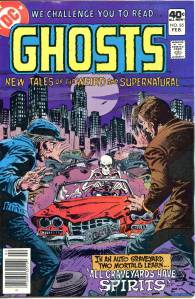
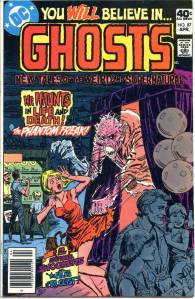
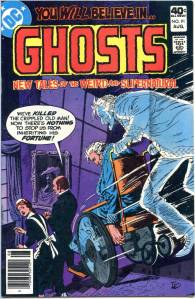
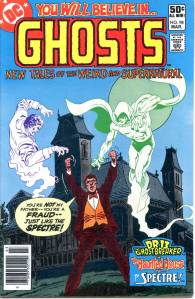
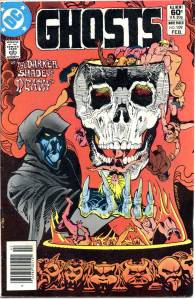
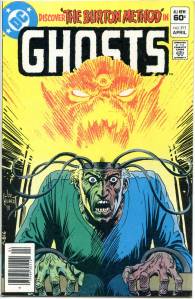
Each issue of Ghosts carried multiple stories of the supernatural. The stories were prefaced by a short description introducing the premise and ended with a summation of how a mysterious justice was dealt to the evildoers of the tale. The first issue of this series carried the singular title Ghost in its indicia, but everywhere else, including advance promotional house ads and even on its own cover, it was the plural Ghosts, as even the indicia would read from #2 on. Limited Collectors’ Edition #C–32 (Dec. 1974–Jan. 1975) reprinted stories from Ghosts #1, 3–6 and featured new material by Leo Dorfman and artists Gerry Talaoc, E. R. Cruz, and Frank Redondo.
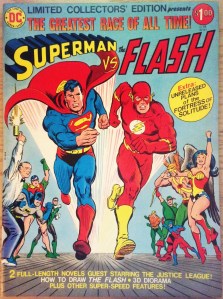
Limited Collectors’ Edition was launched with a collection of Rudolph the Red-Nosed Reindeer stories which went on sale October 24, 1972. DC Comics vice president Sol Harrison had suggested the format stating that “We could create a tabloid size comic that would stand out on the newsstand.”Limited Collectors’ Edition shared its numbering with two other treasury format series, Famous First Edition and All-New Collectors’ Edition. The final issues of the latter two series were tie-ins to the release of Superman: The Movie. DC later published treasuries as part of DC Special Series in 1981 and as a number of one-shots from 1999 to 2003 primarily produced by Paul Dini and Alex Ross.
DC Limited Collectors Edition V5 C48 – Superman Vs Flash VF- $35
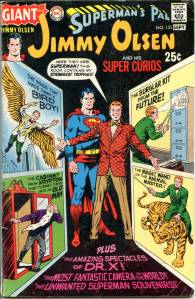
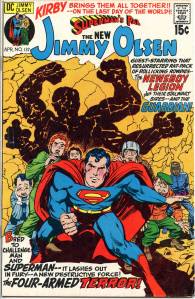
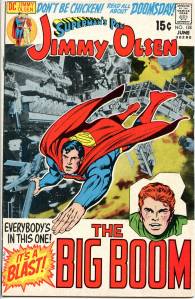
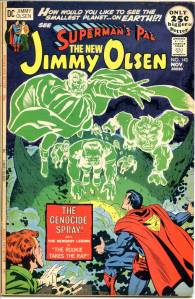
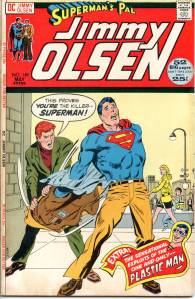
Superman’s Pal, Jimmy Olsen is a series published by DC Comics from September–October 1954 until March 1974, spanning a total of 163 issues.Featuring the adventures of Superman supporting character Jimmy Olsen, it contains stories often of humorous nature.
The 1952 television series Adventures of Superman co-starred actor Jack Larson, who appeared regularly as Jimmy Olsen. Largely because of the popularity of Larson and his portrayal of the character, National Comics Publications (DC Comics) decided to create a regular title featuring Jimmy as the leading character.Curt Swan was the main artist on the series for its first decade.
Many of the issues include Jimmy undergoing a transformation of some form.
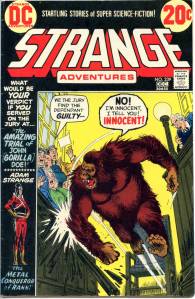
Strange Adventures ran for 244 issues and was DC Comics’ first science fiction title. It began with an adaptation of the film Destination Moon. The sales success of the gorilla cover-featured story in Strange Adventures #8 (May 1951) led DC to produce numerous comic book covers with depictions of gorillas.
With issue #217, the title gained another new logo and began reprinting stories of Adam Strange and the Atomic Knights, among other stories. Several Strange Adventure stories were also reprinted in some of DC Comics’ later anthologies such as From Beyond the Unknown.
In 1978, DC Comics intended to revive Strange Adventures. These plans were put on hold that year due to the DC Implosion, a line-wide scaling back of the company’s publishing output. When the project was revived a year later, the title was changed to Time Warp and the series was in the Dollar Comics format.
When superhero comics became popular again in the mid-1960s in what is now called the “Silver Age of Comic Books“, Fawcett was unable to revive Captain Marvel, having agreed to never publish the character again as part of their 1953 settlement. Looking for new properties to introduce to the DC Comics line, DC publisher Carmine Infantino decided to bring the Captain Marvel property back into print. On June 16, 1972, DC entered into an agreement with Fawcett to license the Captain Marvel and Marvel Family characters. Because Marvel Comics had by this time established Captain Marvel as a comic book trademark for their own character, created and first published in 1967, DC published their book under the name Shazam! Infantino attempted to give the Shazam! book the subtitle The Original Captain Marvel, but a cease and desist letter from Marvel Comics forced them to change the subtitle to The World’s Mightiest Mortal, starting with Shazam! #15 (December 1974). As all subsequent toys and other merchandise featuring the character have also been required to use the “Shazam!” label with little to no mention of the name “Captain Marvel”, the title became so linked to Captain Marvel that many people took to identifying the character as “Shazam” instead of “Captain Marvel”
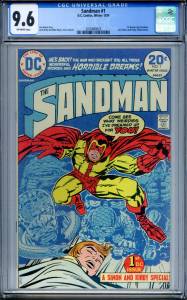
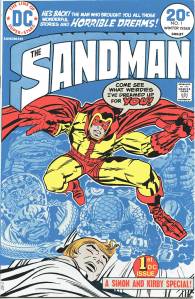
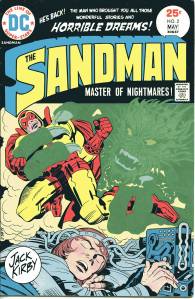
The Sandman of the 1970s was created by Joe Simon and Jack Kirby. Issue #1 was intended as a one-shot, but five more issues and an additional story followed. After the first issue, the stories were written by Michael Fleisher. The second and third issues were illustrated by Ernie Chua. Inks were by Kirby, Mike Royer and, in the sixth issue, Wally Wood. All covers were by Kirby, and the fourth issue noted his return to the interior artwork on the cover.
This Sandman was originally intended to be the actual Sandman of popular myth, “eternal and immortal”, despite his superhero-like appearance and adventures. The Sandman is assisted by two living nightmares named Brute and Glob, whom he releases from domed cells with the help of a magic whistle. They are nuisances who beg for release, who are intent on hand-to-hand combat, but are implied to be relatively harmless and well-intentioned once freed. Using security monitoring devices, the Sandman can enter the “Dream Stream” or the “Reality Stream” (in which he acts like the superhero he looks like), and he carries a pouch of dream dust with which he can cause anyone to sleep and dream. The Sandman’s main task is protecting children from nightmare monsters within their dreams, especially one young boy named Jed, who lives with his grandfather, Ezra Paulsen, as well as to ensure that children have an appropriate level of nightmares rather than dealing with such anxieties in real life.
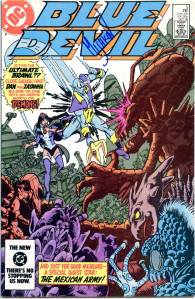
Blue Devil (Dan Cassidy) first appeared in a special insert published in Fury of Firestorm #24 (June 1984). That story led directly into Blue Devil #1, also cover dated June 1984. He was created by Dan Mishkin, Gary Cohn, and Paris Cullins. The Blue Devil comic book ran for 32 issues with Blue Devil later appearing as a regular character in Shadowpact that ran for 25 issues.
Dan Cassidy was working as a stuntman and special effects specialist in Hollywood when he created the Blue Devil full body suit, complete with a built in exoskeleton, specifically designed for the Blue Devil movie being produced by Verner Brothers Studios.
During filming on The Blue Devil, the demon Nebiros was accidentally unleashed from within an ancient temple and, thinking Cassidy was an actual demon, tried to drain his demonic powers with blasts of magic. Instead, the blasts permanently bonded the suit to Cassidy. This unnatural fusion of magic and technology caused Cassidy to experience unusual events and draw the attention of otherworldly beings, a condition known in occult circles as a “weirdness magnet”.
After four issues as The Dark Mansion Of Forbidden Love, the romance angle was abandoned and the title changed to Forbidden Tales of Dark Mansion. Very much in the same vein as House of Mystery and House of Secrets, Forbidden Tales of Dark Mansion was “hosted” by Charity (the character debuted in issue #7).
The character of Charity later became part of the supporting cast in the Starman series and at some point after the last issue married the policeman Mason O’Dare and is pregnant with his child.