After four issues as The Dark Mansion Of Forbidden Love, the romance angle was abandoned and the title changed to Forbidden Tales of Dark Mansion. Very much in the same vein as House of Mystery and House of Secrets, Forbidden Tales of Dark Mansion was “hosted” by Charity (the character debuted in issue #7).
The character of Charity later became part of the supporting cast in the Starman series and at some point after the last issue married the policeman Mason O’Dare and is pregnant with his child.
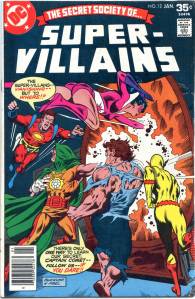
Due to the delays caused by having to redo the first issue from scratch, Conway assigned David Anthony Kraft to script the next three issues of Secret Society of Super Villains over his plots. After issue #4, both Conway and Kraft abruptly left DC, leading to a mad scramble to produce a fill-in issue.
Jack C. Harris took over as editor, and Conway returned as writer only with issue #8, but artists on the series rotated nearly as often as the lineup of the titular supergroup, with Rich Buckler, Mike Vosburg, and Dick Ayers all contributing short stints as pencilers, while inkers changed from issue to issue. Harris felt that the series’ mediocre sales might have been partly his fault: “The cover concepts were one of my editorial duties. Rich Buckler turned my ideas into the best he could do, but I never felt as if my ideas were good enough for his art. I think there was a ‘sameness’ to my ideas which might have hurt the title in that casual readers might have missed buying an issue because they thought they’d already seen it”. Secret Society of Super Villains was cancelled with issue #15 as part of the DC Implosion.
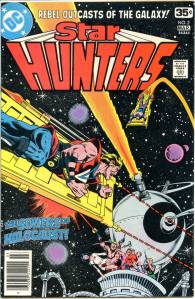
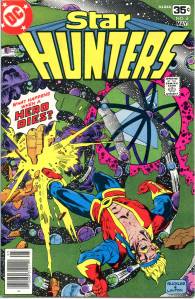
The Star Hunters were infected by the Corporation controlling Earth with a virus which would cause their genes to mutate if they set foot on the planet again without receiving an antidote which the Corporation would only give to them on completion of their mission – to learn the true origins of man.
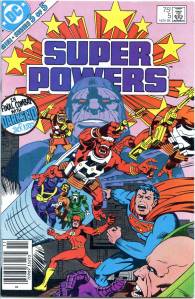
Once the line was on the market, a vigorous merchandising campaign took place, with DC Comics and Kenner striving for the Super Powers logo to become ubiquitous. DC Comics produced three comic book mini-series featuring characters from the toyline, one during each year of the toyline’s existence. The first series of comics in 1984 was plotted by Jack Kirby, who also provided covers, and went on to pencil the second series. (These two series were collected and reprinted in 2013 in The Jack Kirby Omnibus Vol. 2, in 2018 in Super Powers by Jack Kirby, and in 2019 in DC Universe: Bronze Age Omnibus by Jack Kirby). The third and final series was penciled by Carmine Infantino.
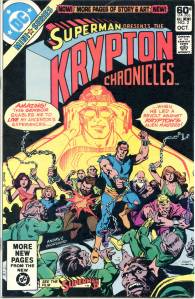
A three-issue miniseries entitled The Krypton Chronicles, published in 1981, tells of Superman researching his roots when, as Clark Kent, he was assigned to write an article about Superman’s family by an assignment editor impressed with the television miniseries Roots. To do so, he and Supergirl travel to Kandor, where they learn the history of the El family.
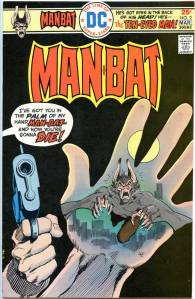
Man-Bat was the second ongoing comic series featuring a Batman villain, the first one being Joker (Volume 1). Man-Bat started publication in 1975, but was prematurely cancelled after the second issue by DC Comics Publisher, Carmine Infantino. The Man-Bat stories featured in this series were later moved as back-up features on Detective Comics (Volume 1) and later Batman Family (Volume 1).
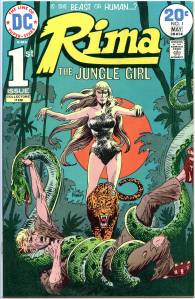
Rima starred in a seven-issue comic book series, DC Comics‘ Rima the Jungle Girl (May 1974 – May 1975), adapted by DC writer-editor Robert Kanigher with artwork by penciler–inkerNestor Redondo and covers by Joe Kubert. A variation of the character debuted in a six-issue DC Comics limited series May 2010 to Mar 2011 First Wave, written by Eisner Award–winning writer Brian Azzarello.
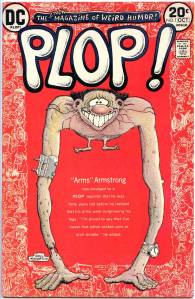
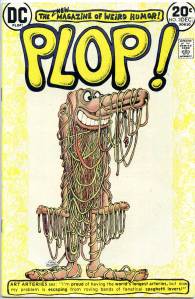
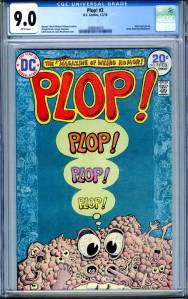
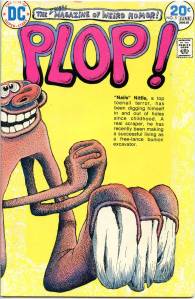
According to Steve Skeates, Plop! was based around a horror / humor story he wrote called “The Poster Plague”, which was published in House of Mystery.
The title initially was intended to be called Zany. A number of the one-panel cartoons published in the comic included the visible prefix ZA, in reference to the originally intended title. Sergio Aragonés credits publisher Carmine Infantino with coming up with the final title: “Joe Orlando and I were sitting in a restaurant talking with Carmine Infantino. They wanted a magazine that was different, something about black humor. Carmine came up with the name. We were talking about it and he said, ‘What will we call it?’ And I said, ‘We can call it anything, because if the magazine is good, then it will stay.’ And he said, ‘No, we can’t call it, for instance … PLOP!’ And I said, ‘Yes, we can.’ And so I started making sketches of things going PLOP! and they laughed and decided the name was good.
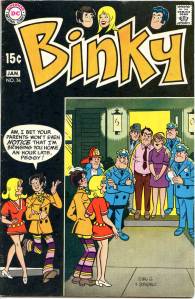
The adventures of teenager Binky Biggs started in DC Comics’ Leave It to Binky #1 (cover-dated March 1948), which ran for 60 issues through 1958. The series was revived by issue #61 (July 1968). With issue #72 (May 1970), the title was shortened to Binky and the series ran until issue #81 (Nov. 1971). Issue #82 was published in Summer 1977.
A spin-off title, Binky’s Buddies, ran 12 issues (Feb. 1969 – Dec. 1970).
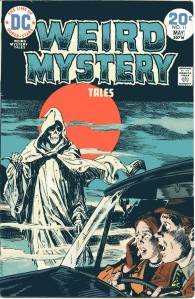
The Weird Mystery Tales ongoing series was launched in July–August 1972 and was originally hosted by Destiny. The hosting role was gradually taken over by Eve, who fully assumed the title with issue #15 (December 1974–January 1975). The title’s name was partially inspired by the sales success of Weird War Tales and Weird Western Tales. Early issues printed material by Jack Kirby that had been intended for his black-and-white, magazine-size DC comic series, Spirit World, which lasted only one issue. These stories featured Dr. E. Leopold Maas as host, sometimes with an appended hosting segment by Destiny.