Four years after his debut, Superboy became only the sixth DC superhero to receive his own comic book when Superboy #1 (March–April 1949) was published. The series became the first new DC superhero title to succeed since World War II. Superboy saw the debuts of the first Superbaby story, (about Clark’s adventures as a super-powered toddler), and of Clark’s two closest friends: Lana Lang, who also serves as a romantic interest for Superboy; and Pete Ross, who later discovers and helps protect Clark’s secret identity. Other notable stories to appear in Superboy include the story of the first Bizarro and the first appearances of Legion of Super-Heroes members Mon-El and Ultra Boy.
Author: EHT Comics
Age of Apocalypse (2012)
Jean Grey and Sabretooth return to Earth 616. Weapon X and his Black Legion attack the last human city where Weapon X slays both Magneto and Rogue, leaving Jean Grey and Sabretooth the last two X-Men alive. Jean telepathically nudges clones of the Scarlet Witch to recreate the Decimation and remove all mutants’ powers across the globe. However, this was only successful within a radius of 12 feet, so Jean Grey and Sabretooth are both left de-powered. The human coalition distracts Weapon X with a bomb long enough for the group to escape as the city explodes behind them. Harper Simons joins with the human team, the X-Terminated. Others who work with the X-Terminated are Doctor Moreau and Bolivar Trask.
Something is Killing the Children (2019)
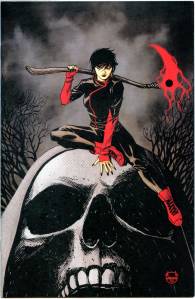
When the children of Archer’s Peak—a sleepy town in the heart of America—begin to go missing, everything seems hopeless. Most children never return, but the ones that do have terrible stories—impossible details of terrifying creatures that live in the shadows. Their only hope of finding and eliminating the threat is the arrival of a mysterious stranger, one who believes the children and claims to be the only one who sees what they can see. Her name is Erica Slaughter. She kills monsters. That is all she does, and she bears the cost because it must be done.
Doomsday Clock (2017)
Doomsday Clock is part of the DC Rebirth initiative, and it continues the narrative that was established with the 2016 one-shot DC Universe: Rebirth Special, the 2017 crossover event “The Button” and other related stories. It is a follow-up to the 1986–1987 miniseries Watchmen by Alan Moore, Dave Gibbons and John Higgins, and it introduces that story’s characters into the DC Universe, alongside a few original characters created for the book. Although Dan DiDio (then DC’s co-publisher) confirmed that it is a sequel to that miniseries, Johns originally declined to characterize it as such, viewing it as a standalone story, saying, “It is something else. It is Watchmen colliding with the DC Universe.”
Marvel Zombies 2 (2007)
Forty years have passed and the zombies have come back home after eating just about everything else in the universe. Yum yum! What awaits them back on Earth, though, is beyond anything even these shambling monstrosities could have conceived! This is a new series featuring the amazing, irreverent take on the Marvel characters that became last year’s unexpected smash hit. They’re back and more stomach-churning than ever! The smash hit series is back, daring to ask: “Whose stomach are you in?”
Thief of Thieves (2012)
Thief of Thieves is a monthly comic book series published by Image Comics‘ Skybound imprint which premiered in 2012. Created by Robert Kirkman, the comic centers on Conrad Paulson, a highly successful thief who quits the business and begins a new life stealing from other thieves. The series will feature a rotation of writers, including Nick Spencer on the first story arc, and art by Shawn Martinbrough. The first three issues sold out upon release, and a television series based on the comic is in development at AMC.
Daredevil (1964)
Daredevil debuted in Marvel Comics‘ Daredevil #1 (cover date April 1964), created by writer-editor Stan Lee and artist Bill Everett, with character design input from Jack Kirby, who devised Daredevil’s billy club. When Everett turned in his first-issue pencils extremely late, Marvel production manager Sol Brodsky and Spider-Man co-creator Steve Ditko inked a large variety of different backgrounds, a “lot of backgrounds and secondary figures on the fly and cobbled the cover and the splash page together from Kirby’s original concept drawing”.
Writer and comics historian Mark Evanier has concluded (but cannot confirm) that Kirby designed the basic image of Daredevil’s costume, though Everett modified it. The character’s original costume design was a combination of black, yellow, and red, reminiscent of acrobat tights. Wally Wood, known for his 1950s EC Comics stories, penciled and inked issues #5–10, introducing Daredevil’s modern red costume in issue #7.
The Mask (1991)
The base concept of The Mask was created by Mike Richardson in 1982. It first saw life as a single sketch he drew in 1985 for APA-5, an amateur press publication created by writer Mark Verheiden. After starting Dark Horse Comics, Richardson pitched his concept to Marvel Comics comic book writer/artist Mark Badger. The outcome was the Masque strip, that ran in the early issues of Dark Horse Presents. Badger’s strips became increasingly political, and Richardson ended the strip in order to bring the character back to his original concept.
Artist Chris Warner was hired to revamp the character based on Richardson’s original APA-5 drawing and created the definitive look for the character, that was given a new launch in 1989 in the pages of Dark Horse’s Mayhem anthology. Aspiring writer John Arcudi and artist Doug Mahnke were hired to create the new adventures, which became the first very popular use of the character, “a combination of Tex Avery and The Terminator“. The Mask stories from Mayhem #1-4 were later collected as the 1991 issue The Mask #0 and in a trade paperback collection as well.
Superboy V4 (1994)
This series featured the clone of Superman and his adventures as part of Cadmus. In Superboy (vol. 4) #1 (February 1994), the new Superboy settled in Hawaii with his supporting cast, becoming Hawaii’s resident superhero for the next four years until Superboy (vol. 4) #48 (February 1998). Starting in Superboy (vol. 4) #56 (November 1998), Superboy returned “home” when he began working for Cadmus. In Superboy (vol. 4) #59 (February 1999), Superman gave Superboy the Kryptonian name of Kon-El. After leaving Cadmus and living on his own for a brief time in Metropolis, Kon-El went to live with Jonathan and Martha Kent in Smallville, where he adopted a secret identity as their nephew (and Clark’s cousin) Conner Kent.
The Savage She-Hulk (1980)
Jennifer Walters, the cousin of Bruce Banner (Hulk), is the small and somewhat shy daughter of Los Angeles County Sheriff William Morris Walters and Elaine (née Banner) Walters (who died in a car crash when Jennifer was seventeen). Operatives of Nicholas Trask, a crime boss who had crossed paths with her father, shot and seriously wounded her on a day that Bruce Banner happened to be in town for a visit. Since no other donors with her blood type were available, Banner provided his own blood for a transfusion; as they already shared the same blood type and DNA, his radioactive blood, combined with her anger transformed Jennifer into the green-skinned She-Hulk when the mobsters tried to finish her off at the hospital.