Amazing Spider-Man (Silver Age)

Due to strong sales on the character’s first appearance in Amazing Fantasy #15, Spider-Man was given his own ongoing series in March 1963. The initial years of the series, under Lee and Ditko, chronicled Spider-Man’s nascent career with his civilian life as hard-luck yet perpetually good-humored teenager Peter Parker. Peter balanced his career as Spider-Man with his job as a freelance photographer for The Daily Bugle under the bombastic editor-publisher J. Jonah Jameson to support himself and his frail Aunt May. At the same time, Peter dealt with public hostility towards Spider-Man and the antagonism of his classmates Flash Thompson and Liz Allan at Midtown High School, while embarking on a tentative, ill-fated romance with Jameson’s secretary, Betty Brant.

By focusing on Parker’s everyday problems, Lee and Ditko created a groundbreakingly flawed, self-doubting superhero, and the first major teenaged superhero to be a protagonist and not a sidekick. Ditko’s quirky art provided a stark contrast to the more cleanly dynamic stylings of Marvel’s most prominent artist, Jack Kirby, and combined with the humor and pathos of Lee’s writing to lay the foundation for what became an enduring mythos.

Aquaman (Silver Age)

Aquaman, published by DC Comics was created by Paul Norris and Mort Weisinger. The character debuted in More Fun Comics #73 (November 1941). Initially a backup feature in DC’s anthology titles, Aquaman later starred in several volumes of a solo title. During the late 1950s and 1960s superhero-revival period known as the Silver Age, he was a founding member of the Justice League of America. In the 1990s Modern Age, Aquaman’s character became more serious than in most previous interpretations, with storylines depicting the weight of his role as king of Atlantis.

Later accounts reconciled both facets of the character, casting Aquaman as serious and brooding, saddled with an ill reputation, and struggling to find a true role and purpose beyond his public side as a deposed king and a fallen hero.

Journey into Mystery (Silver Age)

Journey into Mystery was initially published by Atlas Comics, then by its successor, Marvel Comics. Initially a horror comics anthology, it segued to giant-monster and science fiction stories in the late 1950s. Beginning with issue #83 (cover dated August 1962), it ran the superhero feature “The Mighty Thor“, created by writers Stan Lee and Larry Lieber and artist Jack Kirby, and inspired by the mythological Norse thunder god. The series, which was renamed for its superhero star with issue #126 (March 1966), has been revived three times: in the 1970s as a horror anthology, and in the 1990s and 2010s with characters from Marvel’s Thor mythos.

Beware the Creeper (1968)

Following his debut in Showcase, the Creeper was given his own series Beware the Creeper, written by Dennis O’Neil; Steve Ditko plotted the first issue. It lasted six issues Most pitted him against a chameleonic villain called Proteus, whose true identity was revealed just before his violent death in the final issue.

The Atom (Silver Age)

The Atom introduced in Showcase #34 (1961) is physicist and university professor Dr. Raymond Palmer, Ph.D. (He was named for real-life science fiction writer Raymond A. Palmer, who was himself quite short.) After stumbling onto a mass of white dwarf star matter that had fallen to Earth, he fashioned a lens which allowed him to shrink down to subatomic size. Originally, his size and molecular density abilities derived from the white dwarf star material of his costume, controlled by mechanisms in his belt, and later by controls in the palms of his gloves. Much later, he gained the innate equivalent powers within his own body. After the events of Identity Crisis, Ray shrank himself to microscopic size and disappeared. Finding him became a major theme of the Countdown year long series and crossover event.

Not Brand Echh (1967)

Not Brand Echh is a satiric comic book series published by Marvel Comics that parodied its own superhero stories as well as those of other comics publishers. Running for 13 issues (cover-dated Aug. 1967 to May 1969), it included among its contributors such notable writers and artists as Stan LeeJack KirbyGene ColanBill EverettJohn and Marie Severin, and Roy Thomas. With issue #9, it became a 68-page, 25¢ “giant”, relative to the typical 12¢ comics of the times. In 2017, a 14th issue was released.

Its mascot, Forbush Man, introduced in the first issue, was a superhero wannabe with no superpowers and a costume of red long johns emblazoned with the letter “F” and a cooking pot, with eye-holes, covering his never-revealed head. His secret identity was eventually revealed in issue #5 (Dec. 1967) as Irving Forbush, Marvel’s fictitious office gofer.

Adventure Comics (Silver Age)

Adventure Comics was published by DC Comics from 1938 to 1983 and revived from 2009 to 2011. In its first era, the series ran for 503 issues (472 of those after the title changed from New Adventure Comics), making it the fifth-longest-running DC series, behind Detective Comics, Action Comics, Superman, and Batman. It was revived in 2009 by writer Geoff Johns with the Conner Kent incarnation of Superboy headlining the title’s main feature, and the Legion of Super-Heroes in the back-up story. It returned to its original numbering with #516 (September 2010). The series finally ended with #529 (October 2011), prior to DC’s The New 52 company reboot.

Strange Tales (Silver Age)

Strange Tales switched to superheroes during the Silver Age of Comic Books, retaining the sci-fi, suspense and monsters as backup features for a time. Strange Tales‘ first superhero, in 12- to 14-page stories, was the Fantastic Four‘s Human Torch, Johnny Storm, beginning in #101 (Oct. 1962). Here, Johnny still lived with his elder sister, Susan Storm, in fictional Glenview, Long Island, New York, where he continued to attend high school and, with youthful naivete, attempted to maintain his “secret identity” (later retconned to reveal that his friends and neighbors knew of his dual identity from Fantastic Four news reports, but simply played along).

The title became a “split book” with the introduction of sorcerer Doctor Strange, by Lee and artist Steve Ditko. This 9- to 10-page feature debuted in #110 (July 1963), and after an additional story and then skipping two issues returned permanently with #114. Ditko’s surrealistic mystical landscapes and increasingly head-trippy visuals helped make the feature a favorite of college students, according to Lee himself. Eventually, as co-plotter and later sole plotter, in the “Marvel Method“, Ditko would take Strange into ever-more-abstract realms, which yet remained well-grounded thanks to Lee’s reliably humanistic, adventure/soap opera dialog. Adversaries for the new hero included Baron Mordo introduced in issue #111 (Aug. 1963) and Dormammu in issue #126 (Nov. 1964). Clea, who would become a longtime love interest for Doctor Strange, was also introduced in issue #126.

Strange Adventures (Silver Age)

Initially a science fiction anthology title with some continuing features starring SF protagonists, the series became a supernatural-fantasy title beginning with issue #202, for which it received a new logo. Deadman’s first appearance in Strange Adventures #205, written by Arnold Drake and drawn by Carmine Infantino, included the first known depiction of narcotics in a story approved by the Comics Code Authority. The “Deadman” feature served as an early showcase for the artwork of Neal Adams.

Towerl of Shadows (1969)

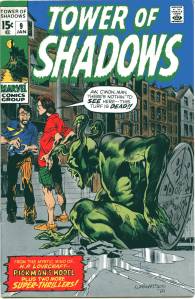
Designed to compete with DC Comics‘ successful launches of House of Mystery and House of Secrets,[2] Tower of Shadows, like its companion comic Chamber of Darkness, sold poorly despite the roster of artists featured. After its first few issues, the title, published bimonthly, began including reprints of “pre-superhero Marvel” monster stories and other SF/fantasy tales from Marvel’s 1950s and early 1960s predecessor, Atlas Comics. After the ninth issue, the title changed to Creatures on the Loose, and the comic became a mix of reprints and occasional sword and sorcery/SF series.