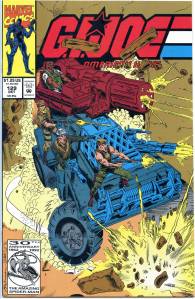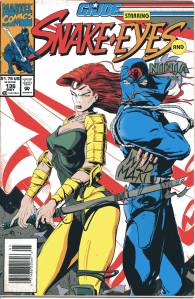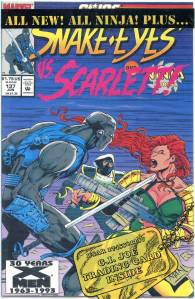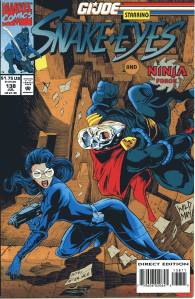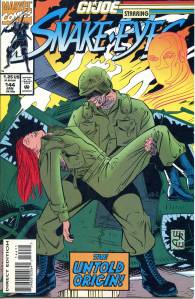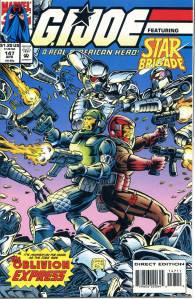
When G.I. Joe began, most toy tie-in comics lasted an average of two years, so G.I. Joe, lasting for 12 years, was considered a runaway success. Through the years, the comic book series chronicled the adventures of G.I. Joe and Cobra, using a consistent storyline. In the early 1990s, however, it began to drop in quality, and was canceled by Marvel in 1994 with issue #155 due to low sales. Hasbro canceled the A Real American Hero toy line in the same year. Between the lack of new toys and the cancellation of the second TV series three years earlier, the comic book could not count on the same cross-platform support it had enjoyed in the past. The target demographic had also changed considerably.
Tag: Iron Age
Death’s Head V1 (1988)
Death’s Head is a fictional character appearing in British comics and American comic books published by Marvel Comics. The character is depicted as a robotic bounty hunter (or rather, as he calls himself, a “freelance peace-keeping agent”). The character was created by writer Simon Furman and artist Geoff Senior for the company’s Marvel UK imprint. Furman decided to use Death’s Head in his Transformers stories, but believed that characters appearing in Transformers “were prone to be absorbed into that title’s catchall copyright” (allowing Hasbro to contest their ownership) and led to a one-page strip titled “High Noon Tex” (which was subsequently published in various Marvel UK titles) being hastily created to establish Marvel’s ownership of the character. Furman has stated that he chose the name Death’s Head for the character while unaware of the “Nazi-connotations of the name”.
The Adventurers (1986)
The Adventurers was a well-produced sword and sorcery title from writer Scott Behnke and Peter Hsu. It draws heavily on fantasy/role-playing games like Dungeons & Dragons in creating its world of fearless adventurers, strange magics, horrible monsters, and lost treasures.
The tale begins when eight adventurers are recruited by Tarrus the One-Eyed to recover a magical key from the lost city of Tecumeth. This city had been considered the home of great evil for generations—and with good cause. The adventurers’ quest would be one of constant peril, with the party facing dangers both living and mystical. Although the adventurers have more than their share of differences, they would need all their skills if they were to have any hope of survival.
Wolverine V2 (2012)
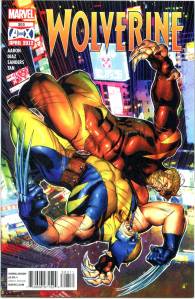
Issue 300 marks a return to the original numbering of V2. Wolverine travels to Tokyo to confront his most dangerous enemy yet and a new Silver Samurai rises to take his place…along with Wolverine’s daughter!
Captain America V5 (2004)
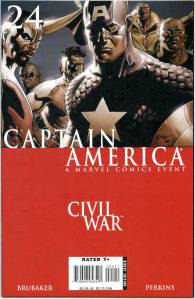
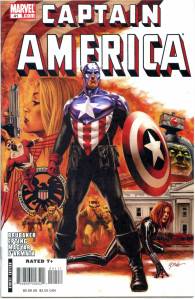
In the 2006–2007 company-wide story arc “Civil War“, Rogers opposes the new mandatory federal registration of super-powered beings, and leads the underground anti-registration movement. After significant rancor and danger to the public as the two sides clash, Captain America voluntarily surrenders and orders the Anti-Registration forces to stand down, feeling that the fight has reached a point where the principle originally cited by the anti-registration forces has been lost.
Scud: The Disposable Assassin (1994)
In this future, it is possible to obtain robot assassins out of vending machines at the cost of 3 Franks. After terminating their target, the robot self-destructs for easy clean-up. During his first mission, the Scud we follow sees his self-destruct warning in a mirror during an 18-page fight scene. Programmed for self-preservation for the sake of winning fights, Scud doesn’t want to die, so only wounds Jeff bad enough to be put on life support at a nearby hospital, ensuring their mutual survival.
The main plot of Scud: The Disposable Assassin follows Scud’s career as a freelance mercenary and assassin, working to pay off Jeff’s medical bills.
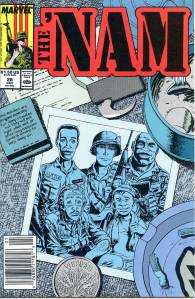
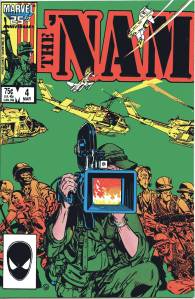
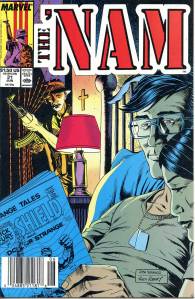
The ‘Nam (1980’s)
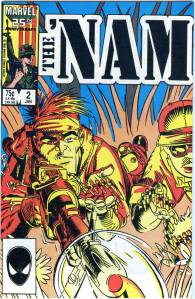
The ‘Nam was a war comic book series detailing the U.S. War in Vietnam from the perspective of active-duty soldiers involved in the conflict. It was written by Doug Murray, initially illustrated by Michael Golden, edited by Larry Hama and published by Marvel Comics for seven years beginning in 1986, which was originally intended to roughly parallel the analogous events of the period of major American military involvement in Vietnam from 1965 to 1973.
Teenage Mutant Ninja Turtles Adventures (1988)
The initial storylines were close adaptations of the 1987 Teenage Mutant Ninja Turtles television series, but by the fifth issue the creators handed the series over to Ryan Brown and Stephen Murphy. In their hands the comic immediately diverged from the cartoon series into unique new story arcs, often incorporating social, environmentalist, and animal-rights themes. It also introduced several new characters of various races and backgrounds, including humans, mutants, aliens, and other anthropomorphic creatures. Additionally, the series added new layers to established players such as April O’Neil, who began training with a katana, and the Shredder, who gradually revealed a sense of honor. The stories were often seen as ‘deeper’ and more ‘serious’ than the cartoon. As the new tales and characters were explored, original antagonists Krang, Bebop and Rocksteady were eventually phased out early, making later appearances during stories involving alien worlds. Shredder would remain a recurring adversary.
Nightwing – New 52 (2011)
After the events of Flashpoint as part of The New 52, Nightwing was relaunched with issue #1. Grayson resumes the role of Nightwing following the return of Bruce Wayne. The new series, written by Kyle Higgins, opens with Grayson having returned to Gotham, when Haly’s Circus comes to town. Through a series of events, Grayson inherits the circus and is working through internal struggles with his past as he investigates the secrets the circus has brought about.
During the events of Death of the Family (a bat-family crossover) Haly’s circus is targeted by the Joker. As a result, the circus is burnt down and the circus members leave. Dick is left feeling depressed and lost as a result of this and the death of Damian Wayne (Robin) and is at a loss for what to do with his life. However, when Sonia Branch reveals to him that she believes her father, Tony Zucco, is alive and living in Chicago, Dick makes the decision take him down. Therefore, in 2013 Nightwing relocated to Chicago to hunt down Tony Zucco and also take down The Prankster, a new supervillain hacker in Chicago.
The Punisher V2 (1980’s)
The Punisher ongoing series premiered in 1987. Initially by writer Mike Baron and artist Klaus Janson, it eventually ran 104 issues (July 1987 – July 1995) and spun off two additional ongoing series — The Punisher War Journal (80 issues, November 1988 – July 1995) and The Punisher War Zone (41 issues, March 1992 – July 1995), as well as the black-and-white comics magazine The Punisher Magazine(16 issues, November 1989 – September 1990) and The Punisher Armory (10 issues, no cover dates, starting 1990), a fictional diary detailing “His thoughts! His feelings! His weapons!” (as stated on the cover of issue #1). The Punisher also appeared in numerous one-shots and miniseries, and made frequent guest appearances in other Marvel comics, ranging from superhero series to the Vietnam War-era comic The ‘Nam.
During this era, the Punisher was assisted by his then-partner, Microchip. Serving as a Q type figure, he would supply the Punisher with high-tech vehicles and equipment such as armored combat “battle vans” specially built and customized.