Wolverine V2 (1990’s)

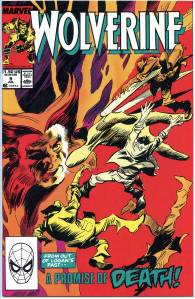
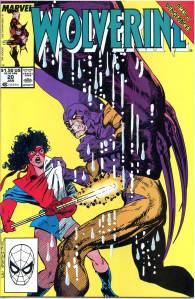
John Byrne stated, in both interviews and his website, that he drew a possible face for Wolverine, but then learned that Dave Cockrum had already drawn him unmasked in X-Men #98 (April 1976), long before Byrne’s run on the series. Later, Byrne used the drawing for the face of Sabretooth, an enemy of the martial artist superhero Iron Fist, whose stories Chris Claremont was writing. Byrne then conceived of the idea of Sabretooth being Wolverine’s father. Together, Byrne and Claremont came up with Wolverine being approximately 60 years old and having served in World War II after escaping from Sabretooth, who was approximately 120 years old. The plan had been for Wolverine to have been almost crushed in an accident; he would discover, when attempting to stand for the first time after recovering, that his healing factor does not work on bones, and his legs immediately break. He then spends over a decade in a hospital bed, almost going mad, when the Canadian government approaches him with the idea of replacing his skeleton one bone at a time with adamantium, the claws being a surprise. This origin, too, was never used.

Hunger (2013)

The Hunger rounds out the Age of Ultron event, dealing with the implications of the changes in the Marvel Universe status quo. For example, The Hunger serves as a catalyst for the Cataclysm event in the Marvel Ultimate Comics universe, which involves that Universe’s war against Galactus.

Action Comics (2000’s)

Several major Superman storylines crossed over with Action Comics including “Emperor Joker” in 2000[and “Our Worlds at War” in 2001. John Byrne returned to Action Comics for issues #827–835 working with writer Gail Simone in 2005-2006.

After the “One Year Later” company-wide storyline, Action Comics had a crossover arc with the Superman series, titled “Up, Up and Away!” which told of Clark Kent attempting to protect Metropolis without his powers until eventually regaining them.

The “Last Son” storyline was written by Geoff Johns and Richard Donner, the director of the 1978 film Superman: The Movie, and was pencilled by Adam Kubert. This story introduced the original character, Christopher Kent and adapts the classic Superman film villains, General Zod, Ursa and Non into the regular DC Universe continuity. Issue #851 (August 2007) was presented in 3-D.

Starting with issue #875 (May 2009), written by Greg Rucka and drawn by Eddy BarrowsThara Ak-Var and Chris Kent, took Superman’s place as the main protagonists of the comic, while Superman left Earth to live on New Krypton. A Captain Atom back-up feature began in issue #879 (September 2009).

L.E.G.I.O.N (1988)

L.E.G.I.O.N. is a science fiction comic book created by Keith GiffenBill Mantlo and Todd McFarlane and published by DC Comics. The principal subject of the comic book is a team of fictional extraterrestrial superheroes. The characters first appeared in Invasion! #1 (December 1988). The original series chronicled the formation and activity of an interplanetary police force whose mission was to act as a peace-keeping force in their galaxy.
Ultimatum (2009)

The series mainly builds on the events of Ultimates 3, in which the villainous robot Ultron shoots and kills the Scarlet Witch. Ultron’s rebellion and Wanda’s death lead to a series of events which end with the apparent death of Wanda’s brother, Quicksilver, who is shot by Hawkeye when Quicksilver uses his super-speed to intercept the bullet meant for his father. Magneto vows revenge on the Ultimates. Before escaping the Ultimates, Magneto is able to steal Thor’s hammer which he uses, along with his magnetic abilities, to reverse the Earth’s polarity. It is further revealed that Doctor Doom was manipulating these events.

Gen 13 Bootleg (1996)

In this series, creators who don’t usually work on the popular Gen13 series, such as Terry Moore, Adam Warren and others, have a chance to craft original stories, and sometimes even new costumes, for the popular super-heroes Rainmaker, Freefall, Fairchild, Grunge, and Burnout. Though the relationships between the characters remains true, the creators’ unique style inevitably surfaces.

Action Comics (2010’s)

Although DC had initially announced Marc Guggenheim as writer of the title following the War of the Supermen limited series, he was replaced by Paul Cornell. Cornell featured Lex Luthor as the main character in Action Comics from issues #890-900 and Death appeared in issue #894, with the agreement of the character’s creator, Neil Gaiman. In April 2011, the 900th issue of Action Comics was released. It served as a conclusion for Luthor’s “Black Ring” storyline and a continuation for the “Reign of Doomsday” storyline. The final issue of the original series was Action Comics #904.

X-Factor V4 (2020)

X-Factor was relaunched in July 2020 as part of Dawn of X written by Leah Williams and drawn by David Baldeon. The new team investigates cases of missing mutants and presumed deaths for Krakoa, confirming if they can be resurrected. The team works closely with The Five, a circuit of mutants introduced in House of X/Powers of X working in conjunction to resurrect fallen mutants.

Captain America V1 (1990’s)

Following Mark Gruenwald’s departure from the series, Mark Waid took over and resurrected Sharon Carter as Cap’s love interest. The title was then relaunched under Rob Liefeld as Cap became part of the Heroes Reborn universe for 13 issues before another relaunch restored Waid to the title in an arc that saw Cap lose his shield for a time using an energy based shield as a temporary replacement.

Secret Wars (2015)

In May 2015, Marvel published a new Secret Wars miniseries, written by Jonathan Hickman and drawn by Esad Ribić, that picked up from where the “Time Runs Out” storyline running in Avengers and New Avengers at the time had ended. The storyline involved the Marvel Universe combining with other alternate universes, including the Ultimate Universe, as well as the 2099 Universe, to form Battleworld, a world which exhibits aspects of the various universes. The core limited series was nine issues long, and ran for eight months, ending in January 2016. One of the core miniseries, Ultimate End, had ended the Ultimate Marvel imprint after 15 years at the time. Ultimate End is written by Brian Michael Bendis and artist Mark Bagley, the team that began the Ultimate Marvel universe with Ultimate Spider-Man.