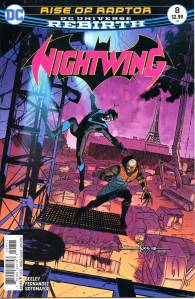
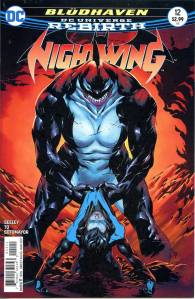
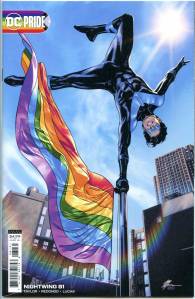
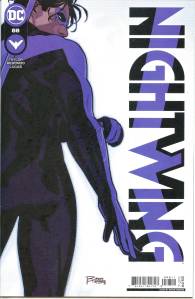
Following the erasure of the knowledge regarding his secret identity from most of the world in the final issue of Grayson, Dick went back to the Nightwing identity in the DC Rebirth era solo series, and the costume’s colors were changed back to the traditional black and blue. At the start of the series (rebirth) Nightwing is still a member of the Court of Owls (after Robin War) and he goes on missions around the world for the Court. They give him a partner named “Raptor” and like Nightwing he wears a costume, but he is much more violent than Dick and multiple times Dick has to try to stop him from killing. Throughout the story arc, Dick must work as an undercover agent but also has to keep his morals and not kill even if the Court tells him to.
The title was the first to feature Neal Adams‘ version of Batman, generating fan interest that led to Adams’ style defining the modern Batman image to this day. In addition, Adams updated Green Arrow‘s visual appearance by designing a new costume for the character in issue #85 (Aug.–Sept 1969). The primary artist for the second half of the run was Jim Aparo, starting with #98 (October–November 1971). Haney frequently disregarded continuity by scripting stories which contradicted DC’s canon or by writing major heroes in an out-of-character fashion. Issue #100 (Feb.–March 1972) featured Batman and “4 Famous Co-Stars” (Green Lantern, Green Arrow, Black Canary, and Robin) in a story by Haney and Aparo. Issues #112 (April–May 1974) to #117 (Feb.–March 1975) of the series were in the 100 Page Super Spectacular format.
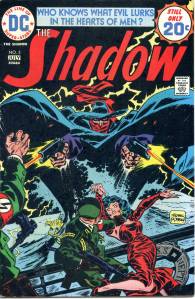
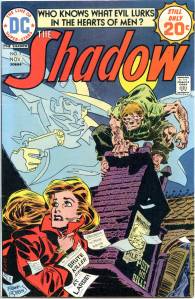
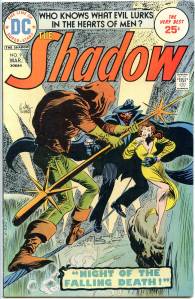
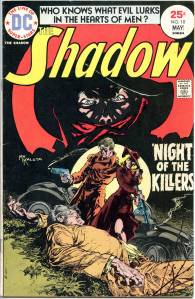
During the mid-1970s, DC Comics published an “atmospheric interpretation” of the character by writer Dennis O’Neil and artist Michael Kaluta in a 12-issue series (Nov. 1973 – Sept. 1975). Kaluta drew issues 1–4 and 6 and was followed by Frank Robbins and then E. R. Cruz. Attempting to be faithful to both the pulp-magazine and radio-drama character, the series guest-starred fellow pulp fiction hero the Avenger in issue #11.
“Menace of the Robot Raiders!” (Mystery In Space #53, October 1959) featured one of the most enduring and fondly remembered space heroes of the next ten years, Adam Strange, in a 10-page tale which led to the best known period for the Mystery In Space title. Adam Strange had begun in a three-issue run in Showcase #17 (November–December 1958), and although DC considered that those issues had not sold sufficiently to warrant granting him his own title, his return a year later in Mystery In Space#53 was to last an impressive 42 appearances over the next seven years. The Adam Strange space opera tales were crafted by Gardner Fox in the best Flash Gordon tradition, with the hero caught between two planets and a love a galaxy away, giant menacing robots, dust devils, perils on two worlds, and distinctive art by Carmine Infantino and Murphy Anderson who drew almost all issues until #92 (June 1964). A number of these stories are considered among the finest of the 1960s, including the full-issue tale “The Planet That Came to a Standstill!” (Mystery In Space #75, May 1962), which won comic fandoms Alley Award for the “Best Book-Length Story” of 1962, and was fairly unusual for the time inasmuch as it featured a cross-over with other major DC characters, the Justice League of America.
The Justice League has long protected Earth from all manner of foreign and alien invaders over the years, always keeping a vigilant eye to the skies for the next threat. But what if the threat was already walking the Earth…hiding in plain sight…watching…waiting for their moment to strike…
Supergirl starred in her first solo eponymous monthly series beginning in 1972 until October 1974, when her monthly title merged with Superman’s Girl Friend, Lois Lane, and Superman’s Pal Jimmy Olsen to produce a new title: then-highest DC selling series called The Superman Family, where she eventually became the steady lead story. Linda worked as a student advisor at New Athens Experimental School, before leaving for New York to follow a career in acting with daytime soap Secret Hearts.
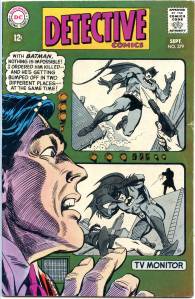
In 1964, Julius Schwartz was made responsible for reviving the fading Batman titles. Writer John Broome and artist Carmine Infantino jettisoned the sillier aspects that had crept into the franchise such as Ace the Bathound and Bat-Mite and gave the character a “New Look” that premiered in Detective Comics #327 (May 1964). Schwartz, Gardner Fox, and Infantino introduced, from the William Dozier produced TV series, Barbara Gordon as a new version of Batgirl in a story titled “The Million Dollar Debut of Batgirl!” in issue #359 (Jan. 1967).Mike Friedrich wrote the 30th anniversary Batman story in Detective Comics #387 (May 1969) which was drawn by Bob Brown.
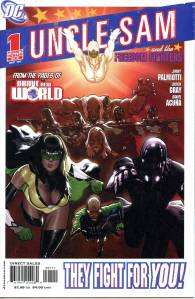
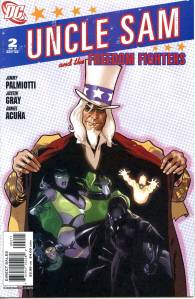
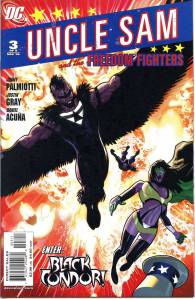
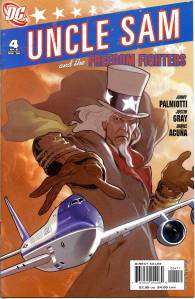
The miniseries Uncle Sam and the Freedom Fighters premiered in July 2006. This team consists of new incarnations of the Phantom Lady, the Ray (Stan Silver), the Human Bomb, Doll Man, Bigfoot, Destroyer and Face. It is part of S.H.A.D.E., a secret American government agency chartered under the USA PATRIOT Act, led by Father Time. The new team conducts assassinations and other illegal acts against criminal and terrorist organizations. As issue #1 of Uncle Sam and the Freedom Fighters begins, the team is tasked to capture the revived Uncle Sam, who is in the process of forming his own Freedom Fighters team; Sam subsequently recruits the S.H.A.D.E. members to his cause, openly disapproving of their use of deadly force (although they continue to kill people even under Uncle Sam’s guidance).
This version of the team is loosely based on notes by Grant Morrison and written by Jimmy Palmiotti and Justin Gray. Uncle Sam is portrayed as an almost Christ-like figure, returning from the dead, with the new Firebrand filling a John the Baptist role. Father Time is shown as aiding in Senator Frank Knight’s being secretly murdered in the midst of his successful campaign for the Presidency of the U.S. and replaced by a sentient robot double, Gonzo the Mechanical Bastard, who proceeds with an agenda to implant RFID chips in every U.S. citizen by law and control them to bring chaos to the world through war.
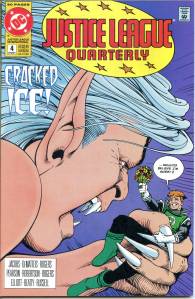
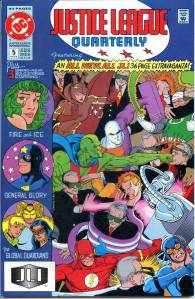
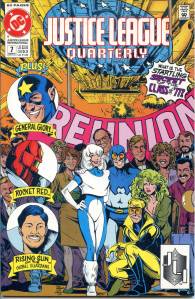
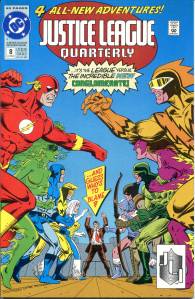
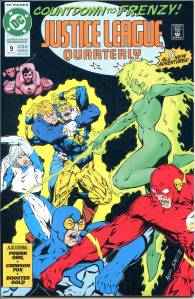
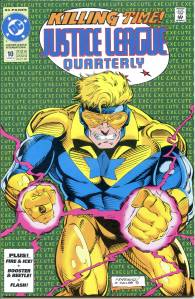
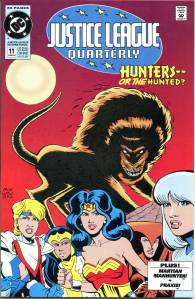
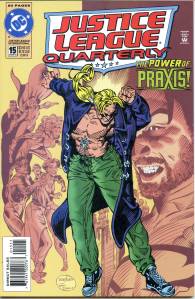
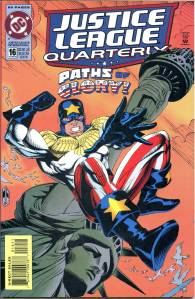
Justice League Quarterly (JLQ) was published from Winter 1990 to Winter 1994; it lasted 17 issues. It had a variable cast, pulling from the Justice League membership. The title centered on short stories featuring a differing number of characters, often solo stories, and in later issues often featured a pin-up section of members of the Justice League. Various writers and artists have worked on the title.
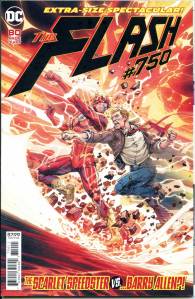
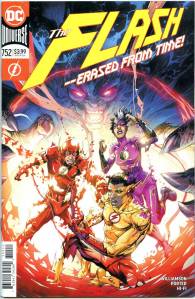
Meet Paradox: a new time-traveling villain with a tragic backstory who poses a big threat–and carries a big grudge against the Flash. He’s determined to destroy the Flash legacy at all costs, and he’s powerful enough to do it! With the Flash about to be erased from time and space, only one ally can help him defeat this seemingly insurmountable foe…Eobard Thawne, the Reverse-Flash? Can Barry Allen really trust his greatest enemy? And does he even have a choice?