Action Comics (2000’s)

Several major Superman storylines crossed over with Action Comics including “Emperor Joker” in 2000[and “Our Worlds at War” in 2001. John Byrne returned to Action Comics for issues #827–835 working with writer Gail Simone in 2005-2006.

After the “One Year Later” company-wide storyline, Action Comics had a crossover arc with the Superman series, titled “Up, Up and Away!” which told of Clark Kent attempting to protect Metropolis without his powers until eventually regaining them.

The “Last Son” storyline was written by Geoff Johns and Richard Donner, the director of the 1978 film Superman: The Movie, and was pencilled by Adam Kubert. This story introduced the original character, Christopher Kent and adapts the classic Superman film villains, General Zod, Ursa and Non into the regular DC Universe continuity. Issue #851 (August 2007) was presented in 3-D.

Starting with issue #875 (May 2009), written by Greg Rucka and drawn by Eddy BarrowsThara Ak-Var and Chris Kent, took Superman’s place as the main protagonists of the comic, while Superman left Earth to live on New Krypton. A Captain Atom back-up feature began in issue #879 (September 2009).

L.E.G.I.O.N (1988)

L.E.G.I.O.N. is a science fiction comic book created by Keith GiffenBill Mantlo and Todd McFarlane and published by DC Comics. The principal subject of the comic book is a team of fictional extraterrestrial superheroes. The characters first appeared in Invasion! #1 (December 1988). The original series chronicled the formation and activity of an interplanetary police force whose mission was to act as a peace-keeping force in their galaxy.

Action Comics (2010’s)

Although DC had initially announced Marc Guggenheim as writer of the title following the War of the Supermen limited series, he was replaced by Paul Cornell. Cornell featured Lex Luthor as the main character in Action Comics from issues #890-900 and Death appeared in issue #894, with the agreement of the character’s creator, Neil Gaiman. In April 2011, the 900th issue of Action Comics was released. It served as a conclusion for Luthor’s “Black Ring” storyline and a continuation for the “Reign of Doomsday” storyline. The final issue of the original series was Action Comics #904.

Justice League V4 (2020’s)

In 2019, Robert Venditti took over from Snyder, relaunching the title, taking place before Snyder’s run and after Metal.

In addition, two more Justice League titles were released. A new volume of Justice League Dark featuring a team led by Wonder Woman and John Constantine. The other, Justice League Odyssey, features Cyborg, Starfire, Green Lantern (Jessica Cruz), Azrael, and Darkseid as they search for answers in the Ghost Sector in one of Brainiac‘s old starships.

Following Dark Nights: Death Metal, Endless Winter and the beginning of Infinite Frontier, Brian Michael Bendis and David Marquez took over the reins of Justice League from Issue 59. While Superman, Batman, Aquaman, and Hawkgirl remained on the team, the team also includes Green Arrow, Black Canary, Black Adam, Queen Hippolyta and Naomi. It also include a Backstory for Justice League Dark.

Strange Adventures (1970’s)

Strange Adventures ran for 244 issues and was DC Comics’ first science fiction title. It began with an adaptation of the film Destination Moon. The sales success of the gorilla cover-featured story in Strange Adventures #8 (May 1951) led DC to produce numerous comic book covers with depictions of gorillas.

With issue #217, the title gained another new logo and began reprinting stories of Adam Strange and the Atomic Knights, among other stories. Several Strange Adventure stories were also reprinted in some of DC Comics’ later anthologies such as From Beyond the Unknown.

In 1978, DC Comics intended to revive Strange Adventures. These plans were put on hold that year due to the DC Implosion, a line-wide scaling back of the company’s publishing output. When the project was revived a year later, the title was changed to Time Warp and the series was in the Dollar Comics format.

Superman V1 (1980’s)

The 1980s saw radical revisions of Superman. DC decided to remove the multiverse in a bid to simplify its comics line. This led to the rewriting of the back story of the characters DC published, Superman included. John Byrne rewrote Superman, removing many established conventions and characters from continuity, including Superboy and Supergirl. Byrne also re-established Superman’s adoptive parents, The Kents, as characters. In the previous continuity, the characters had been written as having died early in Superman’s life (about the time of Clark Kent’s graduation from high school).

JSA (2000’s)

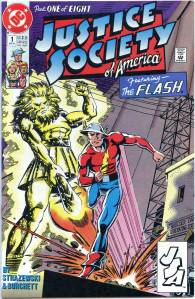
The JSA remained inactive for some time after the events of “Zero Hour“, but the surviving members (the Flash, Wildcat, and Alan Scott, (now going by the name Sentinel) have remained active throughout the DC Universe, having been placed as reserve JLI members, as evidenced in Justice League Europe #50.

The Justice Society was revived as a monthly series called JSA in 1999 which mixed the few remaining original members with younger counterparts. This incarnation of the team focused on the theme of generational legacy and of carrying on the heroic example established by their predecessors. The series was launched by James Robinson and David S. Goyer.  Goyer later co-wrote the series with Geoff Johns, who continued to write the series solo after Goyer’s departure. The series featured the art of Stephen SadowskiLeonard Kirk, and Don Kramer, among others. It featured a story by Pulitzer Prize winner Michael Chabon.
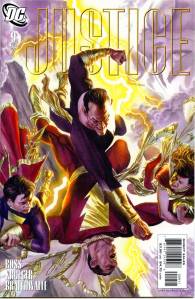
During the events of Infinite Crisis, some of the surviving Golden Age characters, such as Wildcat and the Flash, are transported to the new “Earth-Two”, as created by Alexander Luthor, and seem to recall the existence of the original one, albeit vaguely.


Dark Nights: Metal (2017)

The story involves Batman discovering a dark multiverse that exists beneath the core DC multiverse. It is revealed that both multiverses are connected through mysterious metals that Batman has encountered over the years. His investigations eventually result in him releasing seven evil versions of himself from the dark multiverse, led by the dark god known as Barbatos, who plans to unleash darkness across every Earth.

Crisis on Infinite Earths (1985)

Crisis on Infinite Earths was published by DC Comics from 1985 to 1986, consisting of an eponymous 12-issue, limited series comic book and a number of tie-in books. It was produced by DC Comics to simplify its then-50-year-old continuity. The series was written by Marv Wolfman and illustrated by George Pérez (pencils and layouts), Mike DeCarlo, Dick Giordano and Jerry Ordway (inking and embellishing). The series removed the multiverse concept from the fictional DC Universe, depicting the death of long-standing characters Supergirl and the Barry Allen incarnation of the Flash. Continuity in the DC Universe is divided into pre-Crisis and post-Crisis periods. The Flash was later reborn.

The series’ title was inspired by earlier multiverse crossover stories of parallel Earths, such as “Crisis on Earth-Two” and “Crisis on Earth-Three“, and involves almost every significant character in every parallel universe of DC Comics history. It inspired the titles of three DC crossover series: Zero Hour: Crisis in Time! (1994), Infinite Crisis (2005–2006), and Final Crisis(2008).

52 (2006)

52 debuted on May 10, 2006, one week after the conclusion of the Infinite Crisis miniseries. The series was written by Geoff JohnsGrant MorrisonGreg Rucka, and Mark Waid, with layouts by Keith Giffen. 52 also led into a few limited series spin-offs.

52 consists of 52 issues, published weekly for one year, each issue detailing an actual week chronicling the events that took place during the missing year after the end of Infinite Crisis. The series covers much of the DC Universe, and several characters whose disparate stories interconnect. The story is directly followed by the weekly limited series Countdown to Final Crisis. It was the first weekly series published by DC Comics since the short-lived anthology Action Comics Weekly in 1988–1989.