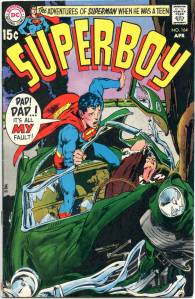
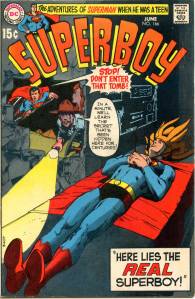
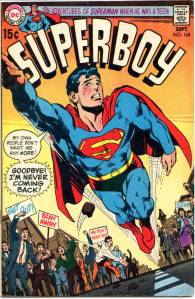
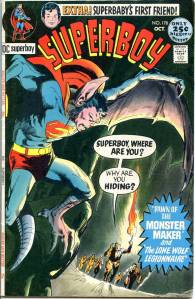
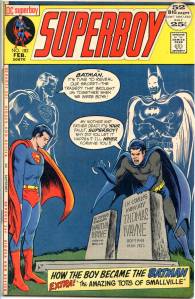
After the Legion pushed new Superboy stories out of Adventure Comics in 1963, Superboy became the only comic book to feature original Superboy stories. Less than two years after the Legion itself left Adventure Comics, Superboy became the Legion’s new home. Starting with Superboy #172 (March 1971), the Legion appeared as an occasional backup feature. Once again, the Legion feature proved so popular that by Superboy #197 (Sept. 1973), the Legion had become the lead feature, and with the next issue, the title’s only feature. Although from issue #197, the cover logo read Superboy starring the Legion of Super-Heroes (and replaced starring with #222), the official title (shown in the indicia) of the comic remained Superboy until #231 (Sept. 1977), when the comic became Superboy and the Legion of Super-Heroes. In issue #259 (Jan. 1980).
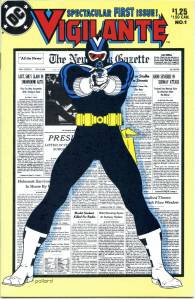
Vigilante was an ongoing series published from November of 1983 to February 1988. The series featured the honorable Adrian Chase, who was first introduced in the pages of New Teen Titans Annual #2. Spanning a total of fifty issues and two Annuals, the series ended with the death of the main character.
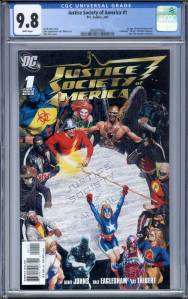
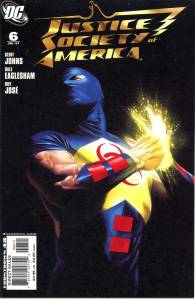
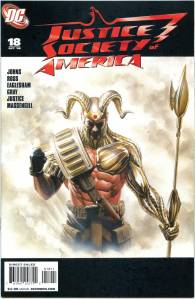
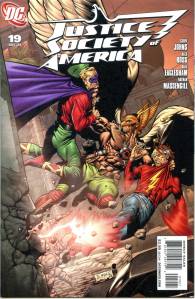
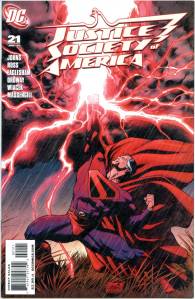
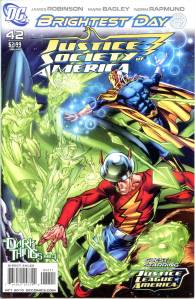
On December 6, 2006, a new series was launched with the creative team of Geoff Johns (writer), Dale Eaglesham (pencils), and Alex Ross (cover art). The beginning of the new series showed JSA veterans the Flash, Green Lantern, and Wildcat choosing members of the new generation of superheroes to train. Continuing a major theme from the previous JSA title, this new series focused on the team being the caretakers of the superhero legacy from one generation to the next.
Justice Society of America #1 CGC 9.8 White Pages $89
Justice Society of America V3 #1 VF-NM $9
Justice Society of America V3 #5 NM $5
Justice Society of America #6 NM $5
Justice Society of America #8 NM- $3
Justice Society of America V3 #9 NM $5
Justice Society of America #11 VF+ $2
Justice Society of America V3 #11 NM $4
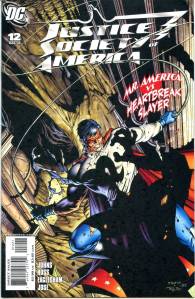
Justice Society of America V3 #12 NM $4
Justice Society of America V3 #13 NM $4
Justice Society of America V3 #14 NM $4
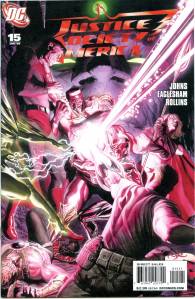
Justice Society of America V3 #15 NM $4
Justice Society of America V3 #16 NM $4
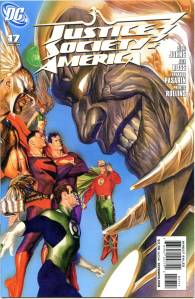
Justice Society of America #17 NM $4
Justice Society of America V3 #17 NM $4
Justice Society of America #18 NM $4
Justice Society of America V3 #19 NM $4
Justice Society of America V3 #20 NM $4
Justice Society of America #21 NM $4
Justice Society of America V3 #21 VF-NM $2
Justice Society of America V3# 22 NM- $3
Justice Society of America V3 #25 NM- $3
Justice Society of America V3 #26 NM $4
Justice Society of America V3 #42 NM $4
Justice Society of America Kingdom Come Special – Superman VF-NM $6
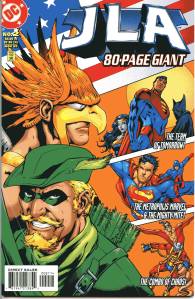
The low sales of the various Justice League spinoff books by the mid-1990s prompted DC to revamp the League as a single team (all the various branch teams were disbanded) on a single title. A Justice League of America formed in the September 1996 limited seriesJustice League: A Midsummer’s Nightmare by Mark Waid and Fabian Nicieza. In 1997, DC Comics launched a new Justice League series titled JLA, written by Grant Morrison with art by Howard Porter and inker John Dell. Morrison stayed as writer for the series through issue #41, though several issues had fill-in writers. JLA #18-#21 and #33 were written by Mark Waid. Mark Millar, Devin Grayson and Mark Waid, and J.M. DeMatteis wrote issues #27, #32 and #35 respectively.
This series, in an attempt at a “back-to-basics” approach, used as its core the team’s original and most famous seven members (or their successors): Superman, Batman, Wonder Woman, Aquaman, Flash (Wally West), Green Lantern (Kyle Rayner), and the Martian Manhunter. Additionally, the team received a new headquarters, the “Watchtower“, based on the Moon. JLA quickly became DC’s best-selling title, a position it enjoyed off and on for several years.
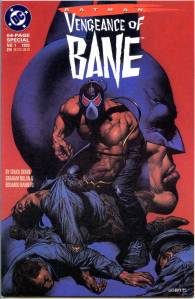
Chuck Dixon, Doug Moench and Graham Nolan created the character of Bane for the Knightfall storyline. Both Dixon and Moench wrote the character’s first appearance in Vengeance of Bane, with art by Graham Nolan. They developed the concept of Bane after an initial idea by Batman editor Dennis O’Neil.
O’Neil had previously created Bane’s birthplace of Santa Prisca in The Question and the drug Venom in the storyline of the same name (published in the pages of Legends of the Dark Knight #16–20, and later reprinted as a trade paperback). In the pages of Azrael, O’Neil introduced Bane’s perception of Venom as both an addiction and the weakness responsible for his earlier defeats.
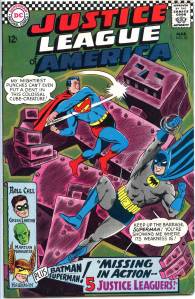
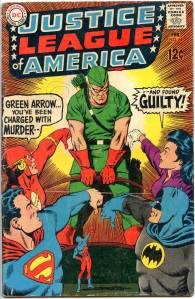
The initial Justice League lineup included seven of DC Comics’ superheroes who were regularly published at that time: Superman, Batman, Aquaman, Flash, Green Lantern, Martian Manhunter, and Wonder Woman. Rarely featured in most of the stories, Superman and Batman did not even appear on the cover most of the time. Three of DC’s other surviving or revived characters, Green Arrow,the Atom, and Hawkman were added to the roster over the next four years.
The title’s early success was indirectly responsible for the creation of the Fantastic Four. In his autobiography Stan Lee relates how in 1961, during a round of golf, DC publisher Jack Liebowitz mentioned to Marvel-Timely owner Martin Goodman how well DC’s new book (Justice League) was selling. Later that day Goodman, a publishing trend-follower aware of the JLA’s strong sales, told Lee, his comics editor, to come up with a team of superheroes for Marvel.
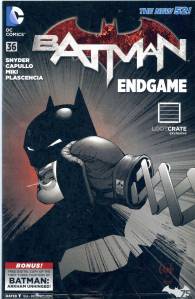
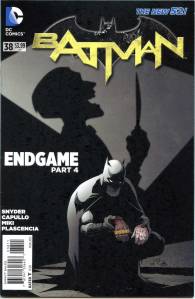
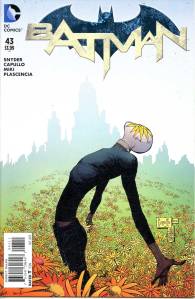
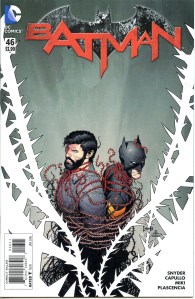
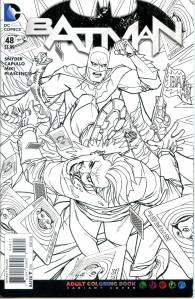
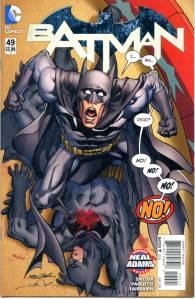
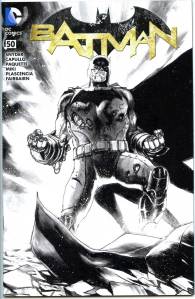
Since the beginning of The New 52, Scott Snyder has been the writer of the flagship Batman title. His first major story arc was “Night of the Owls“, where Batman confronts the Court of Owls, a secret society that has controlled Gotham for centuries. The second story arc was “Death of the Family“, where the Joker returns to Gotham and simultaneously attacks each member of the Batman family. The third story arc was “Batman: Zero Year“, which redefined Batman’s origin in The New 52. It followed Batman #0, published in June 2012, which explored the character’s early years. The final storyline before the Convergence (2015) event was Endgame, depicting the supposed final battle between Batman and the Joker when he unleashes the deadly Endgame virus onto Gotham City. The storyline ends with Batman and the Joker’s supposed deaths. Starting with #41, Commissioner James Gordon takes over Bruce’s mantle as a new, state-sanctioned, mecha Batman, debuting in the Free Comic Book Day special comic Divergence. However, Bruce Wayne is soon revealed to be alive, albeit now suffering almost total amnesia of his life as Batman and only remembering his life as Bruce Wayne through what he has learned from Alfred. Bruce Wayne finds happiness and proposes to his girlfriend, Julie, but Mr. Bloom heavily injures Jim Gordon and takes control of Gotham City and threatens to destroy the city by energizing a particle reactor to create a “strange star” to swallow the city. Bruce Wayne discovers the truth that he was Batman and after talking to a stranger who smiles a lot (it is heavily implied that this is the amnesic Joker) he forces Alfred to implant his memories as Batman, but at the cost of his memories as the reborn Bruce Wayne. He returns and helps Jim Gordon defeat Mr. Bloom and shut down the reactor. Gordon gets his job back as the commissioner, and the government Batman project is shuttered.
Batman: Beyond the White Knight takes place 12 years after the events which are described in the previous volume Batman: Curse of the White Knight, which ended with Bruce Wayne exposed as Batman to the general public and donating his entire fortune to the people of Gotham City, and then turning himself in to the police. Since that, the city has evolved into a futuristic megalopolis known as “Neo-Gotham”. Following the murder of his father Warren, young Terry McGinnis — under the orders of his employer Derek Powers — steals a technologically advanced Batsuit to become the new Batman and avenge his father’s death. At the same time, a middle-aged Bruce escapes from prison in an attempt to rid Neo-Gotham of Batman for good, all while a civil war slowly rages through the city and Powers transforms into the supervillain Blight.
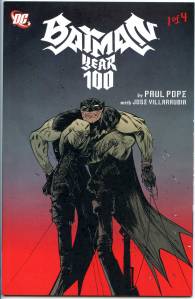
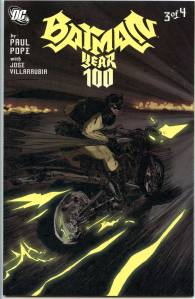
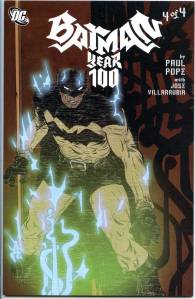
In the year 2039, Gotham City is very nearly a police state, its citizens subject to unwarranted search and seizure. The Gotham Police clash almost daily with Federal agents, who are pursuing the legendary “Batman.” Captain Gordon, the grandson of the original Commissioner Gordon, is also trying to find Batman, and find out what he knows about the murder of a Federal agent.
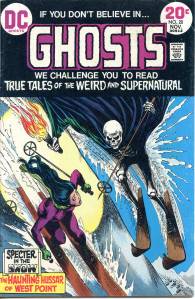
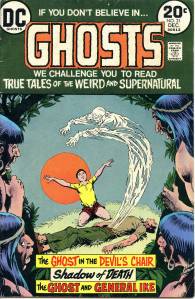
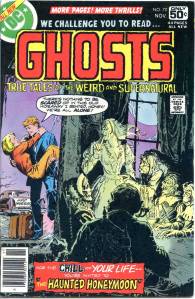
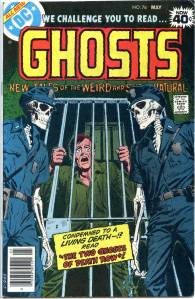
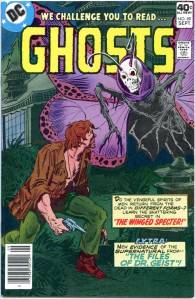
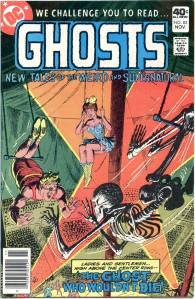
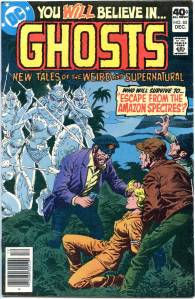
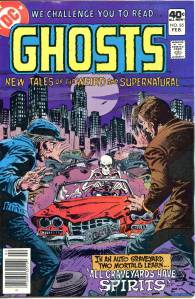
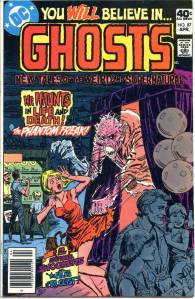
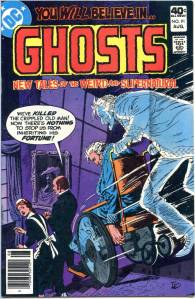
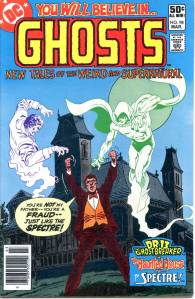
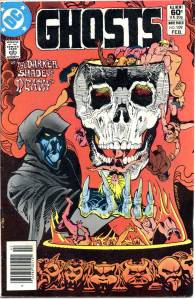
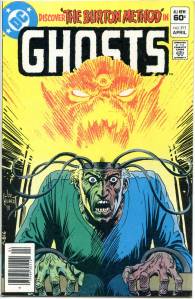
Each issue of Ghosts carried multiple stories of the supernatural. The stories were prefaced by a short description introducing the premise and ended with a summation of how a mysterious justice was dealt to the evildoers of the tale. The first issue of this series carried the singular title Ghost in its indicia, but everywhere else, including advance promotional house ads and even on its own cover, it was the plural Ghosts, as even the indicia would read from #2 on. Limited Collectors’ Edition #C–32 (Dec. 1974–Jan. 1975) reprinted stories from Ghosts #1, 3–6 and featured new material by Leo Dorfman and artists Gerry Talaoc, E. R. Cruz, and Frank Redondo.










































 EHT Comics