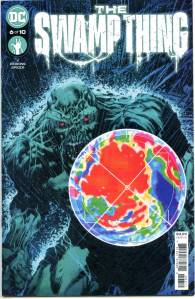
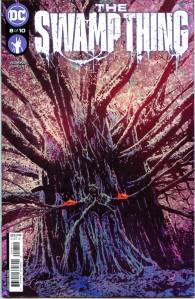
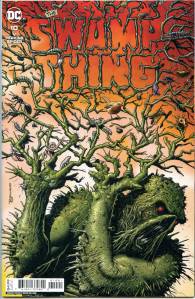
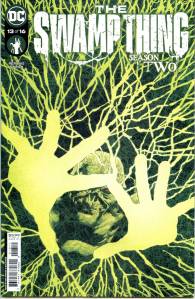
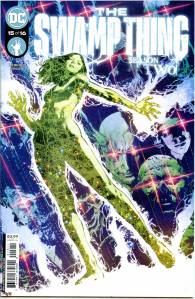
Swamp Thing returns in a new series that stars Levi Kamei as the next Guardian of the Green. Unable to control his transformation into the monstrous Swamp Thing, Levi is thrust into the harsh, unforgiving mystery of grisly murders committed by a supernatural desert legend. Levi must revisit past events in his homeland of India and face the deadly reality of a ravenous new villain in order to comprehend what he is truly, and horrifyingly, becoming.
Frank Miller‘s limited series The Dark Knight Returns (February–June 1986), which tells the story of a 55-year old Batman coming out of retirement in a possible future, reinvigorated the character. The Dark Knight Returns was a financial success and has since become one of the medium’s most noted touchstones. The series also sparked a major resurgence in the character’s popularity.
That year Dennis O’Neil took over as editor of the Batman titles and set the template for the portrayal of Batman following DC’s status quo-altering miniseries Crisis on Infinite Earths. O’Neil operated under the assumption that he was hired to revamp the character and as a result tried to instill a different tone in the books than had gone before. One outcome of this new approach was the “Year One” storyline in Batman #404–407 (February–May 1987), in which Frank Miller and artist David Mazzucchelli redefined the character’s origins. Writer Alan Moore and artist Brian Bolland continued this dark trend with 1988’s 48-page one-shotBatman: The Killing Joke, in which the Joker, attempting to drive Commissioner Gordon insane, cripples Gordon’s daughter Barbara, and then kidnaps and tortures the commissioner, physically and psychologically.
The Batman comics garnered major attention in 1988 when DC Comics created a 900 number for readers to call to vote on whether Jason Todd, the second Robin, lived or died. Voters decided in favor of Jason’s death by a narrow margin of 28 votes (see Batman: A Death in the Family). The following year saw the release of Tim Burton‘s Batman feature film, which firmly brought the character back to the public’s attention, grossing millions of dollars at the box office, and millions more in merchandising.
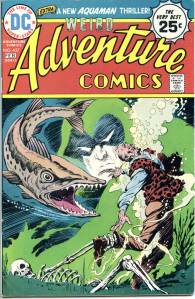
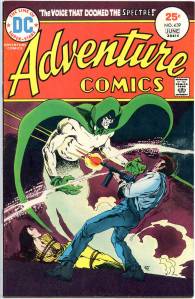
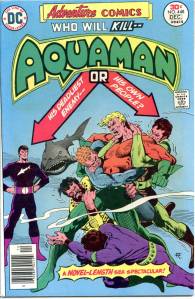
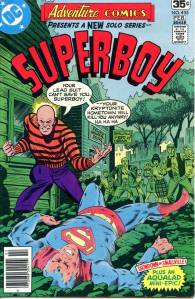
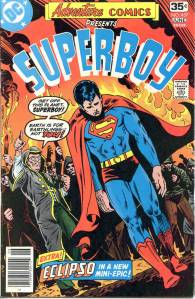
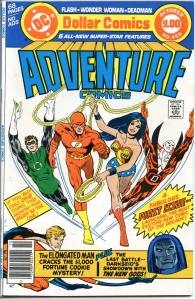
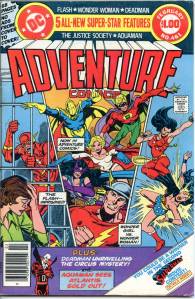
In the late 70’s conventional superheroes returned to the book, beginning behind the Spectre, first a three-issue run of Aquaman (issues #435–437, an early assignment for Mike Grell) and then a newly drawn 1940s Seven Soldiers of Victory script (issues #438–443). Aquaman was promoted to lead (issues #441–452), and backing him up were three-part story arcs featuring the Creeper (#445–447), the Martian Manhunter (#449–451), bracketed by issue-length Aquaman leads. He was awarded his own title and Superboy (#453–458) took over Adventure with Aqualad (#453–455) and Eclipso (#457–458) backups. Following this was a run as a Dollar Comic format giant-sized book (issues #459–466), including such features as the resolution of Return of the New Gods (cancelled in July–August 1978), “Deadman“, and the “Justice Society of America“.
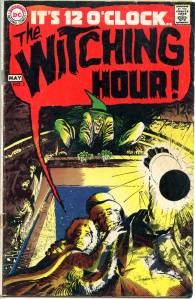
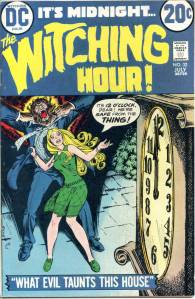
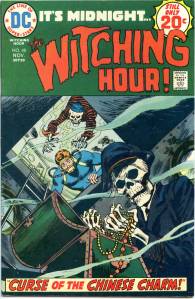
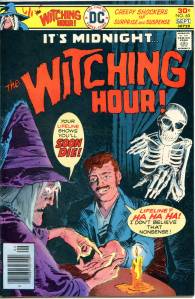
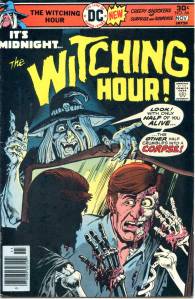
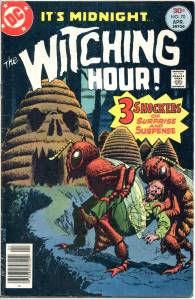
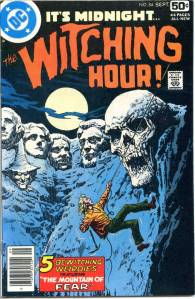
The series was published for 85 issues from February–March 1969 to October 1978. Its tagline was “It’s 12 o’clock… The Witching Hour!” and was changed to “It’s midnight…” from issue #14 onwards. The series was originally edited by Dick Giordano, who was replaced by Murray Boltinoff with issue #14.Nick Cardy was the cover artist for The Witching Hour for issues #1–6, 11–12, 15–16, 18–52, and 60. Stories in the comic were “hosted” and introduced by three witches, Morded, Mildred, and Cynthia.
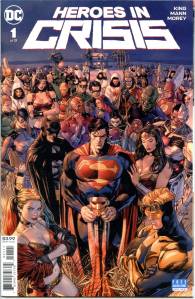
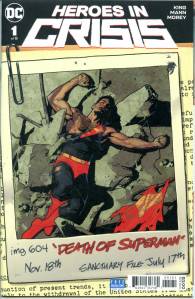
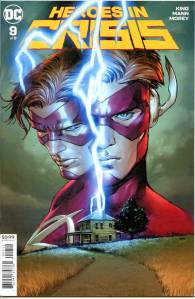
Heroes in Crisis primarily deals with the emotional cost of being a superhero and explores “what violence does to a society”, a common theme in King’s work. King, a former CIA counterterrorism officer, believed this was an important subject that needed to be discussed. King described this creative decision: “Comic books, throughout the whole history of the medium, have been reflective of history. In World War II, there were comics about fighting in World War II. In the seventies, the comics were about psychedelic escape. Today, our moment right now is a moment of violence and living with violence and our comics have to address that”.
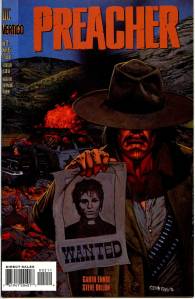
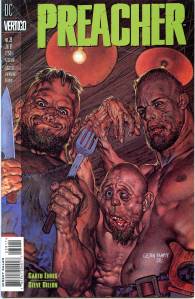
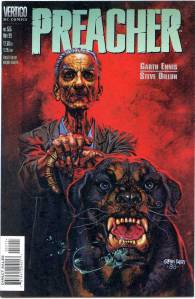
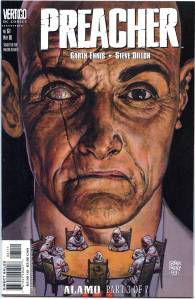
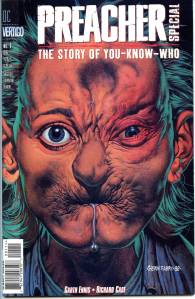
Preacher tells the story of Jesse Custer, a preacher in the small Texas town of Annville. Custer was accidentally possessed by the supernatural creature named Genesis in an incident which killed his entire congregation and flattened his church.
Custer, driven by a strong sense of right and wrong, goes on a journey across the United States attempting to (literally) find God, who abandoned Heaven the moment Genesis was born. He also begins to discover the truth about his new powers. They allow him, when he wills it, to command the obedience of those who hear and comprehend his words. He is joined by his old girlfriend Tulip O’Hare, as well as a hard-drinking Irish vampire named Cassidy.
The world of Batman: White Knight expands with this standalone tale! On the night of Bruce Wayne’s traumatic birth, Victor Fries must intervene to save the lives of Martha Wayne and the future Batman. As the evening unfolds, Victor distracts Thomas with the incredible tale of his own father figures-one a Nazi, the other a Jew-and their complex connection to Wayne Laboratories. As the Third Reich roars into power, the deep friendship and working relationship between the Baron von Fries and his research partner, Jacob Smithstein, is in crisis. Ordered by Himmler to speed development of their cryotechnology in service of world domination, Smithstein is forced to go into hiding and compromise his moral code in order to save his wife and infant daughter, Nora, from persecution and certain death. When the S.S. ramps up surveillance over the project, young Victor begins to question his father’s true allegiance. Both families are driven toward an impossible choice and a sinister standoff, and Victor makes a pact with Smithstein that will ripple through generations.
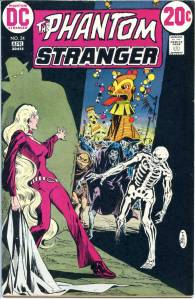
After an appearance in Showcase #80 (February 1969), he received another series beginning May–June 1969 that lasted until February–March 1976. The Showcase appearance and the first three issues of Phantom Stranger consisted of reprints from both the 1950s title and the “Dr. 13: Ghost-Breaker” feature from the last nine issues of Star Spangled Comics at the same time, with new, brief framing sequences. These had Dr. Thirteen, certain that the Phantom Stranger was an impostor, determined to expose him.
Beginning with issue #4 (November-December 1969), the series began featuring all-new material, with stories produced by Robert Kanigher, Len Wein, Jim Aparo, Neal Adams, Tony DeZuniga and others. In these stories, while the Stranger’s past remained a mystery, the writers added a semi-regular cast of characters for him. A demonic sorceress named Tala would become his archenemy; an alchemist/sorcerer named Tannarak was first an enemy and would later assist him against the Dark Circle; and a blind psychic named Cassandra Craft would assist him. Doctor Thirteen, dropped along with the reprints, was given a back-up series here as of #12 (March-April 1971) which morphed into “The Spawn of Frankenstein” in #23 (January-February 1973).
The second volume originally ended with the forty-first issue in November 1975, cover dated March 1976. In January 2010, a forty-second issue was added to the second series during the Blackest Night event, effectively a one-shot.
In response to the restrictions imposed by the Comics Code Authority, DC began a new science-fiction series in 1956. The series featured artwork by Murphy Anderson, Gil Kane, and many others, with stories by John Broome, Gardner Fox, and additional writers. It was an anthology comic for many years, publishing a variety of science fiction stories. The series featured Space Ranger as of issue #40 and running through #82 (April–May 1964) Other features included the “Green Glob” (issues #85–98, 100, 102, 103) and “Automan” (issues #91, 94, 97). The series’ last issue as Tales of the Unexpected was #104 (December 1967–January 1968). As of issue #105 (February–March 1968), the title was shortened to The Unexpected.
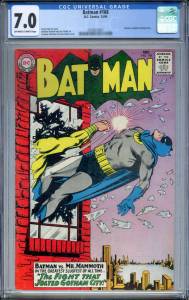
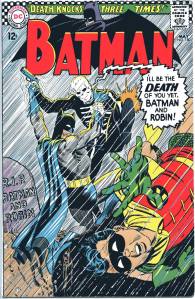
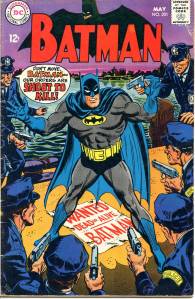
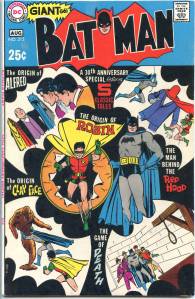
By 1964, sales of Batman titles had fallen drastically. Bob Kane noted that, as a result, DC was “planning to kill Batman off altogether”. In response to this, editor Julius Schwartz was assigned to the Batman titles. He presided over drastic changes, beginning with 1964’s Detective Comics #327 (May 1964), which was cover-billed as the “New Look”. Schwartz introduced changes designed to make Batman more contemporary, and to return him to more detective-oriented stories. He brought in artist Carmine Infantino to help overhaul the character. The Batmobile was redesigned, and Batman’s costume was modified to incorporate a yellow ellipse behind the bat-insignia. The space aliens, time travel, and characters of the 1950s such as Batwoman, Ace, and Bat-Mite were retired. Bruce Wayne’s butler Alfred was killed off (though his death was quickly reversed) while a new female relative for the Wayne family, Aunt Harriet, came to live with Bruce Wayne and Dick Grayson.







































 EHT Comics