Starring Dave Steven’s classic Pulp-inspired character The Rockeeter (later made into a big-budget Hollywood movie). Guest-stars other clasiic Pulp Characters (The Shadow, Doc Savage, etc.) and Bettie Page. Beautiful art & a thrilling storyline. Includes “Brucilla The Muscle: Galactic Girl Guide” by Elaine Lee & Michael Kaluta as a back-up feature.
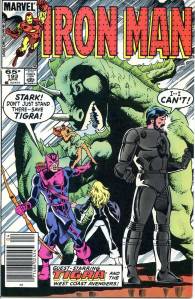
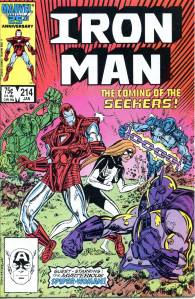
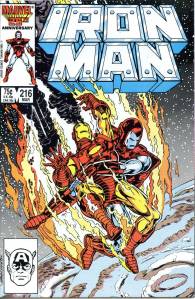
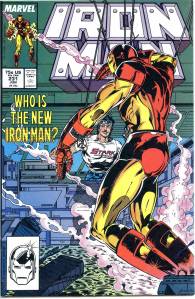
Tony Stark’s health deteriorates, and he discovers the armor’s cybernetic interface is causing irreversible damage to his nervous system. His condition is aggravated by a failed attempt on his life by Kathy Dare, a mentally unbalanced former lover, which injures his spine, paralyzing him.[68] Stark has a nerve chip implanted into his spine to regain his mobility.[69] Stark’s nervous system continues its slide towards failure, and he constructs a “skin” made up of artificial nerve circuitry to assist it. Stark begins to pilot a remote-controlled Iron Man armor, but when faced with the Masters of Silence, the telepresence suit proves inadequate. Stark designs a more heavily armed version of the suit to wear, the “Variable Threat Response Battle Suit”, which becomes known as the War Machine armor. Ultimately, the damage to his nervous system becomes too extensive.
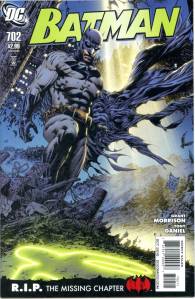
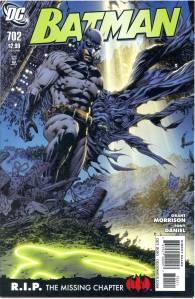
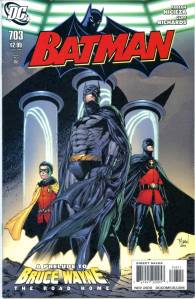
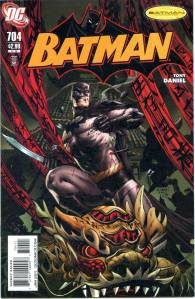
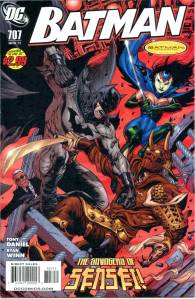
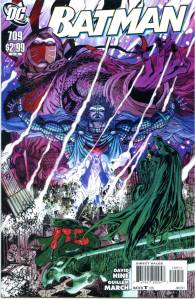
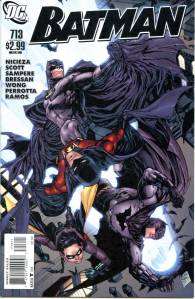
In 2010, the storyline Batman: The Return of Bruce Wayne saw Bruce travel through history, eventually returning to the present day. Although he reclaimed the mantle of Batman, he also allowed Grayson to continue being Batman as well. Bruce decided to take his crime-fighting cause globally, which is the central focus of Batman Incorporated. DC Comics would later announce that Grayson would be the main character in Batman, Detective Comics, and Batman and Robin, while Wayne would be the main character in Batman Incorporated. Also, Bruce appeared in another ongoing series, Batman: The Dark Knight.
Tales brought to you by some of the best and emerging talent in comics. Marvel’s Voices, the podcast series that explores diverse storytellers and their journeys, leaps onto the page in these comic anthologies starring favorite Marvel heroes.
Voyager, the mysterious heroine at the center of the No Surrender event, has sought to recruit a team of Avengers to deal with a terrible threat – the powerful Queen of Night is stealing the light throughout the universe. Now Hawkeye, the Immortal Hulk, Hercules, Scarlet Witch, Vision, Spectrum and newest addition Rocket Raccoon must assemble to face this threat through space and… into the Hyborian Age?
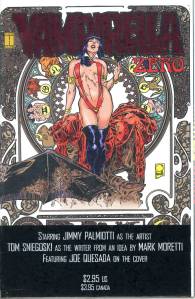
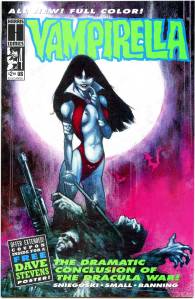
This story picks up after the end of “Morning in America” with United States Senator Adam Van Helsing using his political power to wage war against the world-wide forces of the Cult of Chaos and Vampirella and her friend Pendragon serving as his foremost shock-troops. Vampirella and Pendragon travel to Europe where they discover that Chaos’s tendrils reach to the highest level of the European Union’s leadership, and that their old foe Dracula is poised to seize control of the Continent on behalf of the Mad God he serves.
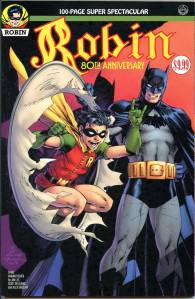
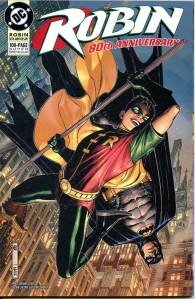
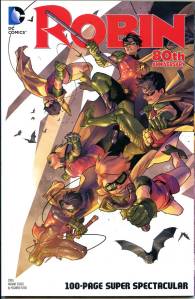
DC Comics celebrates Robin the Boy Wonder’s 80th anniversary in style with an all-star creative team representing each iteration of the iconic character across eight decades of history! From the high-flying adventures of Dick Grayson to the tragedy of Jason Todd, the enthusiasm of Tim Drake and the arrogance of Damian Wayne, the persistence of Stephanie Brown and the rebelliousness of Carrie Kelley-the mantle of Robin has been worn by many, but always represents one thing: a hero.
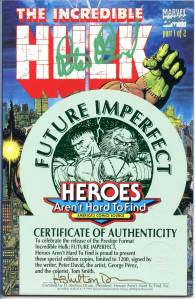
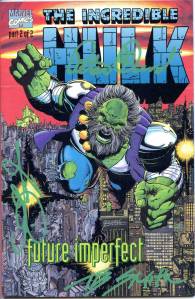
The Incredible Hulk travels to an apocalyptic future to face his ultimate challenge…himself. Meet the Maestro, the Hulk’s future imperfect self. Approximately a hundred years into the future, a nuclear war has killed almost all of Earth‘s superhumans and has taken the world to the brink of extinction. A future version of the Hulk called Maestro has seized control after being driven insane by the nuclear radiation he has absorbed and the bitterness he feels towards the world at his continued treatment. He has the intelligence of Bruce Banner and the absorbed radiation has significantly enhanced his strength. Can even the Green Goliath defeat a foe whose strength rivals his own? A foe who knows his every move before he even makes it?
Incredible Hulk – Future Imperfect #1 Signed Set NM $159
Incredible Hulk – Future Imperfect #2 Signed Set NM $159
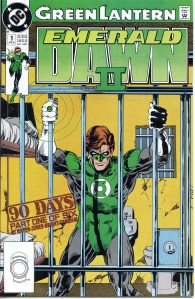
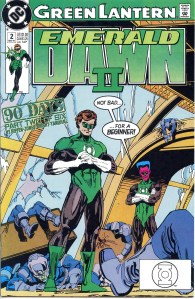
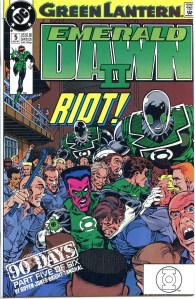
Green Lantern: Emerald Dawn II is the sequel to Green Lantern: Emerald Dawn. It was published from April 1991 through September 1991. Now that Hal Jordan has proven himself worthy of wielding a power ring as a member of the intergalactic Green Lantern Corps, he is expected to earn his place alongside his 3,600 brethren. His instructor is one of the mightiest warriors in the Corps – the Green Lantern called Sinestro. Jordan struggles to meet Sinestro’s exacting standards on distant Korugar while also serving out his 90 day prison term for drunk driving on Earth. But his mettle is truly tested when Sinestro’s darkest secret is revealed.
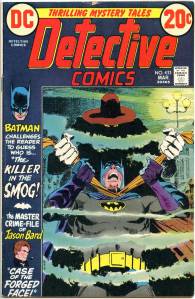
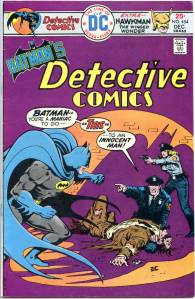
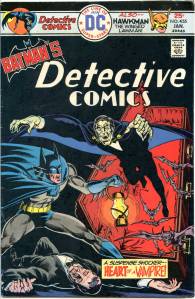
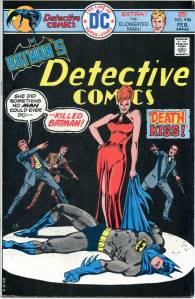
Writer Dennis O’Neil and artist Neal Adams had their first collaboration on Batman on the story “The Secret of the Waiting Graves” in issue #395 (Jan. 1970). The duo, under the direction of Schwartz, would revitalize the character with a series of noteworthy stories reestablishing Batman’s dark, brooding nature and taking the books away from the campy look and feel of the 1966–68 ABCTV series. Comics historian Les Daniels observed that “O’Neil’s interpretation of Batman as a vengeful obsessive-compulsive, which he modestly describes as a return to the roots, was actually an act of creative imagination that has influenced every subsequent version of the Dark Knight.” Adams introduced the Man-Bat with writer Frank Robbins in Detective Comics #400 (June 1970). O’Neil and artist Bob Brown crafted Batman’s first encounter with the League of Assassins in Detective Comics #405 (Nov. 1970) and created Talia al Ghul in issue #411 (May 1971).
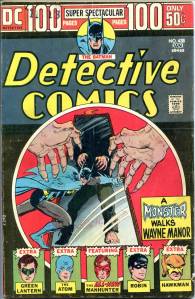
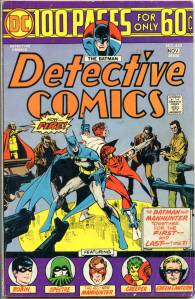
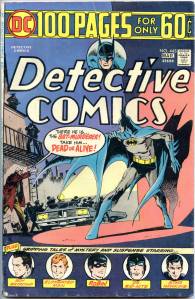
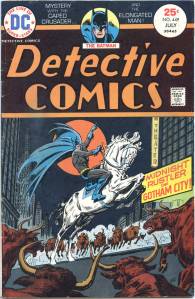
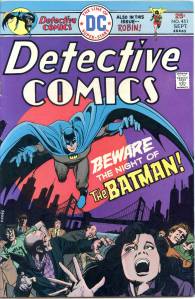
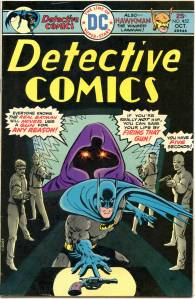
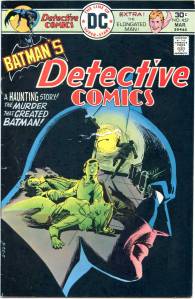
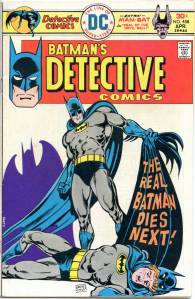
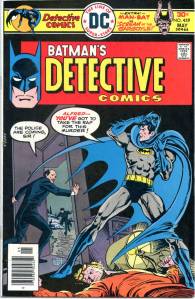
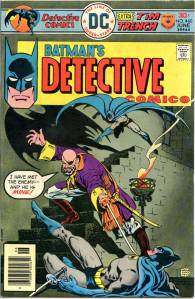
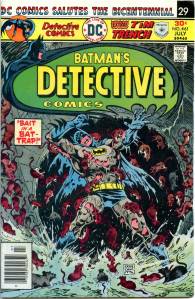
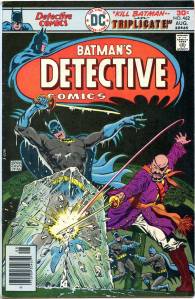
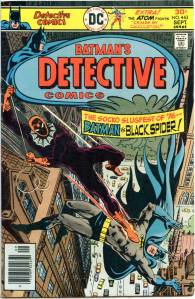
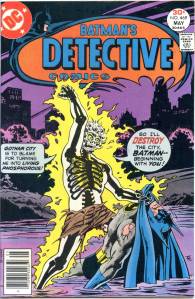
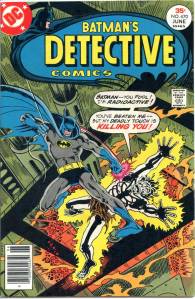
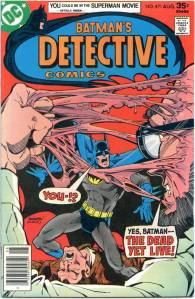
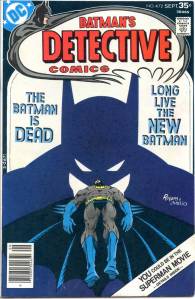
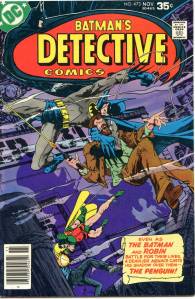
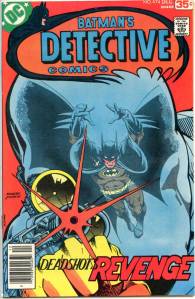
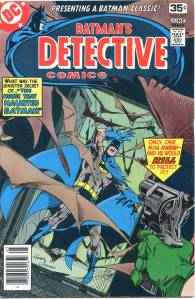
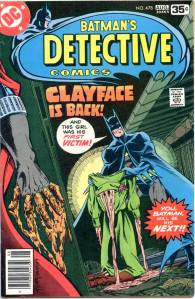
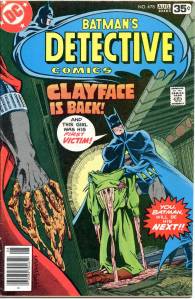
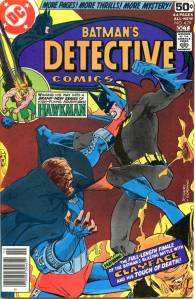
After publishing on a monthly schedule throughout its run, Detective Comics became a bi-monthly book from issues #435 (June–July 1973) to #445 (Feb.-March 1975). Issues #438 (Dec. 1973-Jan. 1974) to #445 (Feb.–March 1975) of the series were in the 100 Page Super Spectacular format. O’Neil and artist Dick Giordano created the Batman supporting character Leslie Thompkins in the story “There Is No Hope in Crime Alley” appearing in issue #457 (March 1976). Writer Steve Englehart and artist Marshall Rogers produced an acclaimed run of Batman stories in Detective Comics #471–476 (Aug. 1977 – April 1978), and provided one of the definitive interpretations that influenced the 1989 Batman movie and would be adapted for the 1990s animated series. The Englehart and Rogers pairing, was described in 2009 by comics writer and historian Robert Greenberger as “one of the greatest” creative teams to work on the Batman character. In their story “The Laughing Fish”, the Joker is brazen enough to disfigure fish with a rictus grin, then expects to be granted a federal trademark on them, only to start killing the bureaucrats who try to explain to him that obtaining such a claim on a natural resource is legally impossible. Writer Len Wein and Rogers co-created the third version of the supervillain Clayface in Detective Comics #478 (July–Aug. 1978). The original Katherine Kane also known as “Batwoman” was killed in the lead story in issue #485 (Aug.–Sept. 1979) by the League of Assassins.





































 EHT Comics