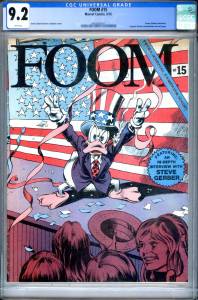
Jim Steranko, in his first-issue introduction, wrote that he had “dropped in at the Marvel bullpen to rap with [publisher] Stan Lee about the current comic scene” and that Lee told him about plans to start an in-house fan club. EC Comics had had its “EC Fan-Addict” club in the 1950s, and Marvel the Merry Marvel Marching Society beginning 1964; after the MMMS had run its course by 1969, Marvel licensed a small company in Culver City, California to produce the fanzine/product catalog Marvelmania, which lasted a year. Steranko, writing that he nostalgically “recalled the days of radio, with all the clubs and super-premiums that were perpetually offered over the air”, volunteered “my services as a designer, writer and comic historian”. Ken Bruzenak served as associate editor, with Marvel editor-in-chief Roy Thomas as consulting editor and Ed Noonchester, Joel Thingvall, and Gary Brown as staff.
Tag: Bronze Age
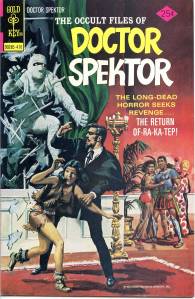
The Occult Files of Doctor Spektor (1970’s)
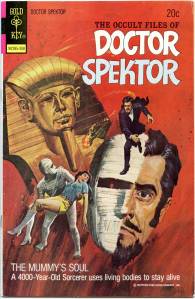
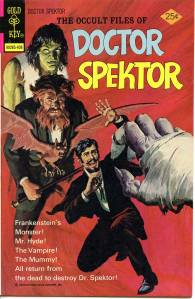
After his first appearance in a 10-page story in Mystery Comics Digest #5, Dr. Spektor was spun off into his own title, The Occult Files of Doctor Spektor. The series ran for 24 issues (May 1973 – February 1977). His final original story appeared in one issue of Gold Key Spotlight (#8, August 1977). Jesse Santos replaced Spiegle as artist on the series, and remained there for the entire run.
Dr. Spektor appeared in all four issues of Gold Key’s Spine-Tingling Tales (1975–76), where he provided linking narration for some of the stories within. (These stories were reprints from Mystery Comics Digest that dealt with characters who later appeared in his title). He also had stories he narrated in Mystery Comics Digest #10, #11, #12, and #21, and articles in Golden Comics Digest #25, #26, and #33.
Under the Whitman Comics name, issue #25 was released in May 1982. It reprinted issue #1, but with a line-art cover instead of the original painted cover.
In 2014, Dynamite Entertainment released a new version of “Doctor Spektor”, written by Mark Waid and drawn by Greg Pak, as part of the company’s revival of several Gold Key characters (which also included Magnus, Robot Fighter, Dr. Solar and Turok)
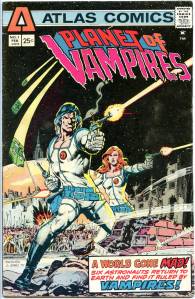
Planet of the Vampires (1975)
In the far-off era of 2010 AD, astronauts return from space to find Earth ruled by technological geniuses who live on human blood. They join the primitive resistance fighters who dwell outside the domed cities. Part of the short-lived Atlas science fiction line from former Marvel publisher Martin Goodman.
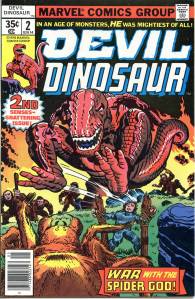
Devil Dinosaur (1978)
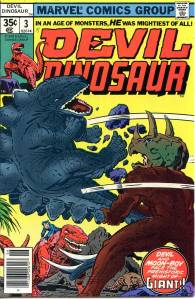
Devil Dinosaur and Moon-Boy are the creations of artist Jack Kirby who scripted and penciled all nine issues of the first series. Devil Dinosaur was created during Kirby’s third stint at Marvel (1975–1978). Having learned that DC Comics was working on an animated series featuring Kirby’s Kamandi, Marvel attempted to one-up their competitor by instructing Kirby to create a series similar to Kamandi, but incorporating a dinosaur co-star, since dinosaurs were hugely popular with young audiences of the time. The resulting Devil Dinosaur series was short lived, lasting only nine months (April – December 1978), and the proposed animated series never entered development. The original Devil Dinosaur series chronicled Devil and Moon-Boy’s adventures in their home, “Dinosaur World”. After the cancellation of Devil Dinosaur, the character’s appearances were relegated to one-shot comics, cameos, and supporting roles in other series.
Monsters on the Prowl (1971)
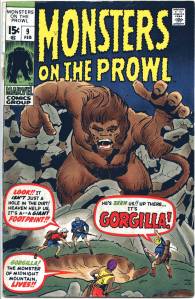
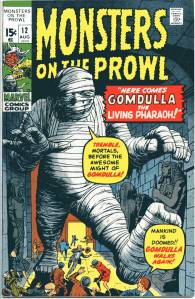
Chamber of Darkness was retitled Monsters on the Prowl with issue #9 (Feb. 1971), this version ran one new story each issue through #13 (Oct. 1971) with the remaining content consisting of reprints from Atlas Comics, Marvel’s 1950s predecessor, and “pre-superhero Marvel”, primarily drawn by Jack Kirby or Steve Ditko. It expanded into a double-sized, 25-cent comic for two issues (#13-14, Oct.-Dec. 1971). Some issues of the reprint books featured new covers by John Severin, Marie Severin, Gil Kane, and Herb Trimpe.
Vision and the Scarlet Witch V1 (1982)
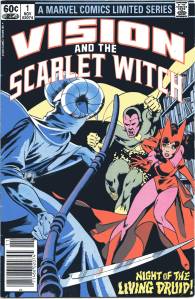
The first limited series was published beginning in November 1982, for four issues. It was written by Bill Mantlo and pencilled by Rick Leonardi. In this series, the villain Magneto is retconned as the father of the Scarlet Witch and Quicksilver, and intending to give up his villainous life. The reveal had some previous clues released in the Avengers and X-Men titles and stayed as comic book canon for decades until it was undone in the 2014 crossover AXIS.
New Adventures of Superboy (1980)
his series was published by DC Comics from January of 1980, until June of 1984, branching off from Superboy and the Legion of Super-Heroes, which also split into Legion of Super-Heroes (Volume 2) and from the Superman Family Vol 1. Like its predecessor, Volume 1, this title focused on the adventures of young Clark Kent before he became Superman. The majority of his adventures took place in his home town of Smallville, Kansas. The title contains the final appearances of the Earth-One Superboy prior to the eradication of the Earth-One continuity during the Crisis on Infinite Earths. Between 1984 and the 1986 Post-Crisis continuity relaunch, the only Superboy to appear in DC Comics was Superboy-Prime.
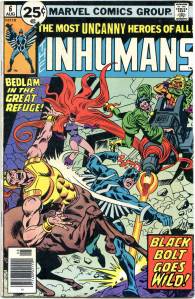
Inhumans (1975)
The Inhumans received their own self-titled series in October 1975, which ran for 12 issues and ended in August 1977. All but issue #9 were written by Doug Moench, who has said he was fascinated with the shaggy God story aspect of the Inhumans. A follow-up to the series’s ending appeared in Captain Marvel #53 (November 1977).
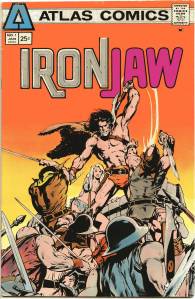
Ironjaw (1975)
Abandoned and left to die by order of his step-father the King, Ironjaw is discovered and raised by the bandit Tar-Lok. Later in life, his jaw is removed by a jealous group of thieves and replaced with a jaw made of iron.
Twisted Tales (1982)
Twisted Tales was published bi-monthly by Pacific Comics from November 1982 to May 1984 (eight issues). After Pacific went bankrupt, two final issues were published by Eclipse Comics in November and December 1984. In August 1986, Blackthorne Publishing released Twisted Tales 3-D #1 (#7 in their 3-D series), with reprints of stories taken from earlier issues. In November 1987 a Twisted Tales trade paperback was released by Eclipse Comics with a Dave Stevens cover, featuring previously unpublished stories and art.