The Brave and the Bold (1980’s)

The character Nemesis, also known as Thomas Tresser, debuted in an eight-page backup story in issue #166 (September 1980) written by Cary Burkett and drawn by Dan Spiegle. The Tresser character was created by Burkett in 1979, and named for an actor with whom Burkett was rooming in New Hampshire.

Alan Brennert wrote four issues of The Brave and the Bold featuring Batman teaming with the CreeperHawk and Dove, the Robin of Earth-Two, and the Catwoman.

The title’s final issue featured a team-up of the Batmen of Earth-One and Earth-Two and included a preview of Batman and the Outsiders, the title that replaced The Brave and the Bold on DC’s schedule and became Aparo’s next regular assignment.

Tor (1974)

After his debut in 1,000,000 Years Ago (St. John, September 1953), Tor immediately went on to become one of the first comic book characters to star in 3-D comic books. The second issue of that series was renamed 3-D Comics before being renamed Tor with issue #3 in May 1954. At this point the series was once again in the traditional two-dimensional format. This series lasted until issue #5 (October 1954).

In 1959, Kubert and inker Carmine Infantino unsuccessfully attempted to sell Tor as a newspaper comic strip. The samples consisted of 12 daily strips, reprinted in six pages in Alter Ego #10 (1969) and later expanded to 16 pages in DC Comics‘ Tor #1. DC Comics would publish the Tor series for 6 issues from 1974-1975.

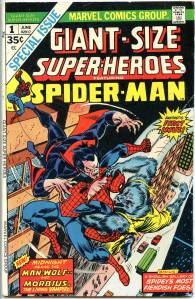
Giant-Size Super-Heroes (1974)

Giant-Size Super-Heroes was intended to be an ongoing series. However, only one issue was published and the series was rennamed Giant-Size Spider-Man with rebooted numbering instead. Morbius the Living Vampire in stalking Manhattan again! His first target is John Jameson, the Man-Wolf; and his second one ? the Amazing Spider-Man! Once Morbius reattaches the moonstone to John Jameson’s neck, the Man-Wolf becomes his to command! Now under the cover of darkness, the deadly duo heads to Empire State University to break into the research laboratory, but the ever-present web-slinger intercepts them along the way! Can Spider-Man defeat these two creatures of the night?

Machine Man V1 (1978)

In Volume 1 Machine Man entering the mainstream Marvel Universe. Jack Kirby wrote and drew the first nine issues, which dealt with the title character’s status as a fugitive from the military after the death of his creator, and his first interactions with mankind. The book was canceled at the end of 1978 with X-51 finally standing up to the military. Machine Man appeared next in a three issue story arc within the pages of The Incredible Hulk vol. 2 #235–237, battling the Hulk within the suburban setting of his human friend, Dr. Peter Spaulding. By the end of the storyline, he incurred a complete system shutdown, leading to the events portrayed in his relaunched monthly series. The title was relaunched in issue #10 after a nine-month hiatus. Status quo in the book changed with Machine Man now living amongst humanity, and dealing with his own new-found emotions. Marv Wolfman came aboard as the new writer, partnered with artist Steve Ditko, which helped set a different tone from Kirby’s previous stories. Issue #15 saw a new writer, Tom DeFalco, taking over the writing chores. The title lasted until issue #19, ending in Feb. 1980.

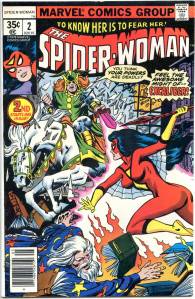
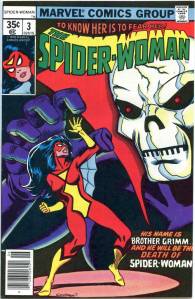
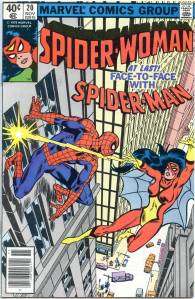
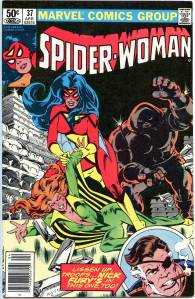
Spider-Woman (1978)

Marvel Comics‘ then-publisher Stan Lee said in 1978, shortly after Spider-Woman’s debut in Marvel Spotlight #32 (Feb. 1977) and the start of the character’s 50-issue self-titled series (cover-datedApril 1978 – June 1983), the character originated because,

I suddenly realized that some other company may quickly put out a book like that and claim they have the right to use the name, and I thought we’d better do it real fast to copyright the name. So we just batted one quickly, and that’s exactly what happened. I wanted to protect the name, because it’s the type of thing [where] someone else might say, ‘Hey, why don’t we put out a Spider-Woman; they can’t stop us.’ … You know, years ago we brought out Wonder Man, and [DC Comics] sued us because they had Wonder Woman, and … I said okay, I’ll discontinue Wonder Man. And all of a sudden they’ve got Power Girl [after Marvel had introduced Power Man]. Oh, boy. How unfair.

1st Issue Special (1975)

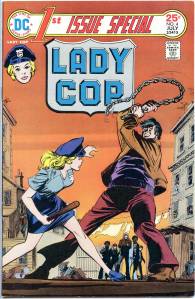
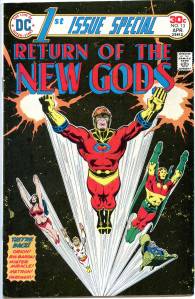
1st Issue Special was a comics anthology series from DC Comics, done in a similar style to their Showcase series. It was published from April 1975 to April 1976. The goal was to showcase a new possible first issue of an ongoing series each month, with some issues debuting new characters and others reviving dormant series from DC’s past. No series were actually launched from 1st Issue Special but the Warlord made his first appearance in the title and the character’s ongoing series was already slated to debut a few months later.

Logan’s Run (1977)

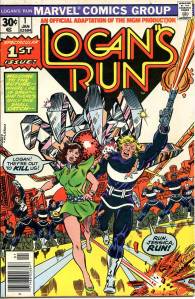
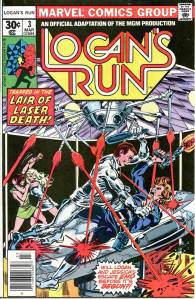
Marvel Comics published Logan’s Run in 1977, with George Pérez drawing five issues between January and May 1977, with “acceptable” sales. The comics adapted the film’s story in five issues and briefly continued beyond. In his art, Pérez sought to follow the art direction of the film. The book was cancelled after issue #7 in July 1977.

Secrets of Haunted House (1975)

The series began in April–May 1975. Like its predecessor Secrets of Sinister HouseSecrets of Haunted House was originally “hosted” by Cain, AbelEve, and Destiny who had moved over from Weird Mystery Tales. By issue #10 (Feb.–March 1978), Destiny was the only one of these who remained a regular. In issue #40 (Sept. 1981), Abel returned with no further mention of Destiny.

Secrets of Haunted House Special was published in 1978 as part of the DC Special Series umbrella titleSecrets of Haunted House was a temporary victim of the “DC Implosion.” With issue #14 (Oct.–Nov. 1978), it was cancelled but revived a year later with issue #15 (Aug. 1979). The title continued until issue #46 (March 1982).

DC Comics Presents V1 (1978)

DC Comics Presents debuted with a July/August 1978 cover date . The series was launched with a team-up of Superman and the Flash by writer Martin Pasko and artist José Luis García-López.  Issue #26 included an insert introduction story to the then-upcoming New Teen Titans series by Marv Wolfman and George PérezLen Wein and Jim Starlin co-created the supervillain Mongul in issue #27 (Nov. 1980) as part of a three-issue storyline. Another insert in issue #41 previewed the “new direction” Wonder Woman. In issue #47, Superman traveled to Eternia and met the Masters of the Universe. Ambush Bug made his first appearance in issue #52 (Dec. 1982)  and made additional appearances in issue #59 and #81. The Superman/Challengers of the Unknown tale in issue #84 was drawn by Jack Kirby and Alex Toth. The series also contained the Alan Moore Superman/Swamp Thing story “The Jungle Line” in DC Comics Presents #85 (Sept. 1985), pencilled by Rick Veitch and inked by Al Williamson. Issue #87 featured the first appearance and origin of the divergent Kal-El of the Earth Prime reality, who would become known as Superboy-Prime. The final issue is an exception to the team-up format, instead featuring Superman in an “Untold Tale” involving the Phantom Zone, by Steve Gerber, following up in his limited series of the same title.

Challengers of the Unknown (1977)

In 1977, the group returned to its own title continuing the number with #81. During this period, they were joined by Deadman and Swamp Thing, and June Robbins got a uniform and official status. No explanation was given for Corinna Stark’s departure, nor June’s joining the team. The revived series was canceled with issue #87 in 1978.