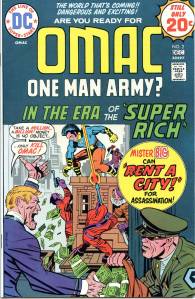
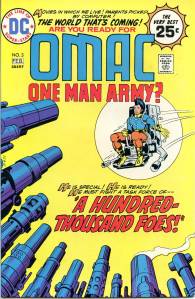
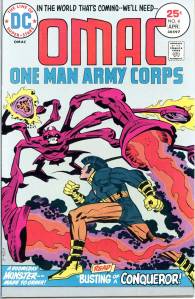
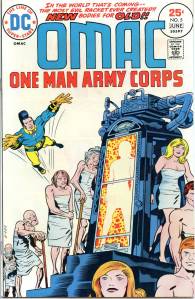
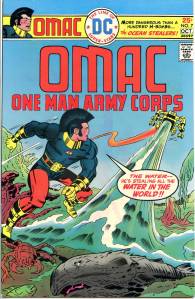
OMAC (Buddy Blank) was created in 1974 by Jack Kirby and published by DC Comics. The character was created towards the end of Kirby’s contract with the publisher, following the cancellation of his New Gods series and was reportedly developed strictly due to Kirby needing to fill his contractual quota of 15 pages a week.As envisioned by Kirby, OMAC is essentially Captain America set in the future, an idea Kirby had toyed with some years earlier while at Marvel Comics, but had never realized.
Set in the near future (“The World That’s Coming”), OMAC is a corporate nobody named Buddy Blank who is changed via a “computer-hormonal operation done by remote control” by an A.I. satellite called Brother Eye into the super-powered One-Man Army Corps (OMAC).
Created and designed by Jack Kirby, The New Gods first appeared in February 1971 in New Gods #1.
Kirby’s production assistant of the time, Mark Evanier, remarked that: “Folks forget but the New Gods saga was intended to be a limited series … There was no intention that these characters would go on forever. After Jack’s books started getting good sales figures, DC demanded that we keep them going and use guest stars like Deadman, which we were very much against doing. So Kirby had this novel he was forever stuck in the middle of – he could never get to the last chapter. … You can spot the issues where Jack kind of gave up trying to advance the story of Darkseid and Orion and was marking time. If those books had been intended from the start to run indefinitely, they would have been done very differently.”
New Gods #1 marks the first appearance of Orion, Highfather, and Metron, among others.
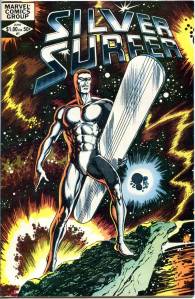
The galactic herald returns in this jam-packed one-shot! Silver Surfer recalls happier times with the Fantastic Four. With Norrin Radd becoming a distant memory with each passing day, will Surfer ever recover the man he once was? Surfer returns to his homeland Zenn-La to find absolute devastation. A new quest begins for Silver Surfer — one that involves finding his soulmate, Shalla Bal!
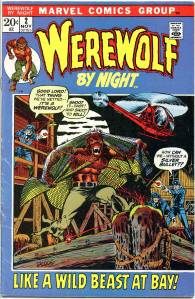
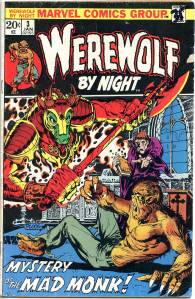
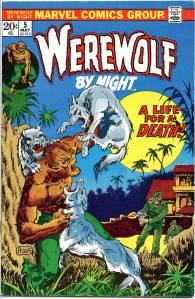
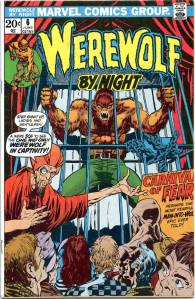
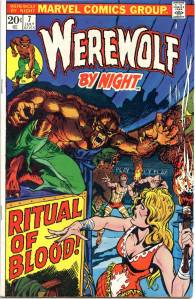
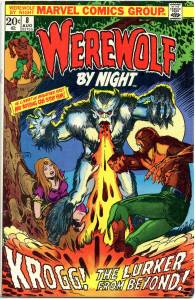
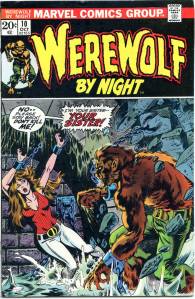
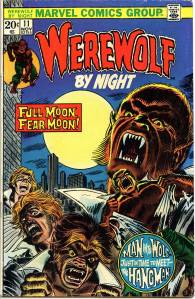
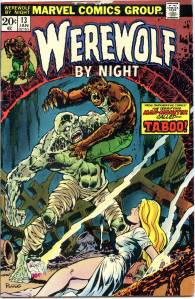
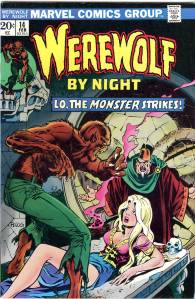
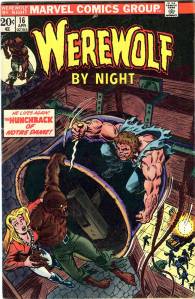
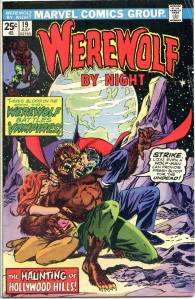
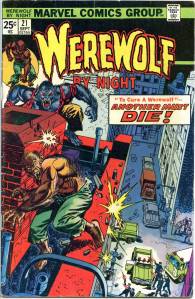
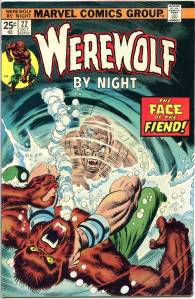
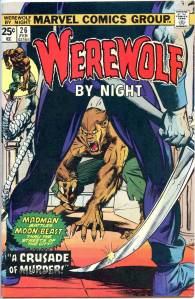
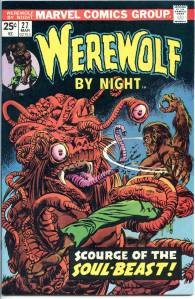
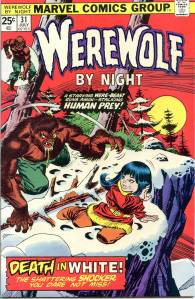
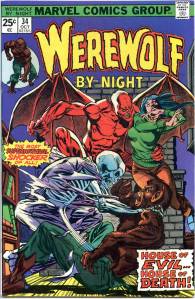
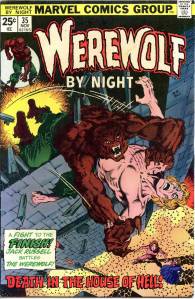
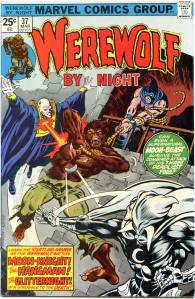
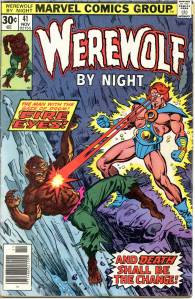
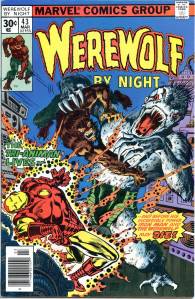
The Werewolf by Night character first appeared in Marvel Spotlight #2 (Feb. 1972) and was based on an idea by Roy Thomas. The series name was suggested by Stan Lee and the debut story was crafted by Gerry Conway and Mike Ploog. The character made additional appearances in Marvel Spotlight #3 and #4 and then graduated to his own eponymous series in September 1972. Werewolf by Night was published for 43 issues and ran through March 1977. Issue #32 contains the first appearance of Moon Knight. Jack Russell co-starred with Tigra in Giant Size Creatures #1 (July 1974), which was the first appearance of Greer Grant as Tigra instead of the Cat.That series was retitled Giant-Size Werewolf with its second issue.
The Werewolf by Night character (birth name Jacob Russoff, legal name Jacob Russell, nicknamed Jack) first appeared in Marvel Spotlight #2 (Feb. 1972) and was based on an idea by Roy Thomas. The series name was suggested by Stan Lee and the debut story was crafted by Gerry Conway and Mike Ploog.The character made additional appearances in Marvel Spotlight #3 and #4 and then graduated to his own eponymous series in September 1972. Jack Russell co-starred with Tigra in Giant Size Creatures #1 (July 1974), which was the first appearance of Greer Grant as Tigra instead of the Cat. That series was retitled Giant-Size Werewolf with its second issue.
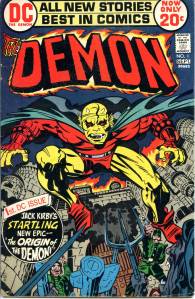
The Demon was created by Jack Kirby. The titular character, named Etrigan, is a demon from Hell who, despite his violent tendencies, usually finds himself allied to the forces of good, mainly because of the alliance between the heroic characters of the DC Universe and Jason Blood, a human to whom Etrigan is bound.
Jack Kirby created the Demon in 1972 when his Fourth World titles were cancelled.According to Mark Evanier, Kirby had no interest in horror comics, but created Etrigan in response to a demand from DC for a horror character. Kirby was annoyed that the first issue sold so well that DC required him to remain on it and abandon the Fourth World titles before he was done with them. Etrigan was inspired by a comic strip of Prince Valiant in which the titular character dressed as a demon. Kirby gave his creation the same appearance as Valiant’s mask.
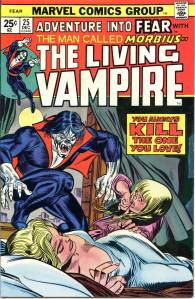
Morbius, the Living Vampire, introduced in The Amazing Spider-Man #101 (Oct. 1971), became the starring feature with Adventure into Fear #20 (Feb. 1974), and continued through the rest of the run. After a single issue by writer Mike Friedrich and penciler Paul Gulacy, Steve Gerber wrote several issues in which Morbius went on a picaresque interdimensional journey and fought the Caretakers of Arcturus and was advised by the eyeball-headed character I. Doug Moench and Bill Mantlo followed, successively, as the feature’s writers. Its round-robin of artists included Gil Kane, P. Craig Russell, Frank Robbins, George Evans, and Don Heck. Back up reprints shortly resumed in issue #20. Morbius would receive his own short-lived comic-book series in the 1990s.
This film adaptation includes one possible explanation of the title’s significance in story context: the narrative line, “Blade runner. You’re always movin’ on the edge.”
This was a reprint of issue 22 of the Marvel Comics Super Special series of titles, which by this time only printed Marvel’s movie adaptations, but without the feature content contained in the special.
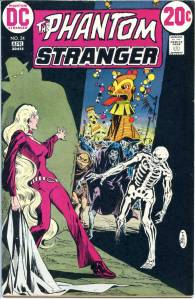
After an appearance in Showcase #80 (February 1969), he received another series beginning May–June 1969 that lasted until February–March 1976. The Showcase appearance and the first three issues of Phantom Stranger consisted of reprints from both the 1950s title and the “Dr. 13: Ghost-Breaker” feature from the last nine issues of Star Spangled Comics at the same time, with new, brief framing sequences. These had Dr. Thirteen, certain that the Phantom Stranger was an impostor, determined to expose him.
Beginning with issue #4 (November-December 1969), the series began featuring all-new material, with stories produced by Robert Kanigher, Len Wein, Jim Aparo, Neal Adams, Tony DeZuniga and others. In these stories, while the Stranger’s past remained a mystery, the writers added a semi-regular cast of characters for him. A demonic sorceress named Tala would become his archenemy; an alchemist/sorcerer named Tannarak was first an enemy and would later assist him against the Dark Circle; and a blind psychic named Cassandra Craft would assist him. Doctor Thirteen, dropped along with the reprints, was given a back-up series here as of #12 (March-April 1971) which morphed into “The Spawn of Frankenstein” in #23 (January-February 1973).
The second volume originally ended with the forty-first issue in November 1975, cover dated March 1976. In January 2010, a forty-second issue was added to the second series during the Blackest Night event, effectively a one-shot.
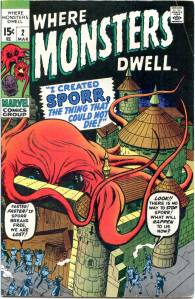
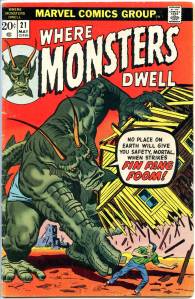
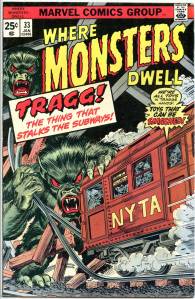
One of Marvel’s revival Horror and Monster comics. It lasted for 38 issues, making it one of the longest running Monster Mags from Marvel in the 1970’s. The series contains stories from many comic legends including Jack Kirby, Steve Ditko, Gil Kane and Bernie Wrightson. Issues #6 contains a reprint of Tales to Astonish #13, which is the 1st appearance of Groot from Guardians of the Galaxy.