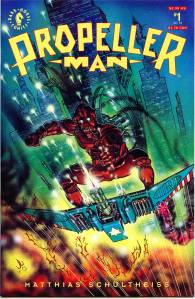
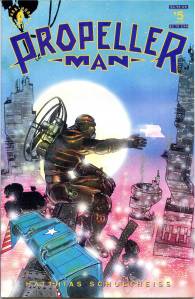
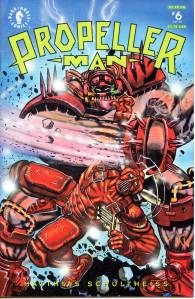
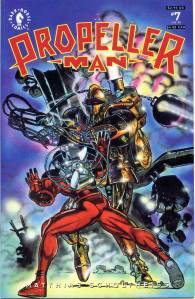
The future. A tired world of economic collapse and ecological disaster. In this corporate-dominated world, a living weapon escapes to blaze a trail of destruction as it searches for its creator. A solitary figure watches from the rooftops. Propellerman. Does the creature provide some clues to his missing memory?
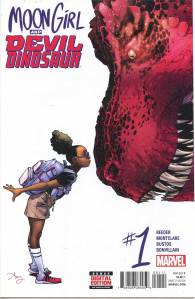
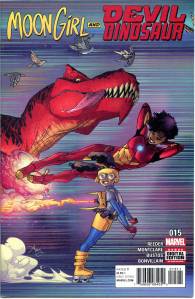
The character was created by Amy Reeder, Brandon Montclare and Natacha Bustos and first appeared in Moon Girl and Devil Dinosaur #1 (January 2016).
The genesis of the character came from Mark Paniccia and Emily Shaw who were a fans of the character Devil Dinosaur and had hired Montclare and Reeder to pen the basis for a new series that involved the character ending up in modern day. They came up with the idea of Devil Dinosaur interacting with a girl and fell in love with the idea of working with a hero who wasn’t a “regular cape-and-tights superhero”.
They also viewed the series as a direct sequel to the Moon-Boy and Devil Dinosaur series from Jack Kirby hence the first villains that Moon Girl and Devil Dinosaur face are the Killer-Folk.
Artist Natacha Bustos found the character a relief from the norm of other typical superheroes. She was primarily inspired by the clear diversity that Moon Girl and Devil Dinosaur promoted, further comparing the character Lunella to herself. She compared her story to a “Ghibli one” due to the immense relationship between the title characters.
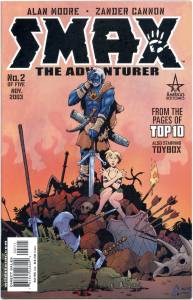
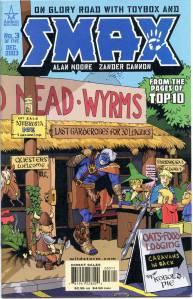
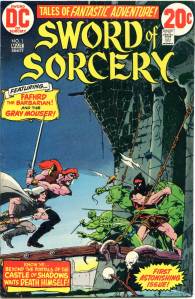
The story deals with Smax and Toybox returning, via magical teleportation, to Jeff’s magically enchanted homeworld. Smax, now a city dweller, seems embarrassed by his unsophisticated, sword-and-sorcery roots. They attend Smax’s uncle’s funeral where Jeff introduces Robyn as his wife, though no such relationship exists. At this point Jeff’s sister Rexa Macksun is introduced, dressed in the typical garb of a female fantasy barbarian such as Red Sonja and just as tall and physically impressive as her brother with the same blue skin and white hair.
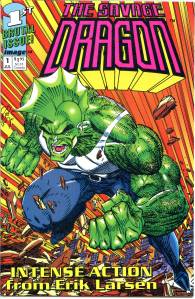
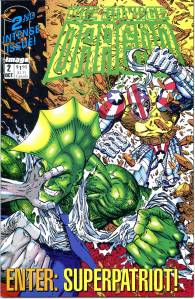
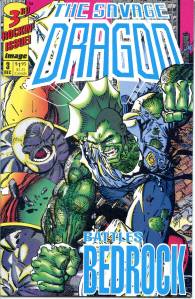
In 1992, when Larsen left Marvel to co-found Image Comics, he reworked the character for the new publication venture. This time, the Dragon was a massively muscled green amnesiac, who joined the Chicago police department after being discovered in a burning field. Initially debuting in a three-issue miniseries (with the first issue cover-dated July 1992), the Savage Dragon comic book met with enough success to justify a monthly series, launched in June 1993. To this day, Larsen continues to write and illustrate the series entirely by himself, and has maintained a reasonably consistent monthly schedule (save for occasional lapses) in comparison with the other original Image Comics titles.
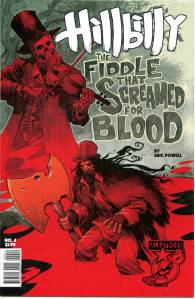
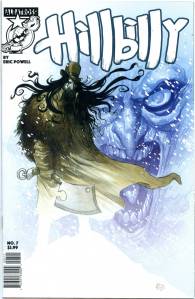
Hillbilly is a fantasy adventure series by Eric Powell (creator of The Goon), set in a fantasy realm drawing less from Tolkien and more from the myths and folklore of rural Appalachia. Unlike The Goon, it’s more-or-less kid-friendly, if still reasonably dark. Rondel is a wanderer, travelling from place to place.
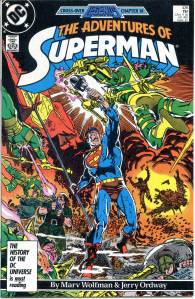
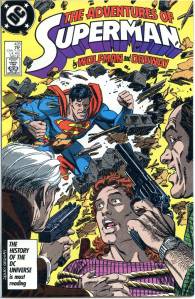
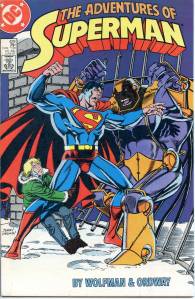
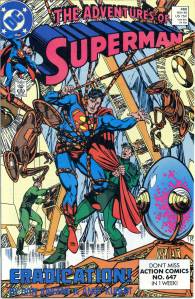
When the series was relaunched in late 1986 under its new title, the creative team initially was writer Marv Wolfman and artist Jerry Ordway.John Byrne replaced Wolfman with issue #436 (January 1988) and Ordway became both writer and artist with issue #445 (October 1988). Writer/artist Dan Jurgens worked on the title from 1989–1991. Hank Henshaw, a character who would later become the Cyborg Superman, first appeared in issue #466 (May 1990). By the late 1980s, the plots of the Superman books were often linked. To coordinate the storyline and sequence of event, from January 1991 to January 2002, “triangle numbers” (or “shield numbers”) appeared on the cover of each Superman comic book. During these years, the Superman storylines ran with the story continuing through the titles Superman, Action Comics and later in two further series, Superman: The Man of Steel and Superman: The Man of Tomorrow.
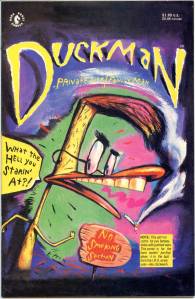
Story and art by Everett Peck. He’s been up–he’s been down–he’s fallen asleep with the TV on! New, hot from this previous engagement in Dark Horse Presents, the tough duck private dick, stars in his first feature length special. The story wouldn’t be complete without Cornfed, Fluffy, and Uranus hanging around waiting for the next dose of abuse from their feathered “friend.”
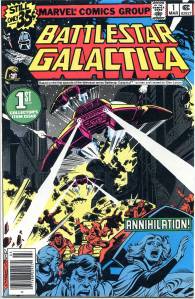
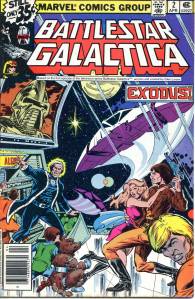
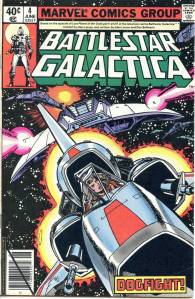
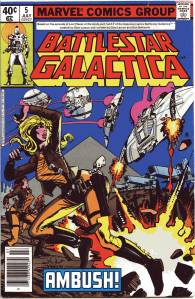
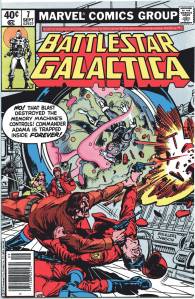
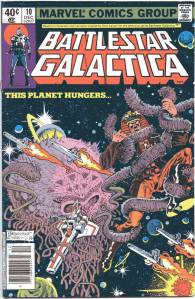
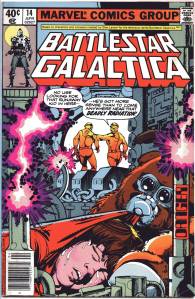
The comic book Battlestar Galactica, based on the ABC television series of the same name, was published monthly by Marvel Comics from March 1979 through January 1981, and lasted 23 issues.
Although there were other attempts to adapt Battlestar Galactica into a comic book format, the Marvel series is considered by many to have been the most successful in terms of run, sales, and content.
This was accomplished against some notable odds. Although Roger McKenzie was most often the writer, and Walt Simonson the most regular artist, the book also had a heavy rotation of guest writers and artists.
Marvel Comics’ began its adaptation of Battlestar Galactica with Marvel Super Special #8, a magazine format comic written by Roger McKenzie and drawn by Ernie Colón which was released as a tie-in to the start of the series. Based on an early script of the three hour series premiere “Saga of a Star World”, this adaptation, which gave a relatively short treatment to the third hour, was also released in a tabloid format and then later as a paperback as well. The tabloid version was also printed by Whitman Comics. Its success led Marvel to print a regular monthly comic depicting the adventures of the ragtag fleet.
A coming-of-age tale told through the eyes of a group of French orphans during World War II who are saved by a brave and daring American boy named Peter. As they travel together, they get tangled up in the French Resistance and their efforts against a growing German presence under the leadership of a fanatical hook-handed SS officer hellbent on wiping them out!