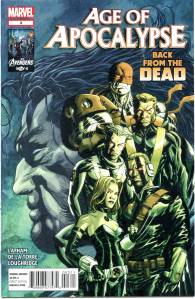
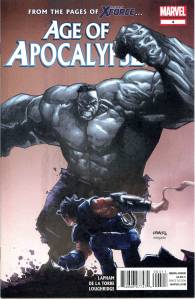
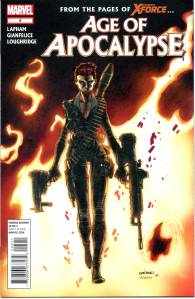
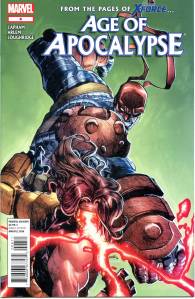
Incredible Hulk V1 (1970’s)

The 1970s saw Banner and Betty nearly marry in The Incredible Hulk #124 (Feb. 1970). Betty ultimately married Talbot in issue #158 (Dec. 1972). The Hulk also traveled to other dimensions, one of which had him meet empress Jarella, who used magic to bring Banner’s intelligence to the Hulk, and came to love him. It was during this period that the Hulk helped to form the Defenders.

Seven to Eternity (2016)

The God of Whispers has spread an omnipresent paranoia to every corner of the kingdom of Zhal; his spies hide in every hall spreading mistrust and fear. Adam Osidis, a dying knight from a disgraced house, must choose between joining a hopeless band of magic users in their desperat e bid to free their world of the evil God, or accepting his promise to give Adam everything his heart desires. Writer RICK REMENDER reteams with collaborators JEROME OPEÑA (Uncanny X-Force, Fear Agent) and MATT HOLLINGSWORTH (TOKYO GHOST, WYTCHES) to take you on a hard road through the strange fantasy world of Zhal. All men have surrendered their freedom for fear. Now, one last free man must choose.

The Demon V3 (1990)

Etrigan the Demon first appeared in The Demon #1 (August 1972) and was created by Jack Kirby. He created the Demon when his Fourth World titles were cancelled. According to Mark Evanier, Kirby had no interest in horror comics, but created Etrigan in response to a demand from DC for a horror character. Kirby was annoyed that the first issue sold so well that DC required him to do sixteen issues and abandon the Fourth World titles before he was done with them.

The 1990 series lasted 58 issues, two Annuals and one #0 issue. Garth Ennis took over the title beginning with issue #40. Ennis’ run included the first appearance of his character Hitman.

Captain Marvel V5 (2002)

The third Captain Marvel is Genis-Vell, who first appeared in Silver Surfer Annual #6 (1993) using the codename of “Legacy”. The character is the genetically-engineered son of Mar-Vell and his lover Elysius, created from the late Mar-Vell’s cell samples and artificially aged to physical, if not emotional, maturity. Genis, like his father, wears the Nega-Bands, possesses Cosmic Awareness, and is, for a time, bonded with Rick Jones. Although the pair do not get along at first, they eventually become good friends. Genis goes insane and threatens to destroy the universe.

After dying and resurrecting himself—with the secret aid of Baron Helmut Zemo—Genis-Vell joins the Thunderbolts under the name Photon. However, in accelerating his resurrection, Zemo links Genis to the ends of time, causing a degenerative effect on the universe. To prevent the inevitable destruction of all existence, Zemo scatters pieces of Genis-Vell’s body through time and the Darkforce Dimension.

Aliens: Labyrinth (1993)

Rabbits, mice, and monkeys have long been the guinea pigs of choice for research scientists everywhere, and since the practice began, it has outraged the general public. So when Colonel Doctor Paul Church switches from animals to Aliens, the public ends their protests and instead praises the good doctor… until his research assistants begin to die of mysterious causes. Only then do they ask the important question: What else is the kind of man who can torture Aliens capable of?

High above earth, aboard space station Innominata, something horrible is happening. And this time, the Aliens are the victims.

Adventure Comics (1980’s)

As of #425 (December 1972), Adventure Comics theme changed from superhero adventure to fantasy/supernatural adventure. That issue debuted one new feature along with three non-series stories, the pirate saga “Captain Fear”. The next edition added a semi-anthology series, “The Adventurers’ Club”. Soon, editor Joe Orlando was trying out horror-tinged costumed heroes, first Black Orchid, then the Spectre. Before long, though, conventional superheroes returned to the book, beginning behind the Spectre, first a three-issue run of Aquaman (issues #435–437, an early assignment for Mike Grell) and then a newly drawn 1940s Seven Soldiers of Victory script (issues #438–443). Aquaman was promoted to lead (issues #441-452), and backing him up were three-part story arcs featuring the Creeper (#445–447), the Martian Manhunter (#449–451), bracketed by issue-length Aquaman leads. He was awarded his own title and Superboy (#453-458) took over Adventure with Aqualad (#453–455) and Eclipso (#457–458) backups. Following this was a run as a Dollar Comic format giant-sized book (issues #459-466), including such features as the resolution of the Return of the New Gods (cancelled in July–August 1978), “Deadman“, and “Justice Society of America“.

Thor (Silver Age)

Thor debuted in the science fiction/fantasy anthology title Journey into Mystery #83 (cover-date Aug. 1962), and was created by editor-plotter Stan Lee, scripter Larry Lieber, and penciller-plotter Jack Kirby. A different version of the mythological Thor had appeared previously in Venus #12-13 (Feb.-April 1951).

In a 1984 interview Kirby said “I did a version of Thor for D.C. in the Fifties before I did him for Marvel. I created Thor at Marvel because I was forever enamored of legends, which is why I knew about Balder, Heimdall, and Odin. I tried to update Thor and put him into a superhero costume, but he was still Thor.” And in a 1992 interview, Kirby said “[I] knew the Thor legends very well, but I wanted to modernize them. I felt that might be a new thing for comics, taking the old legends and modernizing them.”

Journey into Mystery was retitled Thor (per the indicia, or The Mighty Thor per most covers) with issue #126 (March 1966). “Tales of Asgard” was replaced by a five-page featurette starring the Inhumans from #146–152 (Nov. 1967 – May 1968), after which featurettes were dropped and the Thor stories expanded to Marvel’s then-standard 20-page length.

Paul the Samurai V2 (1992)

Paul begins adapting to the unusual barbarians inhabiting his new land. He confronts The Detroit Fury a metal monster created by a disgruntled American autoworker; He also encounters THE MITI MEN a superhero group sent from Japan to protect Japanese interests from the Detroit Fury’s attacks!

Superman (Silver Age)

In the view of comics historian Les Daniels, artist Curt Swan became the definitive artist of Superman in the early 1960s with a “new look” to the character that replaced Wayne Boring’s version. Writer Jim Shooter and Swan crafted the story “Superman’s Race With the Flash!” in Superman #199 (Aug. 1967) which featured the first race between the Flash and Superman, two characters known for their super-speed powers. Another Silver Age first is the “Death of Superman,” from 1961’s Superman #149, by Jerry Siegel, Curt Swan and Sheldon Moldoff. The Silver Age was a fantastic period for Superman fans, giving us  characters such as Braniac, Bizzaro, Titano, Supergirl and The Legion of Superheroes.

Incredible Hulk V1 (1980’s)

In the 1980s, Banner once again gained control over the Hulk, and gained amnesty for his past rampages; however, due to the manipulations of supernatural character Nightmare, Banner eventually lost control over the Hulk. It was also established that Banner had serious mental problems even before he became the Hulk, having suffered childhood traumas that engendered Bruce’s repressed rage. Banner comes to terms with his issues for a time, and the Hulk and Banner were physically separated by Doc Samson. Banner is recruited by the U.S. government to create the Hulkbusters, a government team dedicated to catching the Hulk. Banner finally married Betty in The Incredible Hulk #319 (May 1986) following Talbot’s death in 1981. Banner and the Hulk were reunited in The Incredible Hulk #323 (Sep. 1986) and with issue #324, returned the Hulk to his grey coloration, with his transformations once again occurring at night, regardless of Banner’s emotional state. In issue #347 the grey Hulk persona “Joe Fixit” was introduced, a morally ambiguous Las Vegas enforcer and tough guy. Banner remained repressed in the Hulk’s mind for months, but slowly began to reappear.