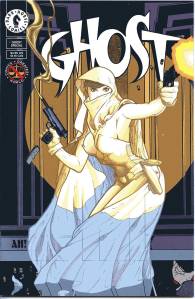
Ghost (1990’s)

Ghost first appeared in Comics’ Greatest World, week three, in 1993. After a popular special in 1994, a monthly title devoted to the character began publication in 1995. It ran for 36 issues, followed by a six-month break and a second series of 22 issues. The second series was a continuation of the first with a number of changes, including new details about Ghost’s origin. The stories in both series were based in (and around) the city of Arcadia, in a self-contained fictional universe outlined in Dark Horse’s Comics’ Greatest World.

Ghost continued appearing in her own titles (and others) into the 2000s, including several crossovers unrelated to Comics’ Greatest World. Most notable among these were a two-issue crossover with Dark Horse’s Hellboy (Ghost/Hellboy), and a four-issue crossover with DC Comics’ Batgirl (Ghost/Batgirl: The Resurrection Machine). Ghost was ranked 15th on the Comics Buyer’s Guide‘s “100 Sexiest Women in Comics” list.

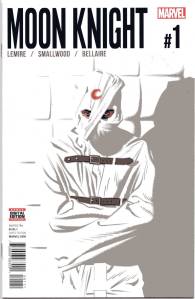
Moon Knight V8 (2016)

Marc Spector wakes up in a mental institute with no recollection of his past or how he got there. The staff, led by Dr. Emmet, seems to have supernatural powers and thwart Marc’s attempts to recover his past. Marc is shown evidence that he is a mentally ill man who has convinced himself he is also Moon Knight, a vigilante he’s seen on the news. Khonshu contacts Marc and explains that Emmet is an avatar like him, one who is connected to the Othervoid god Ammit. Khonshu decides it is now time for him to completely dominate Marc Spector’s body. Marc denies Khonshu and fights him with the help of all of his alters. Marc accepts that whether they are the result of childhood trauma or Khonshu’s interference, his alters are a part of him and have been for most of his life. After defeating Emmet and Khonshu, Marc resumes his life as Moon Knight, determined to be a protector and crime-fighter on his own terms rather than as a tool of anyone else. Later, Marc and Khonshu resume their bond.

Darkchylde (1996)

Darkchylde was created in 1996 by Randy Queen. It was originally published by Maximum Press, and later by Image Comics, through Homage Comics, a publishing imprint of Wildstorm. Subsequent projects would be published by Darkchylde Entertainment, through Wowio.

Darkchylde is the story of Ariel Chylde, a cursed teen who can become the creatures from her many nightmares, and then must save her small town from the forces of darkness she’s set free. Darkchylde was launched as a comic book property to immediate success in the summer of 1996. The book shot to the #1 hottest comics spot in Wizard, where it stayed for nine months collectively in both Wizard and Combo magazines. The book outsold Spider-Man, the HulkSuperman, and Batman in America, and quickly garnered an unusually large female following, in stark contrast to the traditionally male comic book market.

Batgirl V4 – New 52 (2011)

In September, 2011, following the company-wide relaunch, Barbara Gordon stars in a new Batgirl series—one of The New 52 titles featuring the company’s most iconic characters. The conclusion of the limited series Flashpoint (2011) establishes a new continuity within the DC Universe, with all characters regressing to an earlier age and stage in their careers, while remaining in a modern timeline. DC Senior VP of Sales, Bob Wayne, explained that with each of their titles reverting to issue #1, “our creative teams have the ability to take a more modern approach—not only with each character, but with how the characters interact with one another and the universe as a whole, and focus on the earlier part of the careers of each of our iconic characters.” Wayne also stated that “The Killing Joke” still happened and she was Oracle. Now she will go through physical rehabilitation and become a more seasoned and nuanced character because she had these incredible and diverse experiences.

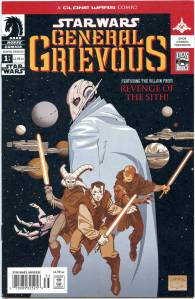
Star Wars: General Grievousis (2005)

Star Wars: General Grievousis a 4-part series published by Dark Horse Comics and released from March 16, 2005 through July 20, 2005. This tale of treachery and genocide leads up to the events of the record-breaking blockbuster Star Wars: Episode III – Revenge of the Sith. Before his all-out battle with Obi-Wan Kenobi, the latest Star Wars supervillain took on an entire alien species!

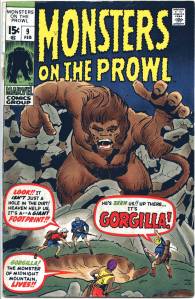
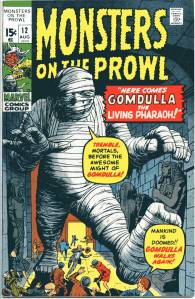
Monsters on the Prowl (1971)

Chamber of Darkness was retitled Monsters on the Prowl with issue #9 (Feb. 1971), this version ran one new story each issue through #13 (Oct. 1971) with the remaining content consisting of reprints from Atlas Comics, Marvel’s 1950s predecessor, and “pre-superhero Marvel”, primarily drawn by Jack Kirby or Steve Ditko. It expanded into a double-sized, 25-cent comic for two issues (#13-14, Oct.-Dec. 1971). Some issues of the reprint books featured new covers by John SeverinMarie SeverinGil Kane, and Herb Trimpe.

Jungle Comics (1940)

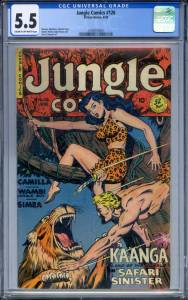
Having not been able to saturate the market’s insatiable demand for jungle sirens with Sheena in Jumbo Comics, Fiction House unleashed another series titled Jungle Comics.  Running 163 issues staring January 1940 the series did not end until Fiction House succumbed to the Comics Code Authority over 14 years later.

Stories featured the main character Kaänga, a rather familiar sounding westerner child raised by apes. Another westerner, Ann Mason, became his mate after he rescued her from slave traders.

John Byrne’s 2112 (1991)

The Next Men characters made a prototypical appearance as “Freaks” in a lithography plate that was published within the History of the DC Universe Portfolio in 1986. Byrne had originally pitched the series to DC Comics, but the series never surfaced there. With some changes, Byrne changed the concept to fit in with his work on the graphic novel 2112, to become the John Byrne’s Next Men series. Two characters from the “Freaks” artwork somewhat retained their physical looks and became the lead characters of the Next Men series: heroine Jasmine and villain Aldus Hilltop.

The Next Men officially debuted in a four-part storyline in Dark Horse Presents #54-57 (later reprinted, in color, as John Byrne’s Next Men #0). The series ran until issue #30 and ended with a cliffhanger. According to Byrne, he intended the series to be science-fiction that had a “sort of smell” of being a super-hero book. In addition to exploring mature topics such as sex, abortion, and child abuse, Byrne also set aside some of the more-traditional conventions of the medium, such as “thought-bubbles” and sound-effects.

Byrne had intended to conclude the story in a second series after a six-month hiatus, but the collapse of the American comic-book industry in the mid-1990s made it financially unfeasible for him to do so, and he returned to working for hire at DC Comics and Marvel Comics.

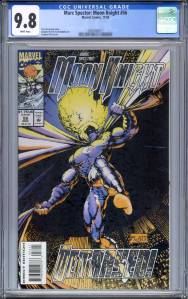
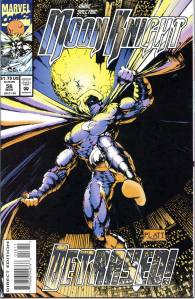
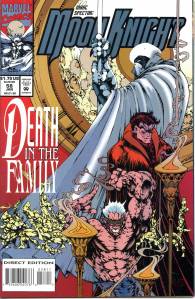
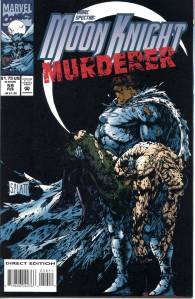
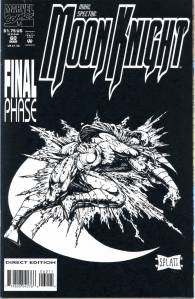
Marc Spector: Moon Knight V1 (1989)

Moon Knight was created by Doug Moench and Don Perlin. He first appeared in Werewolf by Night #32 (August 1975).

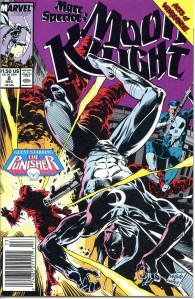
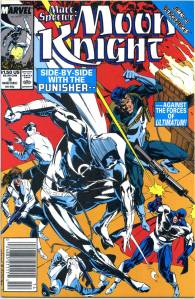
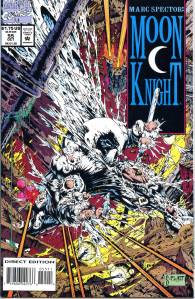
 In 1989, a third Moon Knight volume, titled Marc Spector: Moon Knight was published. It was the longest-running series, lasting sixty issues. This volume introduces Moon Knight’s teenage sidekick Jeff Wilde, also known as “Midnight,” the son of Midnight Man, a villain from the first volume of the series. At this time, Moon Knight first encounters the Black Cat. Turned into a cyborg by the Secret Empire, Midnight is seemingly killed in the “Round Robin” story arc of Amazing Spider-Man, spanning issues #353-#358.

 The series was canceled with issue #60 (March 1994), with four of the last six issues drawn by Stephen Platt, who was hired by Image Comics based on the strength of his work on the series.

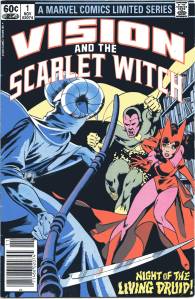
Vision and the Scarlet Witch V1 (1982)

The first limited series was published beginning in November 1982, for four issues. It was written by Bill Mantlo and pencilled by Rick Leonardi. In this series, the villain Magneto is retconned as the father of the Scarlet Witch and Quicksilver, and intending to give up his villainous life. The reveal had some previous clues released in the Avengers and X-Men titles and stayed as comic book canon for decades until it was undone in the 2014 crossover AXIS.