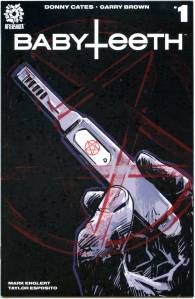
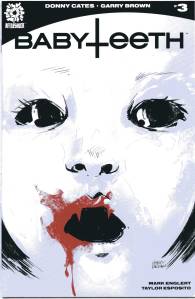
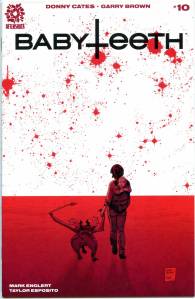
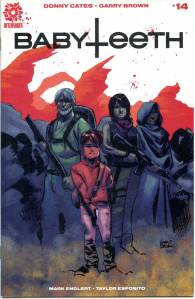
Sadie Ritter is sixteen years old, nine months pregnant, and scared out of her sweet nerdy mind. Having a baby that young is tough, but with the support of her loving family behind her, everything should be okay. OH YEAH, and also her baby is the antichrist and it’s going to break open the barriers between the earthly and demonic planes and unleash eternal suffering to all of humankind. Other than that, though…should be fine.
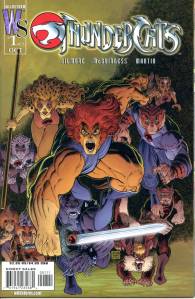
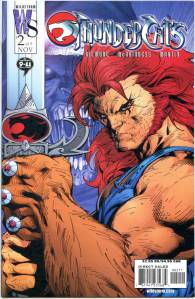
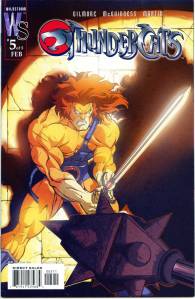
Reclaiming Thundera (written by Ford Gilmore with various artists contributing), published between 2002 and 2003, formed a series of loosely connected “episodes” that saw Lion-O continue his struggle against Mumm-Ra and The Mutants.[8] A major plot point was the slow corruption of WilyKat by Mumm-Ra, which would play a major role in later storylines. After another fateful battle with Grune, Lion-O entered the Book of Omens to begin his training and claim his rightful place as Lord of the ThunderCats, but Mumm-Ra uses a powerful spell to keep Lion-O trapped in the book for several years in real time, not “Book” time, and seizes control of Thundera afterwards.
SDCC 2022 Exclusive celebrating the 30th anniversary of Space Usagi.
Reprinting Space Usagi #1 in color for the first time.
Each cover limited to 500 copies.
Space Usagi featured characters similar to those in the original series, including a descendant of Miyamoto Usagi, but set in a futuristic setting that also emulated feudal Japan in political and stylistic ways. Three mini-series of three issues each and two short stories featuring the characters were produced.
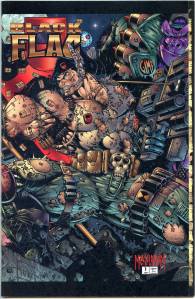
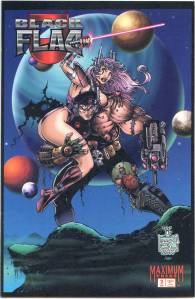
The setup of the series is that a para-military group called Black Flag is formed and funded by April Imoto, aka Geisha, who inherited her father’s billion dollar empire after he was executed. One of the members of Black Flag is Raiden, a master of mysticism. Using his powers, he sees a young boy in trouble, fighting to escape Hades, and a purple gorilla who was the subject of numerous experiments to make him a genius fighting machine. Raiden senses and imbalance in the universe due to these events and Black Flag rescues both of these characters and begin their adventure together as a team.
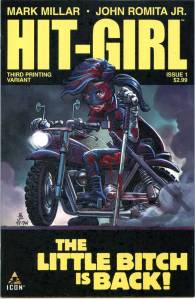
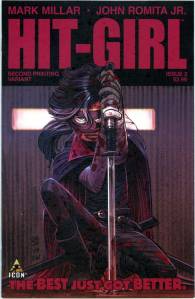
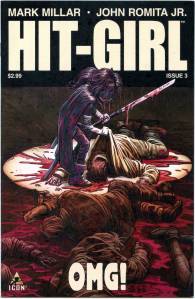
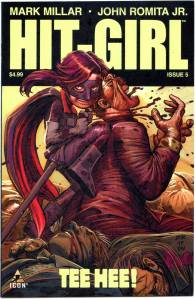
Hit-Girl spins off into her own blood-soaked series by the sales-busting creative team of Mark Millar and John Romita Jr. This story takes place between Kick-Ass Volumes 1 and 2 as Mindy McCready tries to settle into life as a regular school-girl, but wants nothing more than to be dispensing hot justice to the scum of New York City. Her mother and step-father think she’s doing her homework, but in reality she’s taken Kick-Ass on as her sidekick and is training him up to punch, shoot and stab … just like Daddy would have wanted.
Blade Runner Ash hunts the streets of Los Angeles for renegade Replicants. She finds her loyalties and humanity challenged by two Replicants… one offering her salvation, the other deadly damnation.
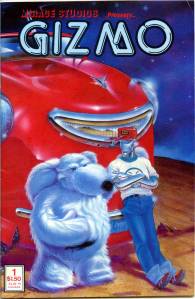
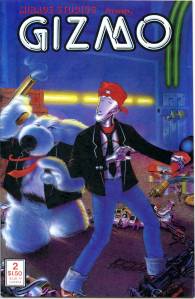
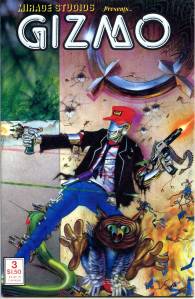
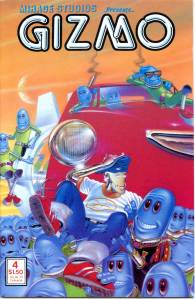
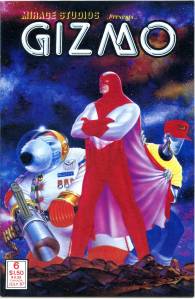
Gizmo is a black and white comic book series created, written, and illustrated by Michael Dooney first published by Chance Enterprises, and later published by Mirage Studios in May 1986. It tells about the story of two space adventurers: Gizmo Sprocket, a robot with a cool attitude, and Fluffy Brockleton, an anthropomorphic dog. They are accompanied by Soto, a sentient, pan-dimensional space vehicle that resembles a trailer truck. Gizmo has crossed over with the character Fugitoid from Teenage Mutant Ninja Turtles.
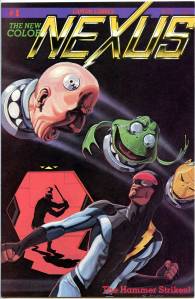
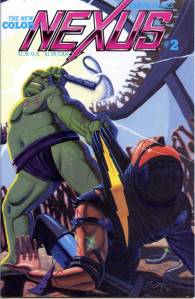
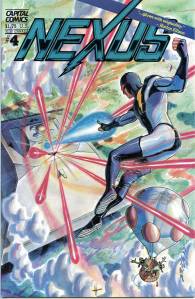
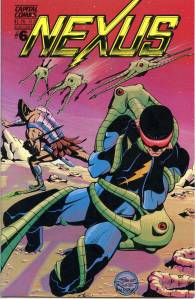
Nexus is a comic book series created by writer Mike Baron and penciler Steve Rude in 1981. The series is a combination of the superhero and science fiction genres, set 500 years in the future.
The series debuted as a three-issue black-and-white limited series (the third of which featured a 33 RPM flexi disc with music and dialogue from the issue), followed by an eighty-issue ongoing full-color series. The black-and-white issues and the first six color issues were published by Capital Comics; after Capital’s demise, First Comics took over publication.
On the creation of the series: Baron noted that they had originally pitched a series called Encyclopaedias to Capital Comics, but the company rejected this, saying they were looking for a superhero title. Over a drink at a restaurant, Baron outlined his ideas for Nexus to Rude.
Nexus was entirely Baron’s idea. He even came up with the lightning bolt for the costume. All that we needed then was a name… a few weeks passed. Baron calls, and, without preamble, just says “Nexus.” We finally had our name.”
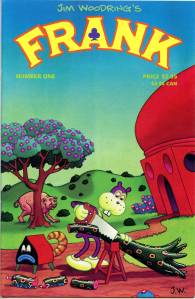
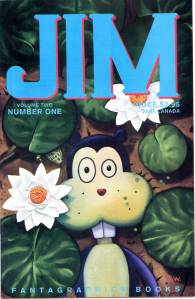
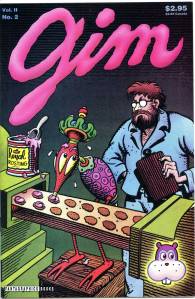
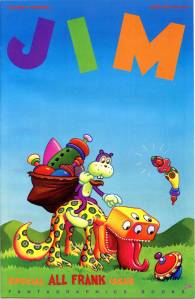
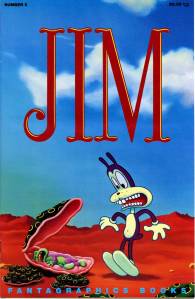
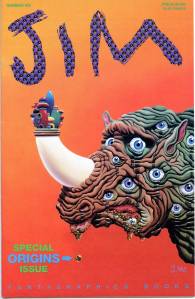
Jim is a series created by Jim Woodring. It began in 1980 as a self-published zine and was picked up by Fantagraphics Books in 1986 after cartoonist Gil Kane introduced Woodring to Fantagraphics co-owner Gary Groth. The publisher released four magazine-sized black-and-white issues starting in September 1987. A comic book-sized continuation, Jim Volume II, with some color, began in 1993 and ran for six issues until 1996.
Jim, which Woodring described as an “autojournal”, contained comics on a variety of subjects, many based on dreams, as well as surreal drawings and free-form text which resembled Jimantha automatic writing. Besides dreams, the work drew on Woodring’s childhood experiences, hallucinations, past alcoholism, and Hindu beliefs. It also included stories of recurring Woodring characters such as Pulque (the embodiment of drunkenness), boyhood friends Chip and Monk, and, in Volume II, his signature creation Frank.