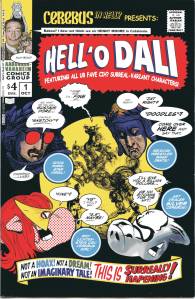
Where has Cerebus been since he died twelve years ago? Is he in hell? Purgatory? Limbo? Some strange 1980 disco with links to Close Encounters of the Third Kind and Henry Kissinger? Some ancient Greek disco with links to Plato, Socrates, Aristotle? Some 1990s disco with links to The Stone Roses, the Happy Mondays, and Oasis? Is he stuck inside his own Cerebus Online Disco Twitter-feed? Well, wherever he is, he deserves it, so feel free to laugh at his misfortune!
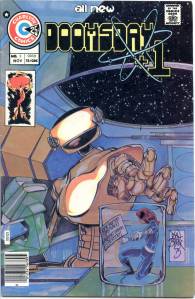
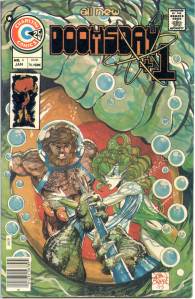
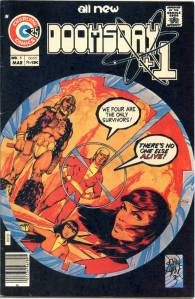
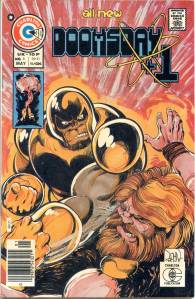
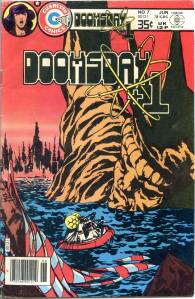
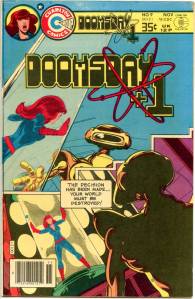
The series takes place in a near future in which a South American despot named Rykos launches his sole two atomic missiles on New York City in the U.S. and Moscow in the U.S.S.R. The two superpowers, each believing the other has launched a first strike, retaliate. By the time American president Cole and a Russian premier with the first name Mikhail have realized their errors, their fully automated nuclear-missile systems can not be countermanded.
Only hours before the apocalypse begins, a Saturn VIrocket launches bearing three astronauts: Captain Boyd Ellis, United States Air Force; his fiancée, Jill Malden; and Japanesephysicist Ikei Yashida. Weeks later, after the post-apocalyptic radiation has subsided to safe levels, their space capsule lands upon a melting Greenland ice field, where the three ally themselves with Kuno, a 3rd-century Goth revived from his ice-encased suspended animation.
The four encounter a Russian scientist/cyborg in Canada, where they commandeer a futuristic jet plane; undersea dwellers; and brutish U.S. military survivors, among others.
Love and Rockets, reuniting all three Hernandez Brothers! Jaime picks up the newly-divorced Maggie’s story as she returns to the old neighborhood to try to reconnect with her past; in the first issue she meets up with everyone’s favorite Hoppers resident, Izzy Ortiz. Gilbert launches a thrilling new graphic novel, “Julio’s Day,” about a man’s life from 1900 to 2000. Every person gets his day… or does he? Finally, Gilbert (artist) and Mario (writer) collaborate on “Me for the Unknown,” a tale of political intrigue, dumping on the little guy, psychosis, and violent revenge reminiscent of some of their earliest L&R stories (or their Mister X “Tales of Somnopolis” stories).
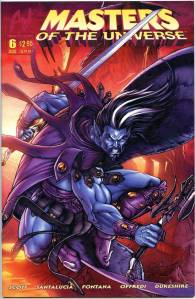
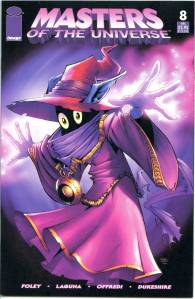
The comic book studio MVCreations produced numerous Masters of the Universe comics during the promotion of the 2002-2004 toy line. MVCreations is a studio headed by Val Staples, originallly publishing through Image Comics. Following their success with the Masters of the Universe license, the two companies parted ways. MVCreations soon partnered with CrossGen Comics. Despite obtaining the license of two Don Bluth properties, as well as publishing a horror comic by Rob Zombie, the studio failed to off-set financial problems, in part due to CrossGen’s own financial downturn. The studio parted ways with CrossGen and became a full publisher on their own. As Hasbro’s enthusiasm in the Masters of the Universe property faded, MVCreations returned to publishd under Image Comics.
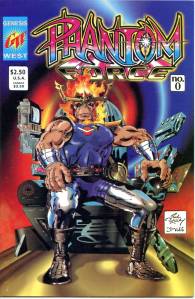
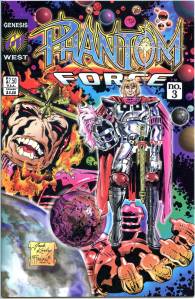
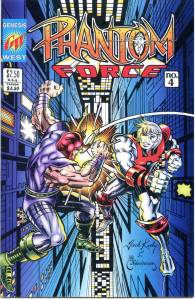
Phantom Force was the last comic book Kirby worked on before his death. The story was co-written by Kirby with Michael Thibodeaux and Richard French, based on an eight-page pitch for an unused Bruce Lee comic in 1978. Issues #1 and 2 were published by Image Comics with various Image artists inking over Kirby’s pencils. Issue #0 and issues #3–8 were published by Genesis West, with Kirby providing pencils for issues #0 and 4. Thibodeaux provided the art for the remaining issues of the series after Kirby died.
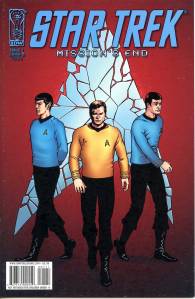
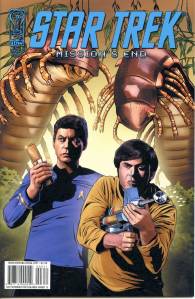
The series centers around the artificial planet Archernar IV and it’s two native sentient species, the Archernariansand Crawlers. The series begins at the start of the Enterprise‘s five-year mission at the start of contact with Archernar, and then skips ahead to the Enterprise‘s final mission to the planet as it prepares to join the Federation. At the conclusion of the Archernar mission the Enterprise returns to Earth, with the crew moved by the mission to take on new roles, as seen at the start of Star Trek: The Motion Picture.
From the legendary Leiji Matsumoto, along with Jerome Alquie, comes an epic new story! Set within the timeline of the original series, this brand-new Captain Harlock adventure marks the beginning of a new story arc. Planet Earth is threatened by an upcoming invasion by the Sylvidres and despite being banished as a pirate, Captain Harlock won’t give up trying to save the world. This time, the source of danger comes directly from Earth, not outer space. A team of scientists discovers a Sylvidres mausoleum where they find information about terrifying genetic manipulations and a destructive power capable of either providing the Sylvidres with immortality or putting an end to their civilization. The unprecedented cold spell hitting Earth might only be a taste of what this new enemy has in store… Will Captain Harlock and his crew manage to solve this mystery and save the Earth from yet another menace?
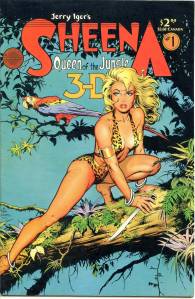
The first issue of Blackthorne’s long-running 3-D series, featuring Jerry Igers classic jungle princess, hero of pulps, comics, and the big and small screens. Absent from comics for almost three decades, this presents some of her 1950s adventures in 3-D format, including one by legendary good-girl artist Matt Baker. But the main draw for many fans will be the stunning cover by beloved artist (and Rocketeer creator) Dave Stevens. Also featuring an introduction by creator Jerry Iger, a Snarzan the Ape spoof from Great Comics (1941) #1, and a Congo King story with art by legendary good-girl artist Matt Baker. Heroine in the Jungle; Sargasso of Lost Safaris; Snarzan the Ape in Mein Kemp Von Der Chungle; Congo King; Spoor of the Dancing Skeletons. 32 pages, B&W with 3-D effects.
Madman first appeared as Frank Einstien in Creatures of the Id and Grafik Muzik published in 1990, but it wasn’t until March 1992 that the first Madman miniseries debuted from Tundra Publishing. The series gained further recognition with its move to Dark Horse Comics in April 1994, where it was relaunched as Madman Comics and went on to be nominated for several Harvey Awards. Madman Comics ran for 20 issues and ended in 2000. From 2007–2009, Image Comics published Madman: Atomic Comics for 17 issues.
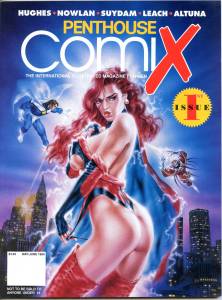
Penthouse Comix began as a series of short segments in Penthouse Magazine. After 3 of these sections were printed (featuring artwork by Adam Hughes, Kevin Nowlan and Garry Leach), publisher Bob Guccione dictated that Penthouse Comix become its own stand-alone magazine, something which he envisioned competing in both US and European magazine markets. Guccione agreed to a budget that was designed to cherry pick art talent from both American comic book companies and non-US publishers and this resulted in Penthouse Comix offering a per-page rate among the highest ever paid to freelance comic book artists.