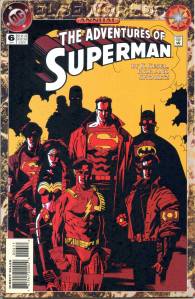
Fan interest resulted in the revival of the JSA in 1991. An eight-issue Justice Society of America limited series featuring a previously untold story set in the 1950s was published in 1991. In the final issues of the four-issue Armageddon: Inferno limited series, the JSA returns to the modern-day DC Universe when Waverider transported the “daemen” of the interdimensional Abraxis to Asgard as a substitute for the JSA in the Ragnarök cycle, allowing the team to return to Earth.
Category: DC
Superman V4 – Rebirth (2016)
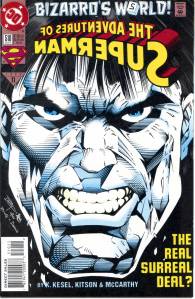
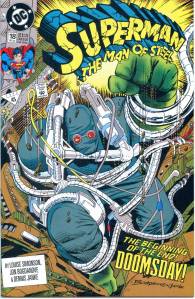
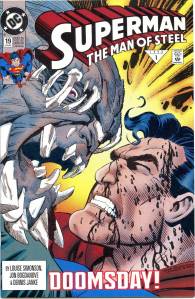
In June 2016, DC Comics once again relaunched its comic book titles with DC Rebirth. The publisher re-established the pre-New 52 Superman as the protagonist of the new comic books, with Lois Lane as his wife once more. He and Lois also conceive a biological son, Jonathan Samuel Kent, who eventually becomes Superboy. The story arc Superman Reborn smooths over the discrepancies between the two versions of the character. According to Mister Mxyzptlk, the creation of the New 52 caused Superman to be separated into two people: the New 52 character that served as the protagonist of the Superman books and the pre-Flashpoint character that took part in the Convergence event and sired Jon. Thanks to Jon, the new Superboy, the two Supermen merge into one complete version of Superman, rearranging their shared histories and accommodating them into the restored DC Universe. This complete Superman features a new suit that combines elements from the two eras. DC Comics ended the Rebirth branding in December 2017, opting to include everything under a larger “DC Universe” banner and naming. The continuity established by Rebirth continues across DC’s comic book titles, including volume one of Action Comics and the fourth volume of Superman.
The Joker: 80th Anniversary (2020)
The Clown Prince of Crime celebrates 80 years of chaos! The stories feature a range of terror and anarchy, showing how the Joker has impacted Gotham City from the police to Arkham Asylum, from the local underworld to the Dark Knight and his allies!
DC Treasury Editions (1970’s)
Limited Collectors’ Edition was launched with a collection of Rudolph the Red-Nosed Reindeer stories which went on sale October 24, 1972. DC Comics vice president Sol Harrison had suggested the format stating that “We could create a tabloid size comic that would stand out on the newsstand.” Limited Collectors’ Edition shared its numbering with two other treasury format series, Famous First Edition and All-New Collectors’ Edition. The final issues of the latter two series were tie-ins to the release of Superman: The Movie. DC later published treasuries as part of DC Special Series in 1981 and as a number of one-shots from 1999 to 2003 primarily produced by Paul Dini and Alex Ross.
Rōnin (1983)
Ronin (formally written as Rōnin) is a limited series published between 1983 and 1984, by DC Comics. The series was written and drawn by Frank Miller with artwork painted by Lynn Varley. It takes place in a dystopic near-future New York in which a ronin is reincarnated. The six-issue work shows some of the strongest influences of manga and bande dessinée on Miller’s style, both in the artwork and narrative style.
Ronin was in part inspired by Kazuo Koike and Goseki Kojima‘s manga series Kozure Okami. (Though Kozure Okami would receive an English localization several years later as Lone Wolf and Cub, at the time Miller could not read the text and had to rely on the artwork for his understanding of the story.) According to former Marvel Comics editor-in-chief Jim Shooter, Ronin was originally slated to be released as part of Marvel’s Marvel Graphic Novel series. Ultimately, however, Miller was persuaded by publisher Jenette Kahn that DC Comics would give him as much freedom as he desired for the series, and the first issue of Ronin was published by that company in 1983.
Blackest Night (2009)
Blackest Night involves Nekron, a personified force of death who reanimates deceased superheroes and seeks to eliminate all life and emotion from the universe. Geoff Johns has identified the series’ central theme as emotion. The crossover was published for eight months as a limited series and in both the Green Lantern and Green Lantern Corps comic titles. Various other limited series and tie-ins, including an audio drama from Darker Projects, were published.
Transmetropolitan (1997)
Transmetropolitan is a cyberpunk transhumanist comic book series written by Warren Ellis and co-created and designed by Darick Robertson; it was published by the American company DC Comics in 1997–2002. The series was originally part of the short-lived DC Comics imprint Helix, but upon the end of the book’s first year the series was moved to the Vertigo imprint after DC Comics shut down their Helix imprint. Transmetropolitan chronicles the battles of Spider Jerusalem, infamous renegade gonzo journalist of the future.
Batman (1940’s)
In early 1939, the success of Superman in Action Comics prompted editors at National Comics Publications (the future DC Comics) to request more superheroes for its titles. In response, Bob Kane created “the Bat-Man”. Collaborator Bill Finger recalled that “Kane had an idea for a character called ‘Batman,’ and he’d like me to see the drawings. I went over to Kane’s, and he had drawn a character who looked very much like Superman with kind of … reddish tights, I believe, with boots … no gloves, no gauntlets … with a small domino mask, swinging on a rope. He had two stiff wings that were sticking out, looking like bat wings. And under it was a big sign … BATMAN”. The bat-wing-like cape was suggested by Bob Kane, inspired by Leonardo Da Vinci‘s sketch of an ornithopter flying device as a child.
Finger suggested giving the character a cowl instead of a simple domino mask, a cape instead of wings, and gloves; he also recommended removing the red sections from the original costume. Finger said he devised the name Bruce Wayne for the character’s secret identity: “Bruce Wayne’s first name came from Robert Bruce, the Scottish patriot. Wayne, being a playboy, was a man of gentry. I searched for a name that would suggest colonialism. I tried Adams, Hancock … then I thought of Mad Anthony Wayne.” He later said his suggestions were influenced by Lee Falk‘s popular The Phantom, a syndicated newspaper comic-strip character with which Kane was also familiar.
Superman’s Pal Jimmy Olsen (1970’s)
Superman’s Pal, Jimmy Olsen is a series published by DC Comics from September–October 1954 until March 1974, spanning a total of 163 issues. Featuring the adventures of Superman supporting character Jimmy Olsen, it contains stories often of humorous nature.
The 1952 television series Adventures of Superman co-starred actor Jack Larson, who appeared regularly as Jimmy Olsen. Largely because of the popularity of Larson and his portrayal of the character, National Comics Publications (DC Comics) decided to create a regular title featuring Jimmy as the leading character. Curt Swan was the main artist on the series for its first decade.
Many of the issues include Jimmy undergoing a transformation of some form.
Infinity Inc. (1984)
Roy Thomas and his wife, Dann Thomas, wrote the series throughout its run. Artists on the series included Jerry Ordway, Don Newton, Todd McFarlane, Michael Bair, and Vince Argondezzi.
The group was organized by Sylvester Pemberton, the original Star-Spangled Kid, in Infinity Inc. #1, when a number of JSA protégés were denied admission to the JSA. They instead formed their own group. Members of Infinity, Inc. were known as Infinitors.
The series ended in 1988 with the death of the Star-Spangled Kid (by then known as Skyman), and presumably the group disbanded shortly thereafter. Several members have gone on to supporting roles in other comics series. Fury filled a pivotal role in The Sandman and is the mother of Daniel Hall. Hourman, Obsidian, Nuklon (as Atom Smasher), Silver Scarab(as Doctor Fate), and Power Girl eventually joined the 21st century incarnation of the JSA.
Originally, the series took place on the parallel world of Earth-Two, but in 1986 it was merged with the rest of DC continuity following Crisis on Infinite Earths. From then on, they shared their spot as Los Angeles’ superteam with the Outsiders, and were involved in a crossover with the New Teen Titans.