Propeller Man (1993)

The future. A tired world of economic collapse and ecological disaster. In this corporate-dominated world, a living weapon escapes to blaze a trail of destruction as it searches for its creator. A solitary figure watches from the rooftops. Propellerman. Does the creature provide some clues to his missing memory?

Moon Girl and Devil Dinosaur (2016)

The character was created by Amy Reeder, Brandon Montclare and Natacha Bustos and first appeared in Moon Girl and Devil Dinosaur #1 (January 2016).

The genesis of the character came from Mark Paniccia and Emily Shaw who were a fans of the character Devil Dinosaur and had hired Montclare and Reeder to pen the basis for a new series that involved the character ending up in modern day. They came up with the idea of Devil Dinosaur interacting with a girl and fell in love with the idea of working with a hero who wasn’t a “regular cape-and-tights superhero”.

They also viewed the series as a direct sequel to the Moon-Boy and Devil Dinosaur series from Jack Kirby hence the first villains that Moon Girl and Devil Dinosaur face are the Killer-Folk.

Artist Natacha Bustos found the character a relief from the norm of other typical superheroes. She was primarily inspired by the clear diversity that Moon Girl and Devil Dinosaur promoted, further comparing the character Lunella to herself. She compared her story to a “Ghibli one” due to the immense relationship between the title characters.

Smax the Adventurer (2003)

The story deals with Smax and Toybox returning, via magical teleportation, to Jeff’s magically enchanted homeworld. Smax, now a city dweller, seems embarrassed by his unsophisticated, sword-and-sorcery roots. They attend Smax’s uncle’s funeral where Jeff introduces Robyn as his wife, though no such relationship exists. At this point Jeff’s sister Rexa Macksun is introduced, dressed in the typical garb of a female fantasy barbarian such as Red Sonja and just as tall and physically impressive as her brother with the same blue skin and white hair.

Uncanny X-men (1990’s)

After Claremont’s run, the X-Men were divided into two color-coded squads, with a Blue team headlining the adjectiveless X-Men title, while the Gold team, consisting of Archangel, Colossus, Jean Grey, Iceman and Storm, appeared in Uncanny. This roster was later joined by Bishop, another refugee from the future. After Claremont’s departure, Jim Lee continued as plotter, while John Byrne scripted from #281 to #286. Byrne was replaced as scripter from #286 by Scott Lobdell, who was fully credited as writer from #289. The “X-Cutioner’s Song” crossover was released in the fall of 1992 and resulted in the outbreak of the Legacy virus, a mutant-specific plague which continued as a story element in X-Men comics until 2001.

Savage Dragon (1992)

In 1992, when Larsen left Marvel to co-found Image Comics, he reworked the character for the new publication venture. This time, the Dragon was a massively muscled green amnesiac, who joined the Chicago police department after being discovered in a burning field. Initially debuting in a three-issue miniseries (with the first issue cover-dated July 1992), the Savage Dragon comic book met with enough success to justify a monthly series, launched in June 1993. To this day, Larsen continues to write and illustrate the series entirely by himself, and has maintained a reasonably consistent monthly schedule (save for occasional lapses) in comparison with the other original Image Comics titles.

Super-Villain Team-Up (1975)

The first series started in 1975 with two giant-size issues before starting as a regular series, and was mostly bi-monthly during its existence. It initially teamed up Doctor Doom and the Sub-Mariner, who had lost his own series, from which it picked up the unresolved plots, especially that of the comatose Atlanteans. After a succession of writers and artists and a crossover with The Avengers, the plot gets resolved in issue #13 when Dr. Doom revives the Atlanteans, thus dissolving his alliance with the Sub-Mariner.

Issue #14 (Oct. 1977), which featured Magneto and Dr. Doom, was billed as the final issue of the series, and its plotline was resolved in The Champions #16. The following year, SVTU continued with issue #15 (Nov. 1978), a reprint of Astonishing Tales #4-5. Issues #16 (May 1979) and #17 (June 1980) featured the Red Skull and the Hate-Monger. The irregular publishing frequency of the final three issues was due to a legal maneuver to prevent DC Comics from trademarking the term “super-villain”.
The series saw the death of the Sub-Mariner’s 1940s sweetheart Betty Dean and the death of her murderer, Dr. Dorcas. Steve Englehart created The Shroud, a character partly inspired by Batman, shortly before he started to work for DC Comics on Detective Comics.

Hillbilly (2016)

Hillbilly is a fantasy adventure series by Eric Powell (creator of The Goon), set in a fantasy realm drawing less from Tolkien and more from the myths and folklore of rural Appalachia. Unlike The Goon, it’s more-or-less kid-friendly, if still reasonably dark. Rondel is a wanderer, travelling from place to place.

Sword of Sorcery (1973)

Sword of Sorcery was an American sword-and-sorcery comics anthology featuring Fafhrd and the Gray Mouser, heroes and rogues created by Fritz Leiber. Published bi-monthly by DC Comics, it ran for five issues in 1973, with a cover price of 20¢. The title was written by Denny O’Neil and featured art by Howard Chaykin, Walt Simonson, and Jim Starlin.

In June 2012, the series returned with a revival of Amethyst, Princess of Gemworld by writer Christy Marx and artist Aaron Lopresti. The title included a backup feature starring Beowulf written by Tony Bedard and drawn by Jesus Saiz.

Moon Knight V5 (2006)

Moon Knight vol. 5, was launched in April 2006, written by Charlie Huston with art by David Finch. The series revises Marc Spector’s history by saying he fought in the Gulf War. Starting with issue #14 of this series, Mike Benson took over writing duties while Huston acted as a story/plot adviser according to Benson. The 2006 series ended with #30 (July 2009), and only one Annual issue for the series was printed in 2008. Peter Milligan wrote a 2008 seasonal one-shot titled Moon Knight: Silent Knight with artist Laurence Campbell.

Adventures of Superman (1986)

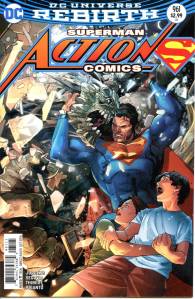
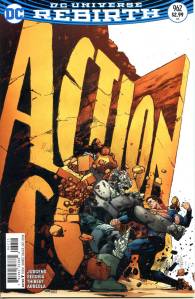
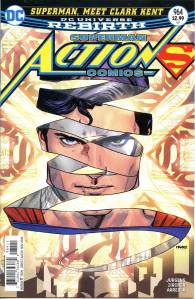
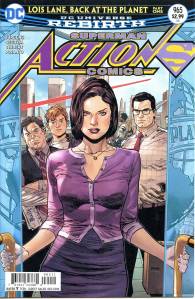
When the series was relaunched in late 1986 under its new title, the creative team initially was writer Marv Wolfman and artist Jerry Ordway. John Byrne replaced Wolfman with issue #436 (January 1988) and Ordway became both writer and artist with issue #445 (October 1988). Writer/artist Dan Jurgens worked on the title from 1989–1991. Hank Henshaw, a character who would later become the Cyborg Superman, first appeared in issue #466 (May 1990). By the late 1980s, the plots of the Superman books were often linked. To coordinate the storyline and sequence of event, from January 1991 to January 2002, “triangle numbers” (or “shield numbers”) appeared on the cover of each Superman comic book. During these years, the Superman storylines ran with the story continuing through the titles SupermanAction Comics and later in two further series, Superman: The Man of Steel and Superman: The Man of Tomorrow.