A bold new chapter for the greatest superhero of all time begins here as writer Brian Michael Bendis and artist Ivan Reis begin their run on the all-new SUPERMAN! The fallout from the Man of Steel miniseries has Clark Kent looking at the world through new eyes…with new ideas about what Superman could and should do for the city of Metropolis and the planet Earth. His first job? Getting the planet back out of the Phantom Zone!
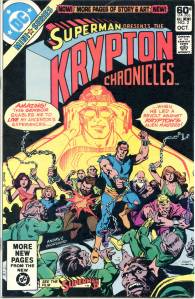
A three-issue miniseries entitled The Krypton Chronicles, published in 1981, tells of Superman researching his roots when, as Clark Kent, he was assigned to write an article about Superman’s family by an assignment editor impressed with the television miniseries Roots. To do so, he and Supergirl travel to Kandor, where they learn the history of the El family.
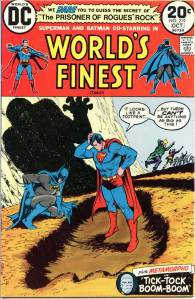
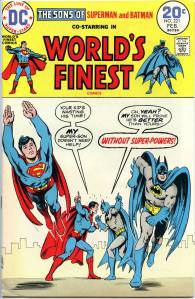
World’s Finest featured Superman and Batman team-ups until issue #197. Noted Batman artist Neal Adams first drew the character in an interior story in “The Superman-Batman Revenge Squads” in issue #175 (May 1968). The title briefly featured Superman teaming with heroes other than Batman in the early 1970s beginning with issue #198 (November 1970). That issue featured the first part of a two-issue team-up with the Flash. The series reverted to Superman and Batman team-ups after issue #214, initially with a unique twist, featuring the children they might one day have, Superman Jr. and Batman Jr. These characters, billed as the Super-Sons, were co-created by writer Bob Haney and artist Dick Dillin in issue #215 (January 1973).
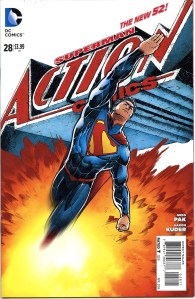
As with all of the books associated with the DC relaunch, Clark Kent appears to be about five years younger than the previous incarnation of the character (where it would focus on the early days of Superman’s career, whereas the main series would focus on the present). Superheroes at large have appeared only in the past five years, and are viewed with at best, suspicion, and at worst, outright hostility. The storyline in Action Comics takes place about a year before the events of Justice League #1, and was referred to by DC Co-Publisher Dan DiDio as “DC Universe Year Zero” while JL operates as “Year One.” The Man of Steel is not yet trusted by the citizens of Metropolis and wears a basic costume consisting of a caped T-shirt, jeans and work boots.
In late July 2011, DC released The New 52, a free preview book giving solicitations and previews of all of the new titles launching from August 31, 2011. Notable continuity changes shown included Superman‘s two new looks: one which consists of jeans, a blue T-shirt with the “S” logo and a cape, the other consisting of Kryptonian battle armor that resembles his classic costume.
In the middle of 1999, the Superman titles relaunched with pretty much all new creators, and folks like Jerry Ordway, Louise Simonson and Dan Jurgens who had been working on the books for years moving on. That relaunch, which starts with Superman #151 by Jeph Loeb and Ed McGuinness more or less jettison most of the triangle era’s supporting cast, with a focus on more action and less character drama.
After Loeb moves on to Superman/Batman, we get a 12 issue run on Superman by Brian Azzarello and Jim Lee, Gail Simone takes over Action Comics for a year, with John Byrne on art, as all three Superman titles begin setting up the next major crossover, Infinite Crisis.
After Infinite Crisis, the DC Universe leap forward “One Year Later.” Geoff Johns and Kurt Busiek are the writers on Superman, starting off co-writing an 8 issue relaunch of the Superman titles. In the wake of Geoff Johns’ final storyline involving Brainiac, the Superman titles got intertwined again as a massive storyline spanning two years involving the creation of a New Krypton in Earth’s solar system, with Supergirl, Action Comics, Superman, the World of New Krypton miniseries, several specials, all culminating in the “War of the Supermen” miniseries.
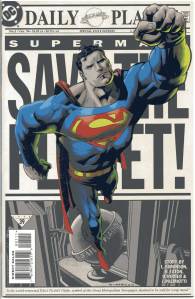
The Daily Planet prints its final edition in an extra-sized one-shot, featuring a transparent acetate cover (featuring an illustration of Superman) wrapped around a replica of the Planet’s last front page! Now it can be sold! Months of falling circulation and fierce competition have made the Planet ripe for takeover, and Lex Luthor is more than happy to buy the great metropolitan newspaper, only to shut it down! Meanwhile, Superman saves the planet…Earth, that is, from a meteor shower, but that won’t help Clark Kent or any of his former co-workers find new jobs. Written by Louise Simonson. Art by Scot Eaton, Denis Rodier and Jimmy Palmiotti. Cover by Kevin Nowlan.
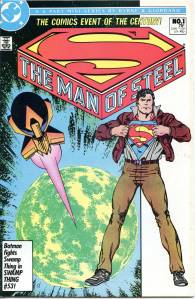
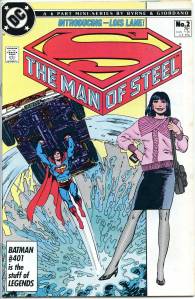
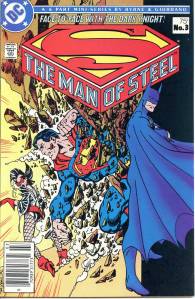
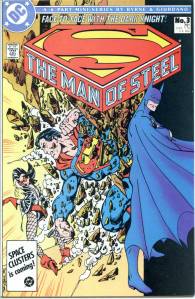
DC editors wanted to make changes to the character of Superman, including making him the sole survivor of his home planet Krypton, and Byrne’s story was written to show these changes and to present Superman’s origin. The series includes the baby Kal-El rocketing away from the destruction of Krypton, Clark Kent as a teenager in Smallville learning that he was found in a crashed space ship, his being hired at the Daily Planet in Metropolis, the creation of his secret identity of Superman, his first meeting with fellow hero Batman, and how he finally learned of his birth parents and from where he came. The series also included the reintroduction of a number of supporting characters, including fellow reporter and love interest Lois Lane and archenemy Lex Luthor, who was re-branded from a mad scientist to a powerful businessman.
In a world where Superman hasn’t aged a day since the Nazis won WWII; Clark Kent infiltrates Axis dominated Europe in pursuit of Lana Lang, who has fallen prey to the enchantress Circe, while Lois Lane finds herself transformed by the power of the ancient gods into a Wonder Woman.
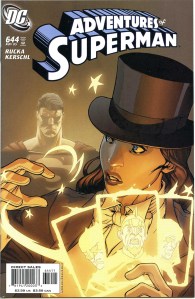
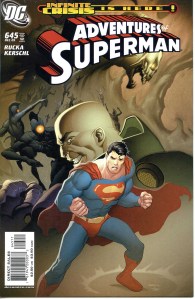
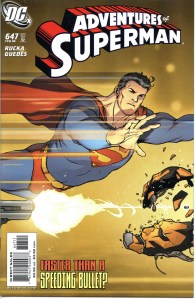
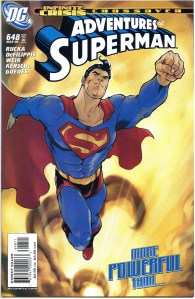
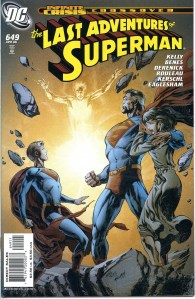
The Adventures of Superman was numbered from issue #424 (January 1987) to issue #649 (April 2006), for a total of 228 monthly issues including issue #0 (October 1994) published between issues #516 and #517 as a tie-in to the Zero Hour limited series and issue #1,000,000 (November 1998) as a tie-in to the DC One Million limited series and nine Annuals published between 1987 and 1997.
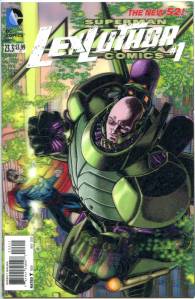
As of the start of 2002, the integration between the Superman titles became less frequent, and the remaining issues of The Adventures of Superman commonly carried self-contained stories. Issue #600 (March 2002) was a double-sized special featuring Superman combating Lex Luthor.The final issue (#649) was part of a three-part crossover with Superman and Action Comics, an homage to the Earth-2 Superman in the wake of events in the limited seriesInfinite Crisis.
For its last two years, The Adventures of Superman was written by Greg Rucka. His stories included the villain Ruin, the attempted assassination of Lois Lane and a number of Mister Mxyzptlk appearances.






















 EHT Comics