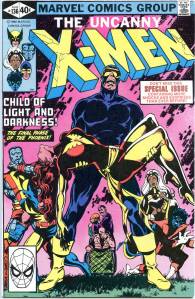
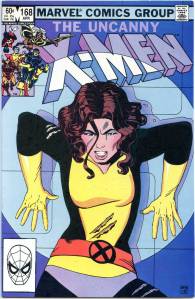
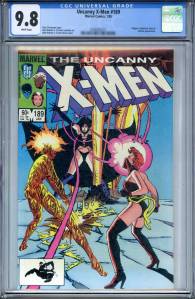
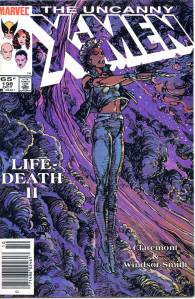
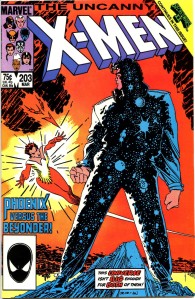
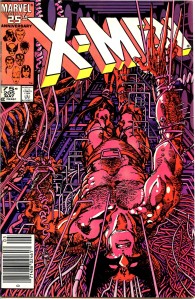
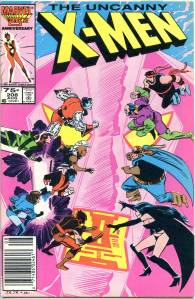
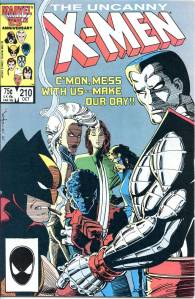
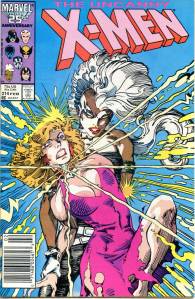
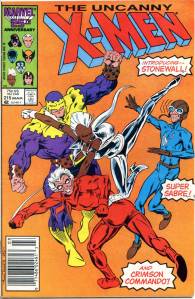
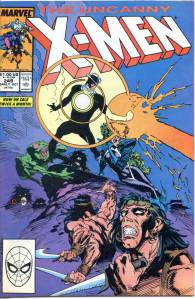
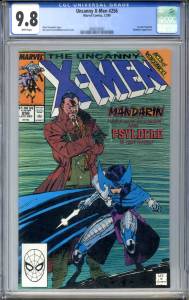
The “Dark Phoenix Saga” in 1980 led to a change in the line-up of the team, with the death of Phoenix (Jean Grey), and Cyclops leaving the team to mourn for her. Comics writers and historians Roy Thomas and Peter Sanderson observed that “‘The Dark Phoenix Saga’ is to Claremont and Byrne what ‘the Galactus Trilogy‘ is to Stan Lee and Jack Kirby. It is a landmark in Marvel history, showcasing its creators’ work at the height of their abilities.” The storyline also saw the introduction of recurring antagonists the Hellfire Club, and its Inner Circle consisting of Sebastian Shaw, Emma Frost, Harry Leland, Donald Pierce, along with Mastermind, previously a member of Magneto’s Brotherhood. The new teenage mutant Kitty Pryde was introduced in #129 (Jan. 1980) and joined the X-Men in #139. The Dazzler, a disco-singing, roller-skating mutant, was introduced in #130 (Feb. 1980), but did not join the team, instead headlining her own solo title.
A new Brotherhood of Evil Mutants, led by Mystique, was introduced in the “Days of Future Past” storyline (#141-#142, Jan–Feb 1981) in which a time-travelling Kitty Pryde tried to avert a dystopian future caused by the Brotherhood assassinating Presidential candidate Senator Robert Kelly. Byrne plotted the story wanting to depict the Sentinels as a genuine threat to the existence of the mutant race. He then left the series after #143, being replaced by a returning Cockrum, who in turn was succeeded by Paul Smith and John Romita Jr.
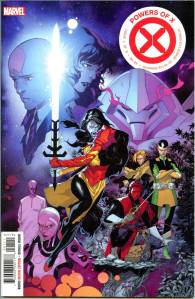
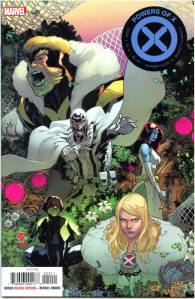
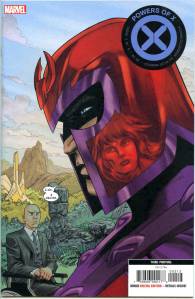
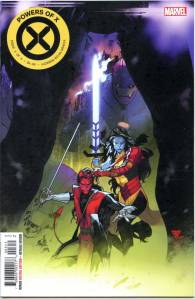
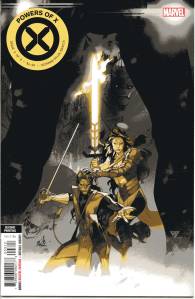
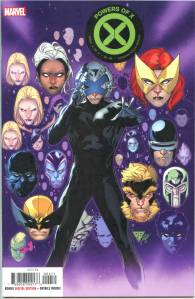
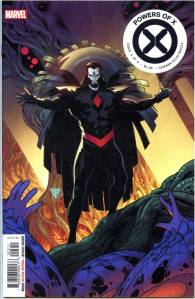
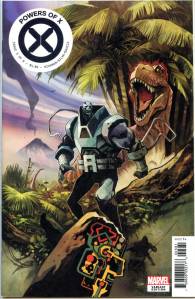
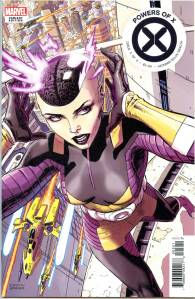
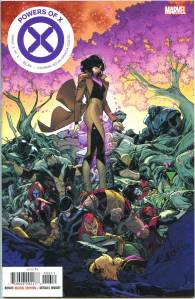
Jonathan Hickman wrote a story arc in the Avengers and New Avengers comic, ending in the 2015 crossover Secret Wars. His return was announced in March 2019. Some days later, it was detailed that he would write two comic books, House of X and Powers of X, with penciling by Pepe Larraz and R.B. Silva. Marvel Editor in Chief C. B. Cebulski said that “We are excited to have Jon back with the Marvel family, and we could not have asked for a better creative team to help usher the X-Men into a whole new era”
Both comics were released as a company wide relaunch of the X-Men. All the ongoing X-Men comics were cancelled: Uncanny X-Men, Mr. and Mrs. X, X-Force, X-23, and the Age of X-Man tie-in miniseries.
Powers of X #1 NM $6Powers of X #2 NM $6Powers of X #2 3rd Print NM- $5Powers of X #3 NM $6Powers of X #3 2nd Print NM $5Powers of X #4 NM $6Powers of X #5 NM $6Powers of X #5 Variant NM $6Powers of X #5 Variant NM $6Powers of X #6 NM $6
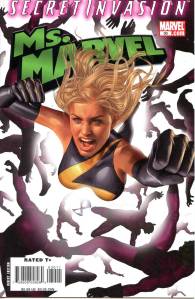
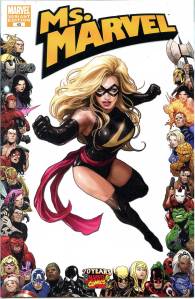
Ms. Marvel also plays a significant role in the 2008 storyline “Secret Invasion“, in which members of the shapeshifting alien race, the Skrulls, are revealed to have secretly infiltrated Earth by impersonating humans. She befriends Captain Marvel’s Skrull impostor and proves to him that she is not a Skrull by revealing intimate details about their life together. At the conclusion of the war with the Skrulls, Norman Osborn is placed in charge of the registered Avengers team. Refusing to serve under Osborn, Ms. Marvel flees Avengers Tower, and joins the New Avengers, becoming second-in-command. Osborn appoints former Thunderbolt member Moonstone (Karla Sofen) as the “new” Ms. Marvel to his Dark Avengers team; Moonstone wears a variation of Ms. Marvel’s original costume. Osborn engineers a battle that results in Danvers’s powers overloading, causing her apparent death. The character Moonstone takes over the title role in the ongoing Ms. Marvel series. Danvers returns with the aid of the New Avengers, a group of MODOKembryos (creations of the organization Advanced Idea Mechanics [AIM]), and a character known as the “Storyteller” and reclaims the title of Ms. Marvel from Karla Sofen.
The increased use of Carol Danvers as a prominent character in many story arcs throughout this decade eventually prompted one commentator to note that “she’s now the House of Ideas’ premier heroine”
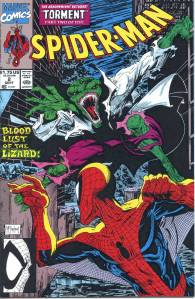
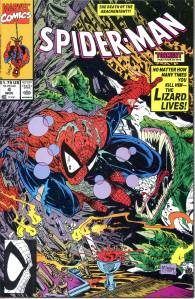
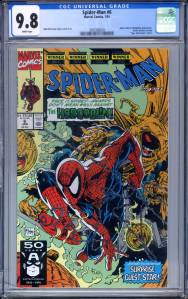
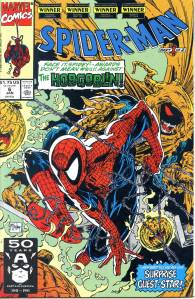
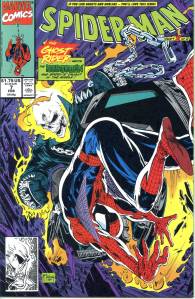
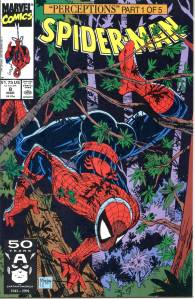
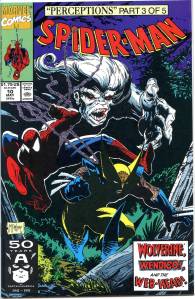
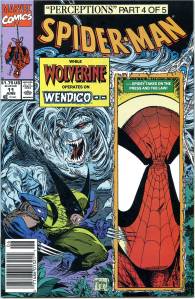
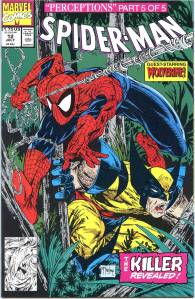
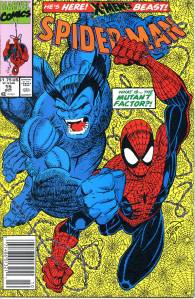
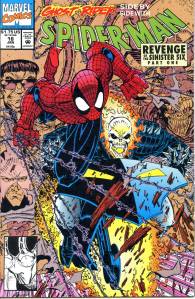
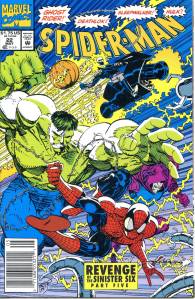
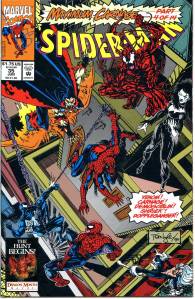
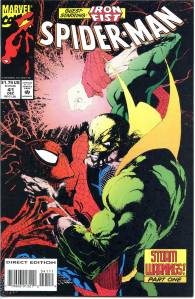
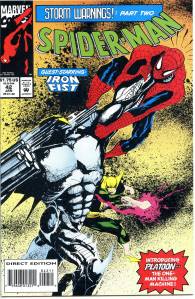
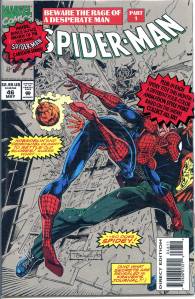
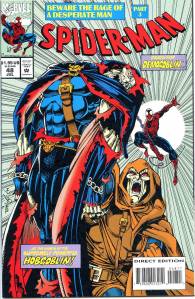
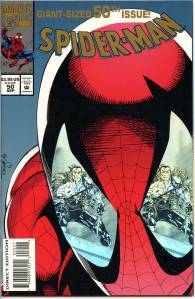
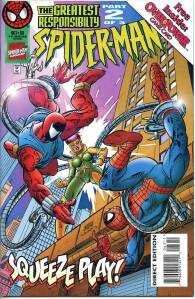
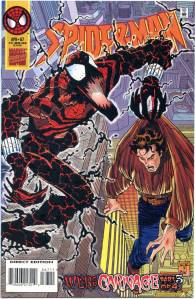
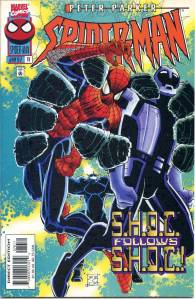
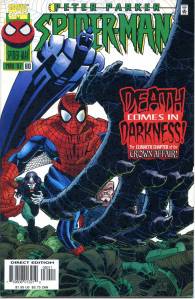
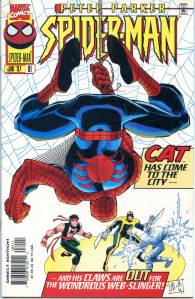
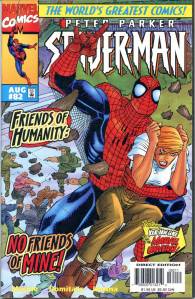
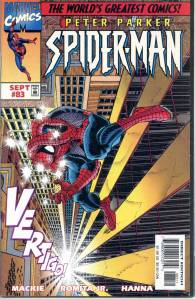
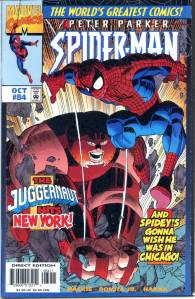
Spider-Man ran for 98 issues from 1990 to 1998. The series was re titled Peter Parker: Spider-Man with issue #75, but only on the covers, the series was still under its original Spider-Man title in the comic’s legal indicia, printed on the title page, from #75 to #98; the comic book would not officially be titled Peter Parker: Spider-Man until the volume 2 series relaunch.
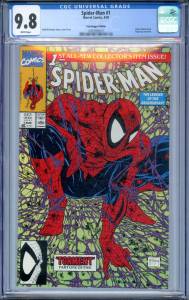
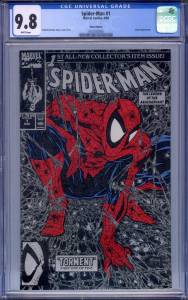
The series originally was conceived as a showcase for Todd McFarlane. McFarlane, who until then had only been known as an artist, was hugely popular at the time and the series was created by editor Jim Salicrup so that McFarlane could pencil, ink, and write a Spider-Man title of his own, starting with the “Torment” storyline.
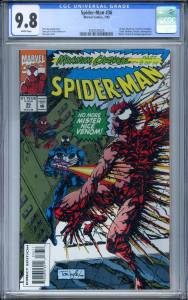
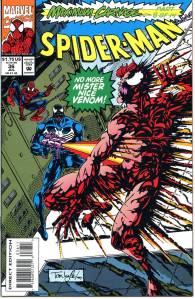
The series was a massive sales success with over 2.5 million copies printed. McFarlane stayed on the title until issue #16 (November 1991) in which the story was printed in a landscape format. He would go on to create the character Spawn and help found Image Comics in 1992. He was succeeded on the title by Erik Larsen, who had succeeded McFarlane on The Amazing Spider-Man two years earlier, and would later join him in the founding of Image. Larsen wrote and drew the six-issue story arc “Revenge of the Sinister Six” (#18–23). Writer Don McGregor and artist Marshall Rogers crafted a two-part story in issues #27–28 dealing with gun violence.
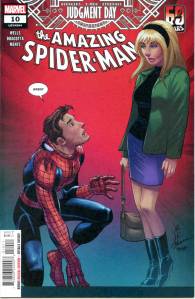
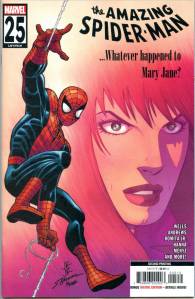
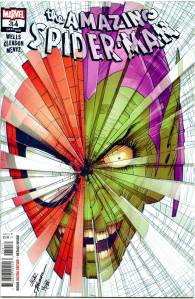
In January 2022, it was announced that writer Zeb Wells and John Romita Jr. would be working on a relaunched The Amazing Spider-Man, bringing the number of volumes for the title to its sixth, with the series beginning in April 2022. The relaunch encompasses both a legacy numbering of #900 as well as the 60th anniversary for the character. It included the crossover event, Dark Web, with Chasm having teamed up with Madelyne Pryor to bring limbo to Earth.
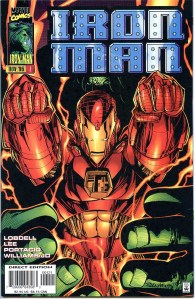
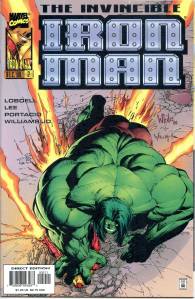
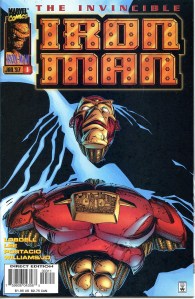
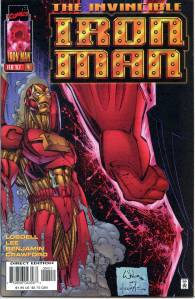
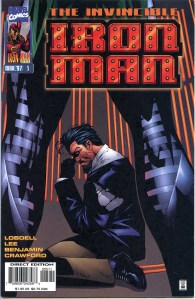
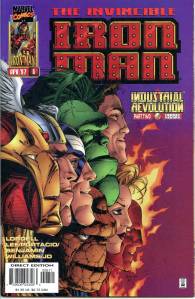
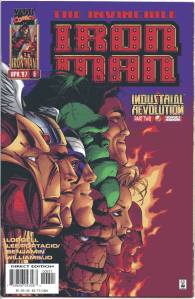
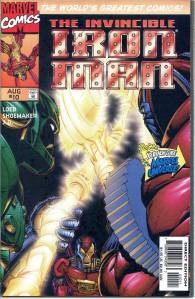
Iron Man left two lives behind when he vanished, but can he avoid his former mistakes in his new one? The armored Avenger takes on Hydra, Heralds and the Hulk – and the eyes of the Marvel Universe are upon him in the form of Loki, the Watcher and Onslaught himself! Featuring Doc Samson and… or rather as …the Abomination! Plus: Rebel O’Reilly, later of Thunderbolts fame!
Iron Man V2 1A NM $4Iron Man V2 1B NM $4Iron Man V2 #2 NM $4Iron Man V2 #3 NM $3Iron Man V2 #4 NM $3Iron Man V2 #5 NM $3Iron Man V2 #6 NM $3Iron Man V2 #6 NM- $2Iron Man V2 #7 NM $3Iron Man V2 #8 NM $3Iron Man V2 #9 NM $3Iron Man V2 #10 NM $3Iron Man V2 #11 NM- $9
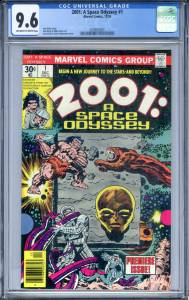
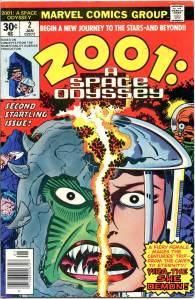
Shortly after the publication of the treasury edition, Kirby continued to explore the concepts of 2001 in a monthly comic book series of the same name, the first issue of which was dated December 1976. In this issue, Kirby followed the pattern established in the film. Once again the reader encounters a prehistoric man (“Beast-Killer”) who gains new insight upon encountering a monolith as did Moon-Watcher in the film. The scene then shifts, where a descendant of Beast-Killer is part of a space mission to explore yet another monolith. When he finds it, this monolith begins to transform the astronaut into a star child, called in the comic a “New Seed”.
Issues #1-6 of the series replay the same idea with different characters in different situations, both prehistoric and futuristic. In #7 (June 1977), the comic opens with the birth of a New Seed who then travels the galaxy witnessing the suffering that men cause each other. While the New Seed is unable or unwilling to prevent this devastation, he takes the essence of two doomed lovers and uses it to seed another planet with the potential for human life.
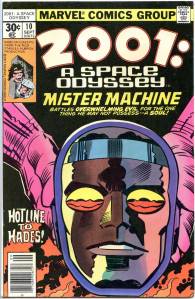
In issue #8 (July 1977), Kirby introduces Mister Machine, who is later renamed Machine Man.Mister Machine is an advanced robot designated X-51. All the other robots in the X series go on a rampage as they achieve sentience and are destroyed. X-51, supported by both the love of his creator Dr. Abel Stack and an encounter with a monolith, transcends the malfunction that destroyed his siblings. After the death of Dr. Stack, X-51 takes the name Aaron Stack and begins to blend into humanity. Issues #9 and 10, the final issues of the series, continue the story of X-51 as he flees destruction at the hands of the Army.
2001 A Space Odyssey 1 CGC 9.6 Off White to White Pages $792001 #1 FN $82001 #2 VF- $52001 #3 VF- $52001 A Space Odyssey #5 VF- $52001 A Space Odyssey #7 VF+ $72001 A Space Odyssey #10 VF- $5
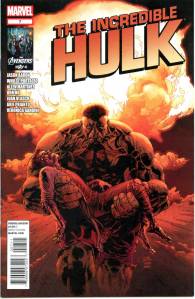
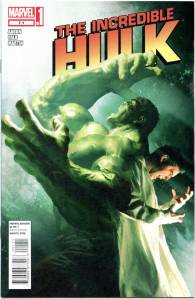
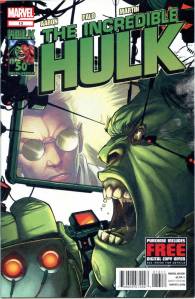
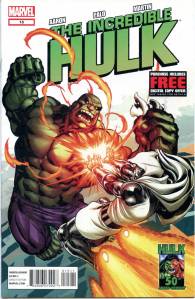
After the events of Fear Itself, the Hulk has gone into hiding, seemingly safe from a world that hates and fears him. But when government agents come knocking at his door, the Hulk has no choice but to return to war against the one man whose existence threatens the safety of every living creature on the Earth. The one man who’s existence could doom the Hulk himself. And that man is Bruce Banner. Now separated into two men, the Hulk and Banner exist worlds apart but one climactic battle will bring them face to face again—and leave the Marvel Universe shaking in its wake.
Incredible Hulk V3 #7 NM $7Incredible Hulk V3 #7.1 NM $5Incredible Hulk #13 NM $5Incredible Hulk V3 #15 NM $5
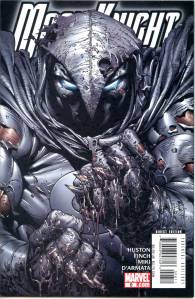
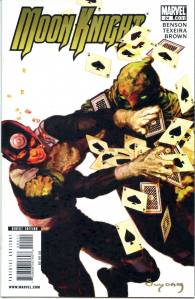
Moon Knight vol. 5, was launched in April 2006, written by Charlie Huston with art by David Finch. The series revises Marc Spector’s history by saying he fought in the Gulf War. Starting with issue #14 of this series,Mike Benson took over writing duties while Huston acted as a story/plot adviser according to Benson. The 2006 series ended with #30 (July 2009), and only one Annual issue for the series was printed in 2008. Peter Milligan wrote a 2008 seasonal one-shot titled Moon Knight: Silent Knight with artist Laurence Campbell.